Digital badges: What they are, how they work and how to use them
Last editorial update: July 24, 2026
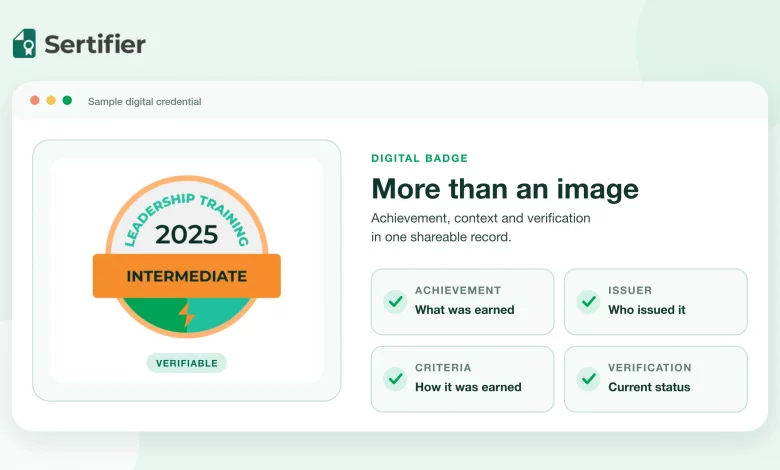
A digital badge is a visual, online representation of an achievement. A well-implemented badge does more than display an image: it connects the achievement to information about the issuer, the earner, the criteria, the issue date and the method used to verify the claim. It is one presentation of a broader digital credential.
That distinction matters. A badge graphic can communicate recognition, but a verifiable digital badge can also give a viewer evidence and context. For a university, training provider, professional association or L&D team, the real design challenge is therefore not the shape of the badge. It is deciding what the badge means, what evidence supports it and how another person can check it.
This guide explains the structure of a digital badge, how Open Badges works, when badges and certificates serve different needs, and how to launch a program without reducing a credential to decorative artwork.
In this guide
- What is a digital badge?
- What information should a digital badge contain?
- How do digital badges work?
- What is Open Badges 3.0?
- Digital badges, digital certificates and microcredentials
- Where are digital badges used?
- Are digital badges worth it?
- How to create a digital badge program
- How to evaluate a digital badge platform
- Frequently asked questions
- Final checklist
In short
- A digital badge combines a visual symbol with information about an achievement.
- Clear earning criteria and a trustworthy issuer give the badge meaning.
- Verification lets a viewer examine the claim rather than simply trust an image.
- Open Badges 3.0 defines an interoperable format for signed achievement credentials.
- A successful badge program starts with the achievement and governance model, not the design tool.
What is a digital badge?
A digital badge is a digital representation of an achievement, skill, status or participation milestone. It is normally issued by an organization to a specific person after that person meets defined criteria.
The visible badge might be a shield, circle or other compact graphic. Behind that visual layer, a standards-based badge can describe:
- the achievement and what it represents
- the organization that issued it
- the person who earned it
- the criteria used to award it
- when it was issued and, where relevant, when it expires
- evidence or an assessment connected to the achievement
- how the credential can be verified
The 1EdTech Open Badges overview describes an OpenBadgeCredential as an issuer’s claim that an individual earner has met the criteria for a defined achievement. This is a more useful way to think about a badge than “an image for LinkedIn.” The image makes the achievement visible. The credential data makes the claim inspectable.
A badge graphic is not automatically a verifiable credential
Any organization can create an image that looks like a badge. That image becomes a meaningful credential only when people can answer questions such as:
- Who issued it?
- Who earned it?
- What did the earner do?
- When was it awarded?
- Is it still valid?
- Can the claim be verified?
This is why achievement design, evidence and verification should be defined before visual design begins.
What information should a digital badge contain?
The exact data depends on the program and the standard used, but a credible badge usually needs five layers.
| Layer | What it should explain | Why it matters |
|---|---|---|
| Achievement | Name, description and type of achievement | Tells a viewer what the badge represents |
| Criteria | Requirements, assessment or participation threshold | Shows what the earner had to do |
| Issuer | Issuing organization and its identity | Establishes who is making the claim |
| Earner and timing | Recipient identity, issue date and optional expiry date | Connects the achievement to a person and time |
| Verification and evidence | Verification method and optional supporting evidence | Helps a viewer assess authenticity and rigor |
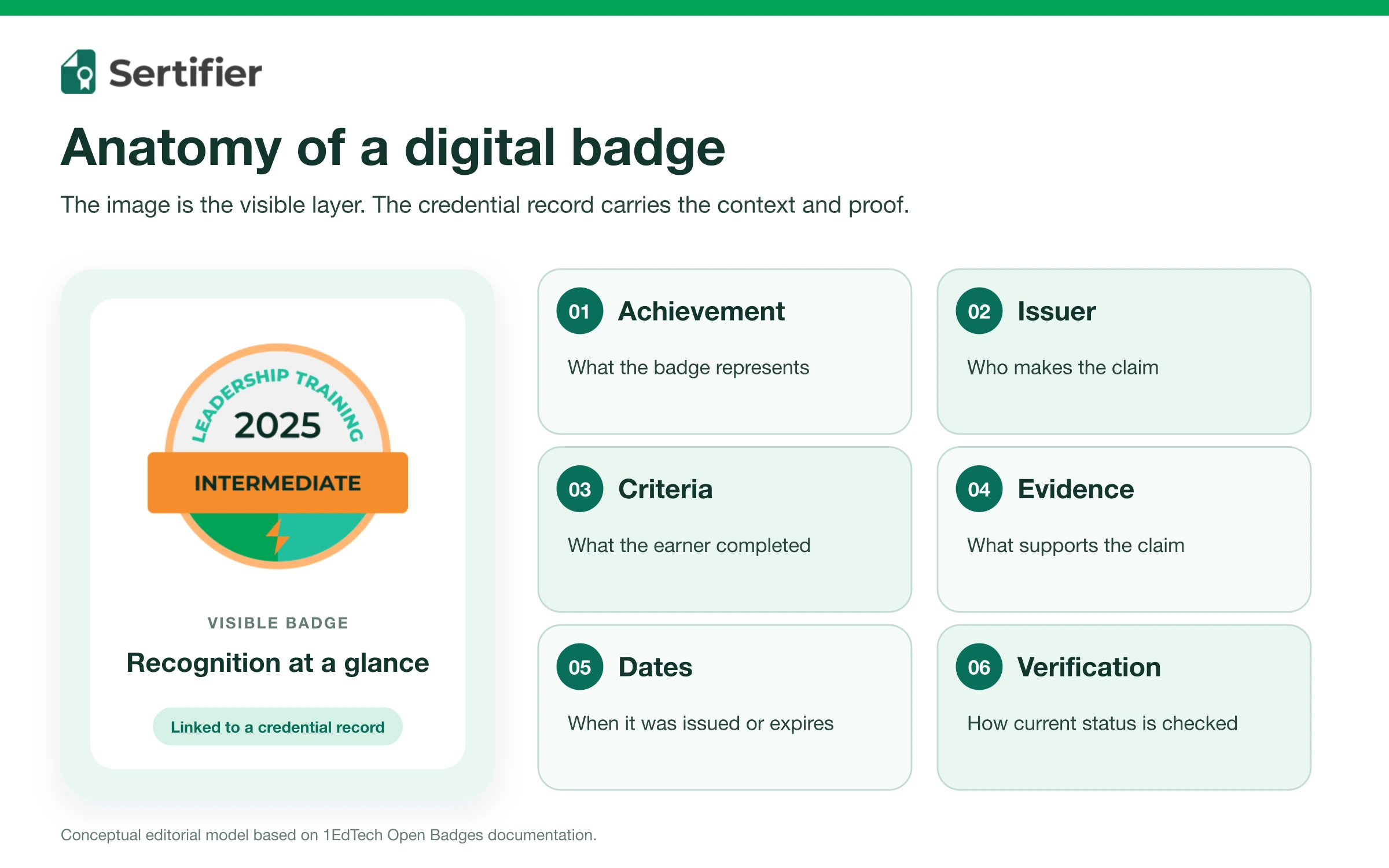
Criteria should be specific enough for an unfamiliar viewer to understand the accomplishment. “Completed leadership training” gives limited context. A better description might identify the learning outcomes, required activities, assessment method and passing rule. Only include details that the program actually uses.
Evidence is not mandatory in every badge design, and privacy may limit what can be displayed. When evidence is appropriate, it might include a project, assessment result, portfolio artifact or reference to an evaluated activity. Program owners should decide what can be public, what should be private and how long the evidence should remain available.
How do digital badges work?
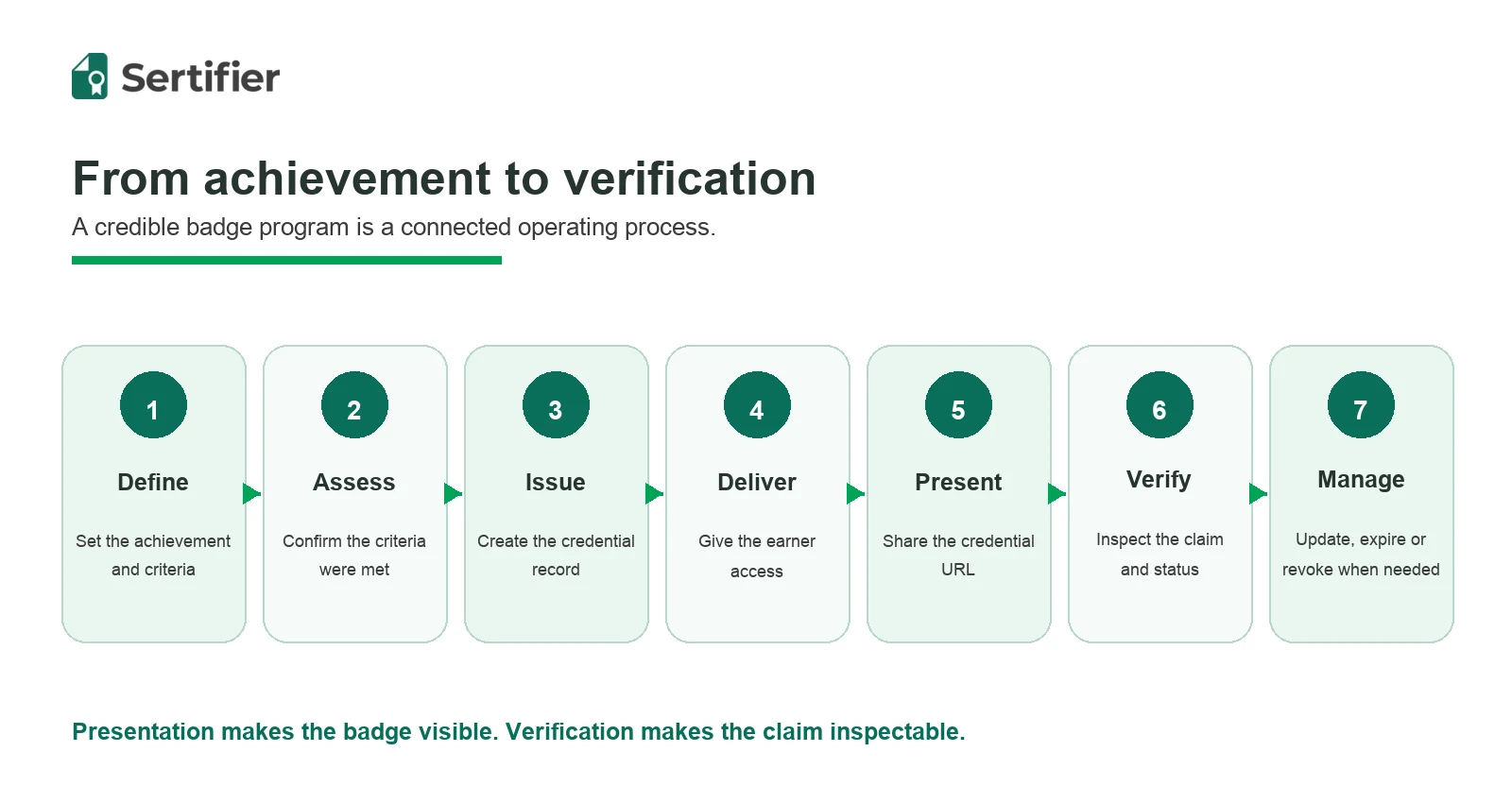
The badge lifecycle can be understood as seven connected steps.
1. Define the achievement
The issuer decides what the badge recognizes and who is eligible. This includes the target audience, learning outcomes, assessment method, criteria, validity period and any renewal rules.
2. Design the credential
The issuer creates the badge image and the information associated with it. The design should remain recognizable at small sizes, but it should not attempt to place every detail inside the image. The verification page or credential record carries the explanation.
3. Confirm that the criteria were met
A learning platform, assessment system or program administrator determines whether the earner met the published requirements. Depending on the program, this may happen automatically or require a reviewer.
4. Issue the badge
The issuing platform creates a credential for the recipient and delivers an email or wallet notification. At this point, the record should connect the recipient, achievement, issuer and verification method.
5. Share or present the badge
The earner can present the badge through a credential page, digital wallet, professional profile, portfolio, email signature or résumé. The available sharing methods depend on the issuing platform and the destination.
6. Verify the badge
A viewer follows the credential link or uses a compatible verifier to inspect the claim. The viewer should be able to identify the issuer, achievement, recipient and current status without insider knowledge.
7. Manage the credential
The issuer may need to correct, update, expire or revoke the credential if the status changes. These operations should have named owners and an audit trail.
Key takeaway
Sharing is the presentation step. Verification is the trust step. A screenshot can be shared, but it does not by itself prove who earned the achievement or whether the record is still valid.
What is Open Badges 3.0?
Open Badges is an open standard maintained by 1EdTech. It defines how achievement information can be structured and exchanged so that compatible systems can interpret it.
According to 1EdTech’s technical overview, Open Badges 3.0 credentials use JSON or JSON-LD, include a visual PNG or SVG representation, and are digitally signed as credentials compatible with the W3C Verifiable Credentials Data Model 2.0.
In practical terms, the standard gives issuers and platform teams a shared model for information such as the:
- achievement
- issuer
- earner
- criteria
- evidence
- issue and expiry dates
- cryptographic proof
Standards support does not make every badge equally valuable. The value still depends on the issuer, the rigor of the criteria, the quality of the evidence and the relevance of the achievement. The standard makes the record easier for compatible systems to understand and verify. It does not evaluate the quality of the learning program.
Questions to ask a platform about standards
Do not stop at a logo or a broad “standards compliant” claim. Ask:
- Which Open Badges version is supported?
- Is the product certified by 1EdTech for the role you need?
- Can earners export or move credentials to compatible wallets?
- How are issuer identity and cryptographic proofs handled?
- What happens to issued credentials if your subscription ends?
- How are expiry, revocation and updates represented?
- Can your team retrieve credential data through an API?
The answers should be documented and tested against your intended workflow.
Digital badges, digital certificates and microcredentials
These terms are related, but they are not interchangeable.
Digital badge
A digital badge is a compact visual representation of an achievement. It works well when recognition, visibility and easy presentation are important.
Digital certificate
A digital certificate usually uses a document-style layout. It can provide formal recognition of course, program or certification completion. “Certificate” describes the way the credential is presented and understood in a given context, not one universal technical standard.
Microcredential
A microcredential is a focused unit of assessed learning or competency. It describes the scope and purpose of the achievement. A microcredential may be represented as a badge, a certificate or another type of digital credential.
| Decision question | Badge may fit better | Certificate may fit better |
|---|---|---|
| Is compact professional sharing a priority? | Yes | Sometimes |
| Is a formal document expected? | Sometimes | Yes |
| Is the achievement one skill or milestone? | Often | Sometimes |
| Is the record used in a formal completion process? | Sometimes | Often |
| Can both presentations help the earner? | Use both only when each has a defined purpose | Use both only when each has a defined purpose |
There is no rule that every program should issue both. Choose the format or combination that helps the intended audience understand and use the achievement.
Where are digital badges used?
Digital badges can support many recognition models. The badge should match the level of rigor and the decision it is intended to inform.
Higher education and continuing education
Institutions can use badges to represent assessed skills, short courses, co-curricular learning or milestones within a longer pathway. Program teams should make the relationship between the badge, academic credit and any formal qualification explicit.
Employee learning and development
L&D teams can recognize onboarding, role-based learning, product knowledge, leadership development or assessed competencies. A badge should not imply mastery if the underlying activity only measured attendance.
Professional associations and certification programs
Associations can issue badges for certification, membership status or continuing professional development. Expiry and renewal rules are especially important when the achievement must remain current.
Product and partner education
Companies can recognize customers, partners or professionals who complete product training or pass an assessment. Clear versioning helps viewers understand which product or competency version the badge covers.
Events and community programs
Badges can recognize participation, contribution or competition results. The badge name and criteria should distinguish attendance from assessed achievement.
Are digital badges worth it?
They can be, when they solve a real recognition or verification problem.
For earners, a badge can make an achievement easier to present and explain. For issuers, it can create a consistent record and reduce manual credential administration. For viewers, it can provide a route to the issuer, criteria and current credential status.
Those benefits are not automatic. A badge program may underperform when:
- the achievement has vague or minimal criteria
- the issuer is difficult to identify
- the verification experience is confusing
- recipients do not understand why or how to use the badge
- the image becomes illegible in the places where it is shared
- privacy, expiry and revocation rules are undefined
- the program measures sends but not claims, shares, verification or business outcomes
The right question is not “Do badges increase engagement?” in the abstract. It is “What behavior or decision should this badge improve, and how will we observe that change?”
How to create a digital badge program
Step 1: Write the credential statement
Complete this sentence:
This badge confirms that [earner] demonstrated [achievement] by completing [criteria or assessment], issued by [organization], valid [time period, if applicable].
If the sentence is vague, the badge design is not ready.
Step 2: Define governance
Assign owners for:
- approving the achievement and criteria
- confirming eligibility
- issuing the credential
- correcting recipient data
- expiring or revoking credentials
- responding to verification questions
- reviewing the program over time
Step 3: Map the data and privacy rules
Decide what recipient information is required, what will be public, how consent is handled, what evidence can be shown and how long records will be retained. Involve privacy or legal owners when the program crosses jurisdictions or uses sensitive evidence.
Step 4: Design for recognition at small sizes
Use a clear hierarchy, limited text, sufficient contrast and a consistent visual system across badge levels. Test the image in the smallest real context where it will appear. Sertifier’s practical badge design guide explains how to build a recognizable visual system without placing every detail inside the badge artwork.
Step 5: Configure issuance and verification
Set up the achievement details, recipient data, email, verification page, expiry rules and any integrations. Test with internal recipients before issuing a full cohort.
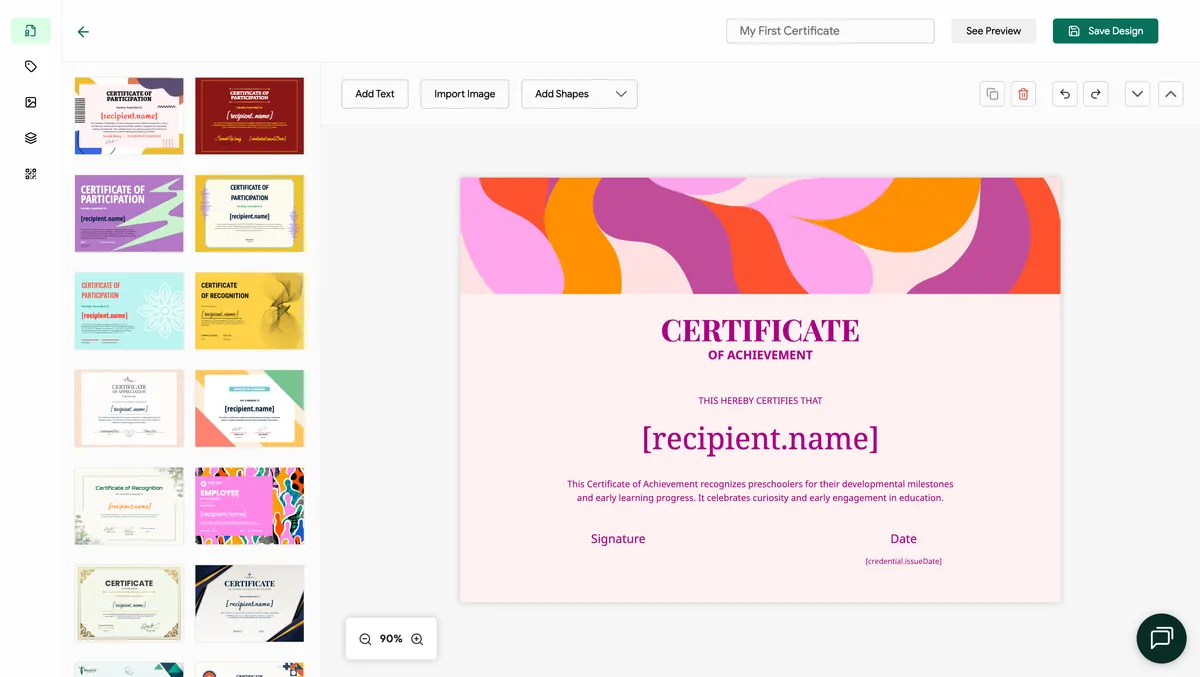
Sertifier’s current digital badge issuance guide documents a six-part workflow: select a credential design, define details and skills, prepare the email, configure campaign options, upload recipients, then preview and send. The guide also recommends sending a test credential before the campaign is released.
Step 6: Prepare the earner experience
The delivery message should explain:
- what the badge recognizes
- who issued it
- where to view and verify it
- how to share or present it
- where to get help
Do not assume recipients already understand digital credentials.
Step 7: Run a controlled pilot
Start with one achievement and a defined group. Check the full experience as an issuer, earner and verifier. Record issues before expanding to other programs.
Step 8: Measure the program
Choose metrics that reflect the intended outcome.
| Stage | Example measures |
|---|---|
| Delivery | Delivered, bounced and opened notifications |
| Recipient action | Viewed, claimed or accepted credentials |
| Presentation | Shares or profile additions where observable |
| Verification | Credential-page views and verification attempts |
| Program operation | Time to issue, correction rate and support volume |
| Business or learning outcome | Enrollment, completion, renewal, partner activation or another pre-defined outcome |
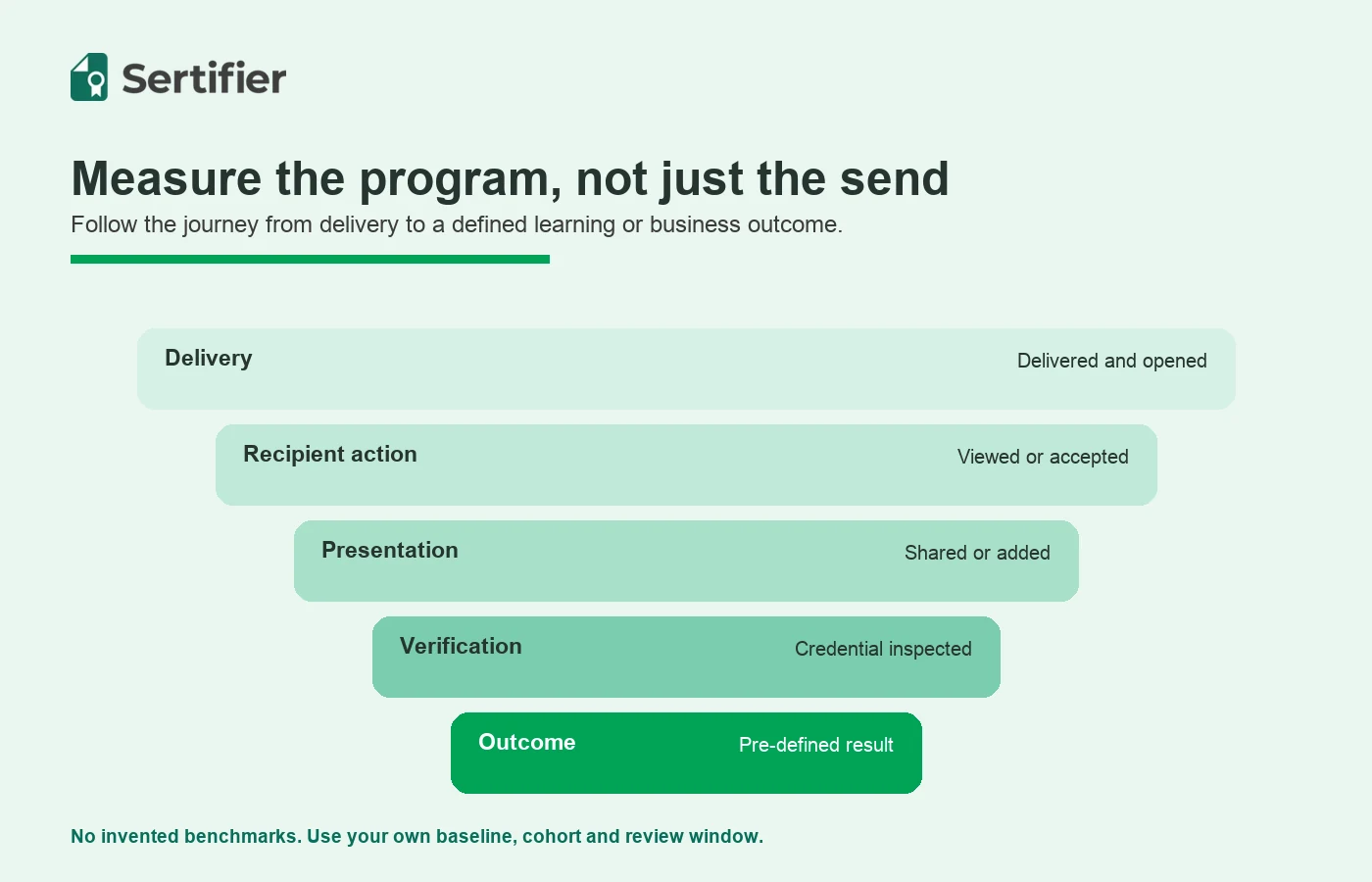
Use a baseline or comparison group where feasible. A high share rate does not prove learning, and a high completion rate does not prove that the badge caused the result.
For a more detailed operating model, use the credentialing program metrics guide to define each event, owner and review window before launch.
How to evaluate a digital badge platform
Create a scorecard before watching product demos. At minimum, evaluate:
- Standards and verification: supported standards, certification status, proof method and verifier experience.
- Credential governance: expiry, revocation, updates, permissions and audit history.
- Issuer workflow: design, data import, bulk issuance, testing and error handling.
- Recipient experience: delivery, claim or access flow, wallet and sharing options.
- Integration: LMS, HRIS, CRM, automation and API requirements.
- Analytics: delivery, recipient action, sharing, verification and exportable data.
- Privacy and security: data location, access controls, retention, subprocessors and contractual commitments.
- Portability and continuity: export options, compatible wallets and post-cancellation treatment.
- Accessibility: keyboard access, contrast, screen-reader behavior and accessible credential pages.
- Commercial fit: recipient model, issuance limits, implementation support and total cost.
Ask vendors to demonstrate your own workflow, including a correction, expiry or revocation scenario. A polished badge editor is useful, but operational controls determine whether a program remains trustworthy at scale.
Planning a badge program?
You can start with Sertifier’s free plan to test a credential workflow, or request a demo if your team needs to review integrations, governance or enterprise requirements.
Keep an accessibility test record
Test a sample credential from the notification through to its verification result. Use synthetic recipient details and record the page, browser, assistive technology, steps and observed outcome. The table below is a suggested test record, not a statement that a platform conforms to every accessibility requirement.
| Step | Check | Record |
|---|---|---|
| Open the credential | Can a keyboard user reach and activate the relevant link and controls? Can they see which control has focus? | Input sequence, control name and any point where progress stops. |
| Understand the award | Can the reader find the award, issuer and earning criteria without relying on the badge artwork alone? | Where the equivalent information appears and what is missing. |
| Check the result | If verification produces an inline status message without moving focus, can assistive technology identify that message? | Displayed result, actual announcement and the technology used. |
| Resolve a failure | Can the tester reproduce the problem and identify who maintains the affected email, page or integration? | Issue owner, correction, retest date and observed result. |
W3C keyboard guidance and visible-focus guidance explain the first check. Choose image alternatives according to the image’s purpose using the W3C image decision tree. Apply status-message guidance to qualifying messages; a new page or focus-taking dialog needs a different assessment.
A passing sample only supports the recorded test scope. Repeat the relevant checks when the template, hosted page or integration changes, and keep unresolved findings visible to the responsible owner.
Frequently asked questions
What makes a digital badge verifiable?
A verifiable badge connects the achievement to structured credential data and a verification method. A viewer should be able to identify the issuer, earner, criteria and current credential status rather than rely on the image alone.
Is every digital badge an Open Badge?
No. “Digital badge” is a broad term. An Open Badge is a credential implemented according to the Open Badges specification. Ask the issuer or platform which version and verification method it supports.
Can someone add a digital badge to LinkedIn?
Yes, but the exact workflow depends on the issuing platform and LinkedIn’s current interface. The important element is the credential URL: it gives profile visitors a path to inspect the record. For detailed instructions, use Sertifier’s LinkedIn badges guide.
Do digital badges need blockchain?
No. Open Badges 3.0 supports cryptographically signed verifiable credentials without requiring a blockchain. A platform may offer blockchain anchoring for a separate use case, but it is not a requirement for a standards-based badge.
Should a badge expire?
It depends on the achievement. A badge for an event may not need an expiry date. A badge representing knowledge that changes, a regulated role or a renewable professional status may need one. Define the rule before issuing the first credential.
Can a digital badge be revoked?
Standards-based credential systems can represent status changes, but the workflow depends on the issuer and platform. Buyers should test revocation and the public verifier experience before launch.
What is the difference between a badge and a microcredential?
A microcredential describes a focused learning achievement. A badge is one way to represent and share an achievement. A microcredential can be displayed as a badge, but not every badge represents assessed microcredential learning.
Final checklist
Before issuing a badge, confirm that:
- the achievement and audience are clear
- the criteria match what was actually assessed
- the issuer and responsible owners are named
- recipient identity and privacy rules are documented
- the badge remains legible in real sharing contexts
- verification works without insider knowledge
- expiry, renewal and revocation rules are defined
- the recipient message explains what to do next
- a test credential has completed the full lifecycle
- success metrics and a review date are recorded
A digital badge earns trust through the system behind it. Begin with a defensible achievement, make the evidence understandable and give every viewer a clear way to verify the claim.
Sources
- 1EdTech, Open Badges overview, accessed 2026-07-24.
- 1EdTech, Open Badges 3.0 implementation guide, accessed 2026-07-24.
- W3C, Verifiable Credentials Data Model 2.0, accessed 2026-07-24.
- Sertifier Help Center, How to issue digital badges, accessed 2026-07-24.
- Sertifier pricing, accessed 2026-07-24.