Customer education certification: credential program design
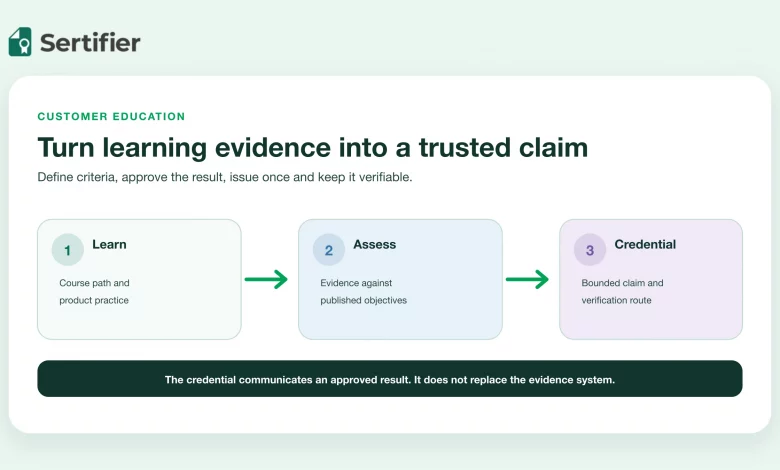
Customer education certification turns a product-learning result into a claim that a customer, partner or employer can inspect. It is not the same as a course completion email, an academy leaderboard or a decorative badge. A credible program defines what the learner can do, what evidence supports that claim, who approves it, how the credential is issued and how another person can verify it.
Start with the decision the credential will support. A completion credential may confirm that a customer finished onboarding. A proficiency credential may show that the customer passed an assessment. An authorization credential may indicate that a person is approved to perform a bounded task. These claims need different criteria, evidence and lifecycle rules.
Short answer: A customer education certification program defines a bounded claim, accepts evidence against published criteria, approves one result, issues one credential and keeps its meaning and status verifiable.
Short answer
A customer education certification program needs seven connected decisions:
- Name the customer capability or completion result.
- Define observable criteria and acceptable evidence.
- Choose a credential level that does not overstate the result.
- Assign assessment, approval and issuance owners.
- Connect the learning system result to one controlled issuance event.
- Give recipients a clear way to access, share and verify the credential.
- Define expiry, renewal, correction and retirement before launch.
The credential is the portable record of an approved result. It should not replace the learning platform, assessment system or customer record that produced the evidence.
Separate customer education from certification
Customer education helps people understand and use a product or service. Sertifier’s existing customer training guide owns the broader job: learning content, delivery formats, touchpoints and program strategy. Certification is a narrower operating layer inside or next to that program.
Use the following role boundary:
| Program layer | Primary job | System of record |
|---|---|---|
| Customer education | Teach product knowledge and workflows | LMS, academy or learning portal |
| Assessment | Collect evidence against defined objectives | Exam, rubric, lab or observed task |
| Approval | Decide whether the evidence satisfies the rule | Program owner or governed workflow |
| Credential | Communicate the approved claim | Credential platform |
| Verification | Let another person inspect issuer, claim, dates and status | Verification page or supported verifier |
A new credential should begin only after the learning and assessment teams can state what has been proved. Issuing first and defining the meaning later creates an attractive record with an unstable claim.
Choose the decision the credential supports
Write one sentence that names the credential user and the decision they need to make. Examples include:
- A customer administrator needs to confirm that a team member completed the
- A partner manager needs to confirm that a consultant passed a current product
- A customer needs to show an employer that they demonstrated a named product
- A support leader needs to identify people who completed advanced
required onboarding path.
configuration assessment.
skill under published criteria.
troubleshooting training.
Avoid a single badge that tries to represent attendance, proficiency, authorization and partner status at once. The reader should not have to infer which claim applies.
Match the credential level to the evidence
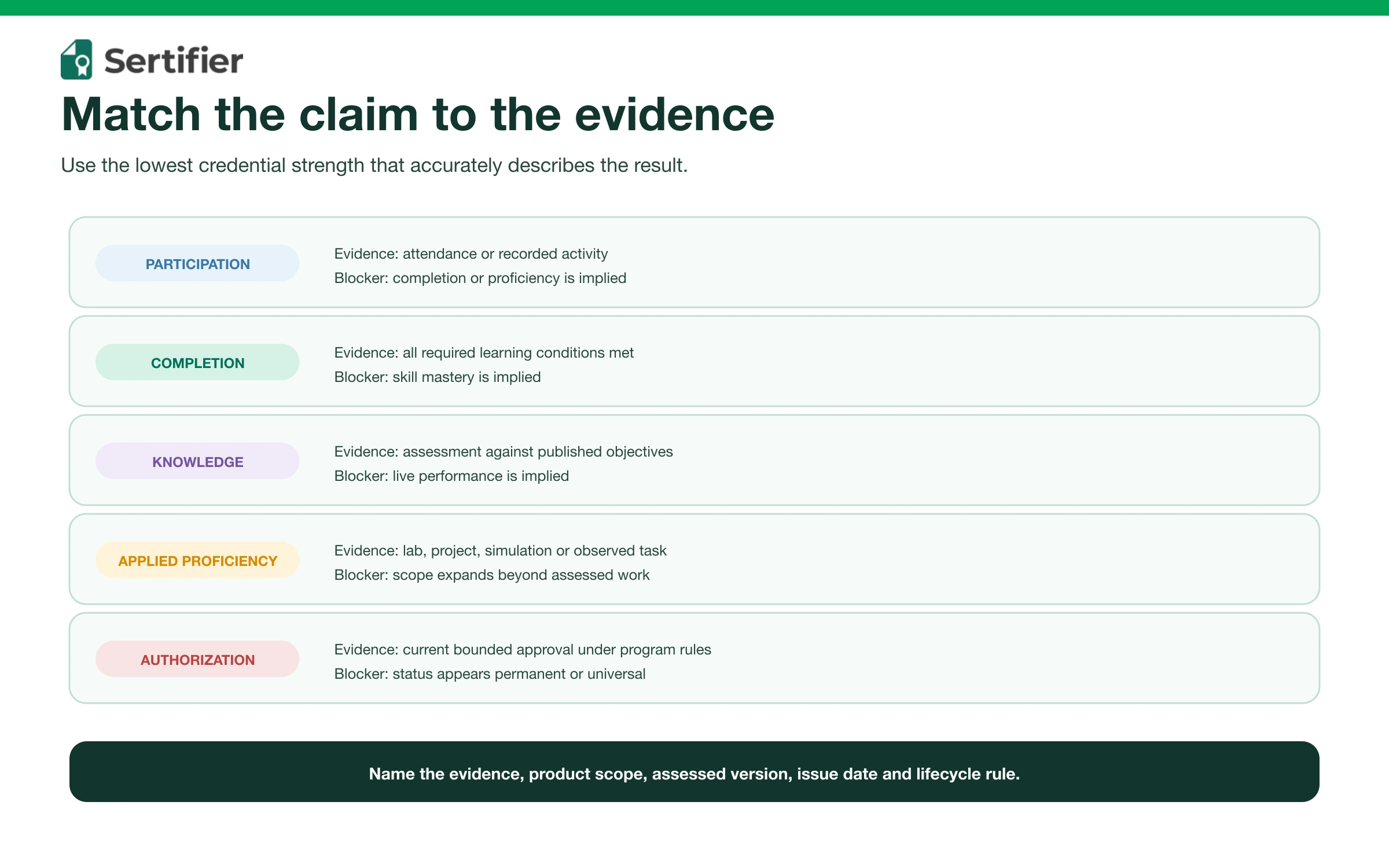
Use the lowest claim strength that accurately describes the result.
| Credential level | Suitable evidence | Do not imply |
|---|---|---|
| Participation | Attendance or a recorded learning activity | Course completion or proficiency |
| Completion | Required modules and completion conditions met | Independent skill mastery |
| Knowledge | Scored assessment against published objectives | Performance in a live environment |
| Applied proficiency | Lab, project, simulation or observed task assessed with a rubric | Broad expertise outside the assessed scope |
| Authorization | Current approval to perform a bounded task under program rules | Permanent status or universal permission |
The 1EdTech Open Badges implementation guide describes an issuer making a claim that a learner met the criteria for a defined achievement. Its current guidance separates the achievement definition from the credential awarded to one learner. Preserve that separation in customer education: define the reusable achievement first, then issue an individual credential only when the result passes.
Build an assessment blueprint before the credential
For a certification-style assessment, map the job or product tasks before writing questions. The Customer Education Management Association’s exam blueprint guidance identifies sections, objectives and item allocation as core blueprint elements. It also distinguishes recall from reasoning. Use that principle without turning one published ratio or exam format into a universal rule.
Record:
- Intended audience and prerequisites.
- Product version or feature scope.
- Objectives tied to real customer tasks.
- Evidence type for each objective.
- Passing and retake rules.
- Accessibility and accommodation process.
- Content security and item-review process when an exam is used.
- Version review owner and retirement trigger.
An academy quiz can be useful learning feedback without being sufficient certification evidence. Label formative checks and credential-bearing assessments separately.
Define the achievement and credential record
The current Open Badges 3.0 conformance guide describes achievement information and learner-specific assertion data such as issuer, achievement date, expiry, results and evidence. It also defines verification requirements for conformant implementations. A customer education program should translate that structure into a plain-language record.
Include:
- Credential name that matches the claim level.
- Issuing organization and responsible program.
- Recipient identifier appropriate to the workflow.
- Achievement description and criteria.
- Product, role or capability scope.
- Issue date and validity period when applicable.
- Evidence or result reference when disclosure is appropriate.
- Verification and current-status route.
- Renewal or replacement rule.
Do not put confidential exam answers, customer account details or unnecessary personal data in a public credential. The visible record should contain enough context for interpretation without exposing the underlying assessment system.
Design the operating workflow
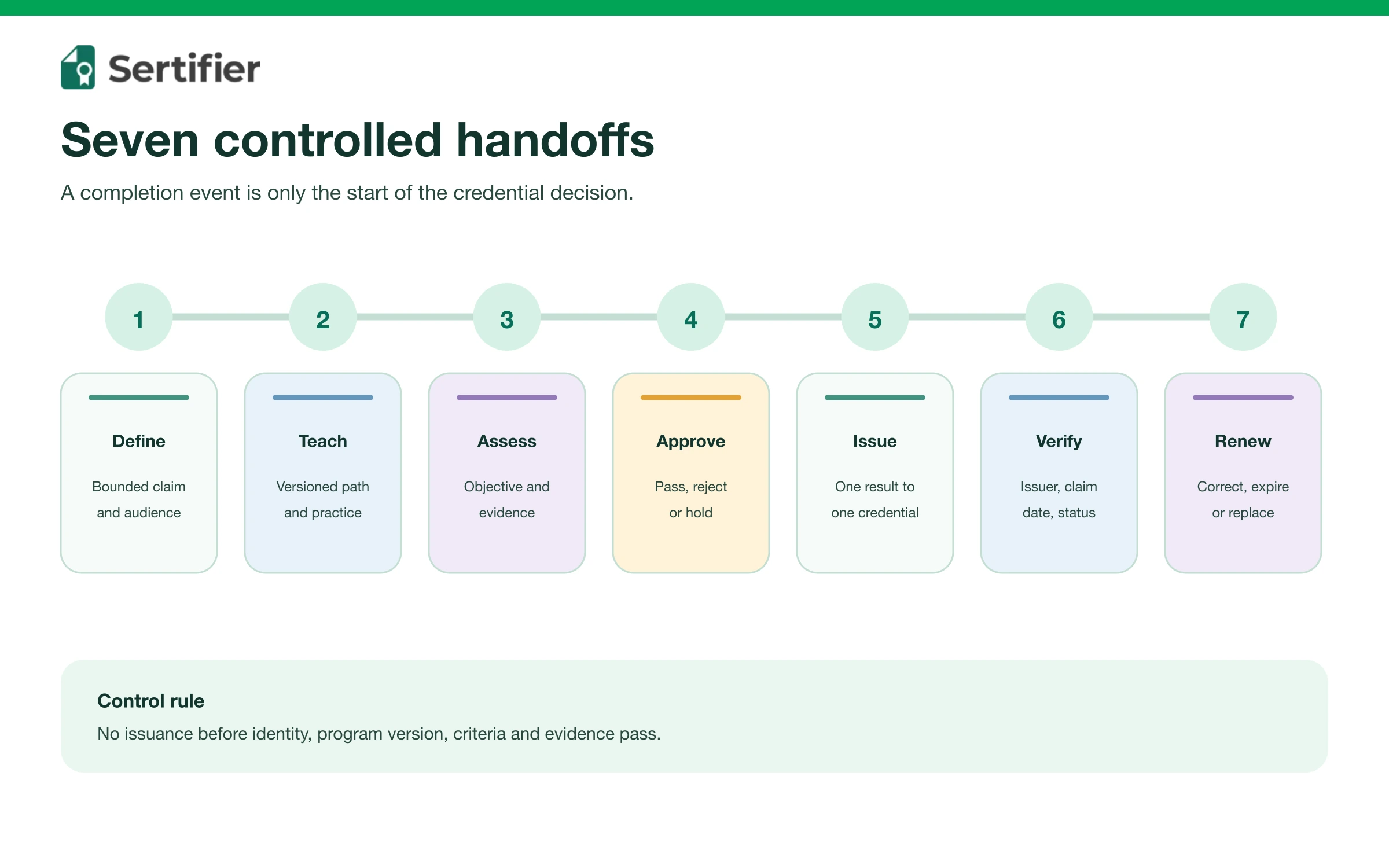
Treat issuance as a controlled handoff between systems.
- The learning or assessment system records a result.
- A rule validates identity, program version and required evidence.
- The approval owner accepts, rejects or holds the result.
- One issuance request is created with the approved credential details.
- The recipient receives and can access the credential.
- A verifier can inspect issuer, claim, dates and current status.
- The program reconciles failed, duplicate, corrected and expired records.
Sertifier’s current credential automation help documents scheduled issuance, external application triggers and Pathways with prerequisites. Use only the mechanism that matches the source-of-truth event. The presence of an integration does not define the eligibility rule for you.
For the broader control pattern, use the credentialing automation workflow. Keep customer education logic specific to course versions, assessment results, customer roles and program renewal.
Assign owners and permissions
At minimum, assign these roles:
- Program owner: defines audience, claim and business purpose.
- Product subject-matter owner: confirms current product scope.
- Assessment owner: maintains objectives, evidence and passing rules.
- Credential owner: maintains metadata, design and lifecycle settings.
- Operations owner: monitors issuance and delivery exceptions.
- Support owner: handles recipient identity, correction and access cases.
Sertifier’s current users and permissions documentation describes configurable access for team members, including credential details, designs and other application areas. Map permissions to the operating roles. Do not give every course author the ability to alter credential validity or issue production credentials.
Plan verification for the real audience
A verification experience should answer:
- Who issued the credential?
- Who received it, within the program’s privacy model?
- What exactly was completed or demonstrated?
- Which criteria and product scope apply?
- When was it issued, and is it still current?
- How can a verifier confirm authenticity and status?
Sertifier’s current verification page documentation describes a branded destination for certificate and badge recipients and a custom-domain option. These are current public product statements. They do not prove that every external wallet, HR system or procurement workflow will accept the credential. Test the intended verifier route before launch.
Define expiry, renewal and product-version changes
Customer education credentials can age quickly when the underlying product or task changes. Choose a lifecycle rule based on the claim, not on a default calendar interval.
Ask:
- Does the credential represent a past event or a current capability?
- Which product change would make the evidence materially incomplete?
- Can the credential remain valid while showing the assessed product version?
- Does renewal require a full reassessment, a delta module or an approval?
- Who decides that a credential must be retired or replaced?
- What will the verifier see after expiry or replacement?
A completion credential may remain a historical record. An authorization or current-proficiency claim may need expiry and reassessment. Make the distinction visible.
Use this release checklist
| Gate | Acceptance evidence | Blocking failure |
|---|---|---|
| Claim | One bounded result and intended verifier decision | Marketing label has no testable meaning |
| Criteria | Published objectives and evidence rules | Criteria exist only in an administrator’s memory |
| Assessment | Versioned blueprint, pass rule and exception process | Quiz result cannot support the claimed level |
| Approval | Named owner and auditable outcome | Issuance happens before eligibility is confirmed |
| Issuance | One approved result creates one credential | Duplicate, wrong-recipient or unexplained failure |
| Recipient | Access, understanding and sharing path tested | Recipient cannot recover or interpret the record |
| Verification | Issuer, claim, criteria, dates and status are inspectable | Only an image is available |
| Lifecycle | Renewal, correction, expiry and retirement rules recorded | Outdated credentials remain unexplained |
Test the entire chain with a non-production learner before opening the program. Record the academy version, assessment version, credential version, expected result and observed result.
Measure learning, credential and business outcomes separately
Do not use credential issuance count as proof that customer education worked. Measure each layer with its own source:
- Learning: enrollment, completion and assessment evidence from the academy or
- Credential operations: approved, issued, delivered, failed, corrected,
- Recipient behavior: access, sharing and verified presentation where the
- Customer outcomes: adoption, support, retention or expansion only when the
LMS.
expired and renewed records.
measurement is available and privacy-appropriate.
customer-data join is defined and trustworthy.
A credential can make a result portable and verifiable. It cannot establish causal customer impact by itself.
Build a verifiable customer education credential
Map the learning result, evidence, approval rule, credential record and verification route before automating issuance.
Frequently asked questions
Should every customer education course issue a credential?
No. Issue a credential when the result needs to be portable, recognized or verified. A course completion record inside the academy may be enough for a low-stakes learning step.
Is a completion badge a certification?
Not automatically. Certification usually implies defined criteria and an assessment or approval process. Name the credential according to the evidence.
Can customer credentials be automated?
Yes, when a reliable source event and eligibility rule exist. Validate identity, program version, required evidence and duplicate handling before issuance.
Should product certifications expire?
It depends on the claim and product change rate. Historical completion and current authorization need different lifecycle rules.
What should a verifier see?
The issuer, recipient context, bounded claim, criteria, issue date, validity or status and an authentic verification route should be clear enough for the intended decision.