Digital credentials for awarding bodies: qualification authority and verification handoff
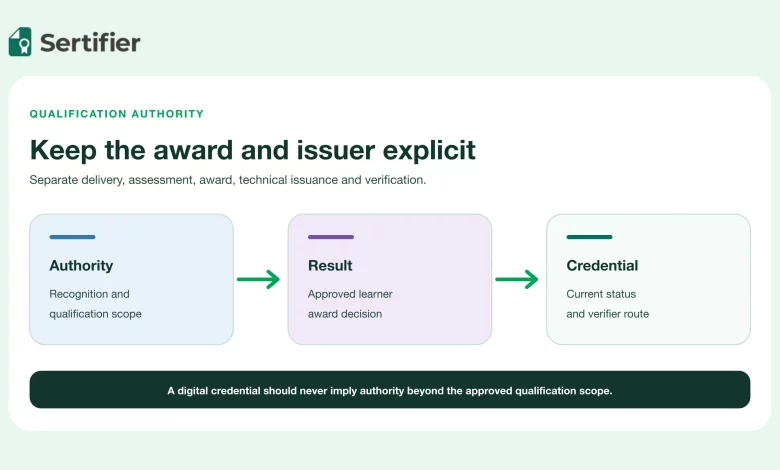
Short answer: An awarding body should use a digital credential to communicate one authorized qualification or achievement result. Keep the qualification specification, assessment evidence, result record and regulator’s register in the systems that own those decisions.
Short answer
An awarding body should use a digital credential to communicate one authorized qualification or achievement result, not to replace the qualification specification, assessment evidence, result record or regulator’s register. The operating design must connect the recognized awarding authority, approved qualification, learner evidence, result decision, credential record and verifier route without blurring who owns each decision.
This article addresses the awarding-body handoff. A training provider may deliver learning without owning the award, while a professional regulator may control permission to practise. For those adjacent jobs, use the separate guides for training-provider evidence handoff and professional licensing status and verification.
Define awarding authority before credential design
“Awarding body” is used differently across jurisdictions. In England, Ofqual uses “awarding organisation” for recognized organisations that design, deliver and award regulated qualifications. The current Ofqual Handbook sets rules for those organizations, including governance, qualification design, assessment, results, appeals and certificates.
Start with the jurisdiction and the authoritative register. The Ofqual scope of recognition data records which qualification types, levels and sectors a recognized organization can offer. A digital credential should never imply authority outside that scope.
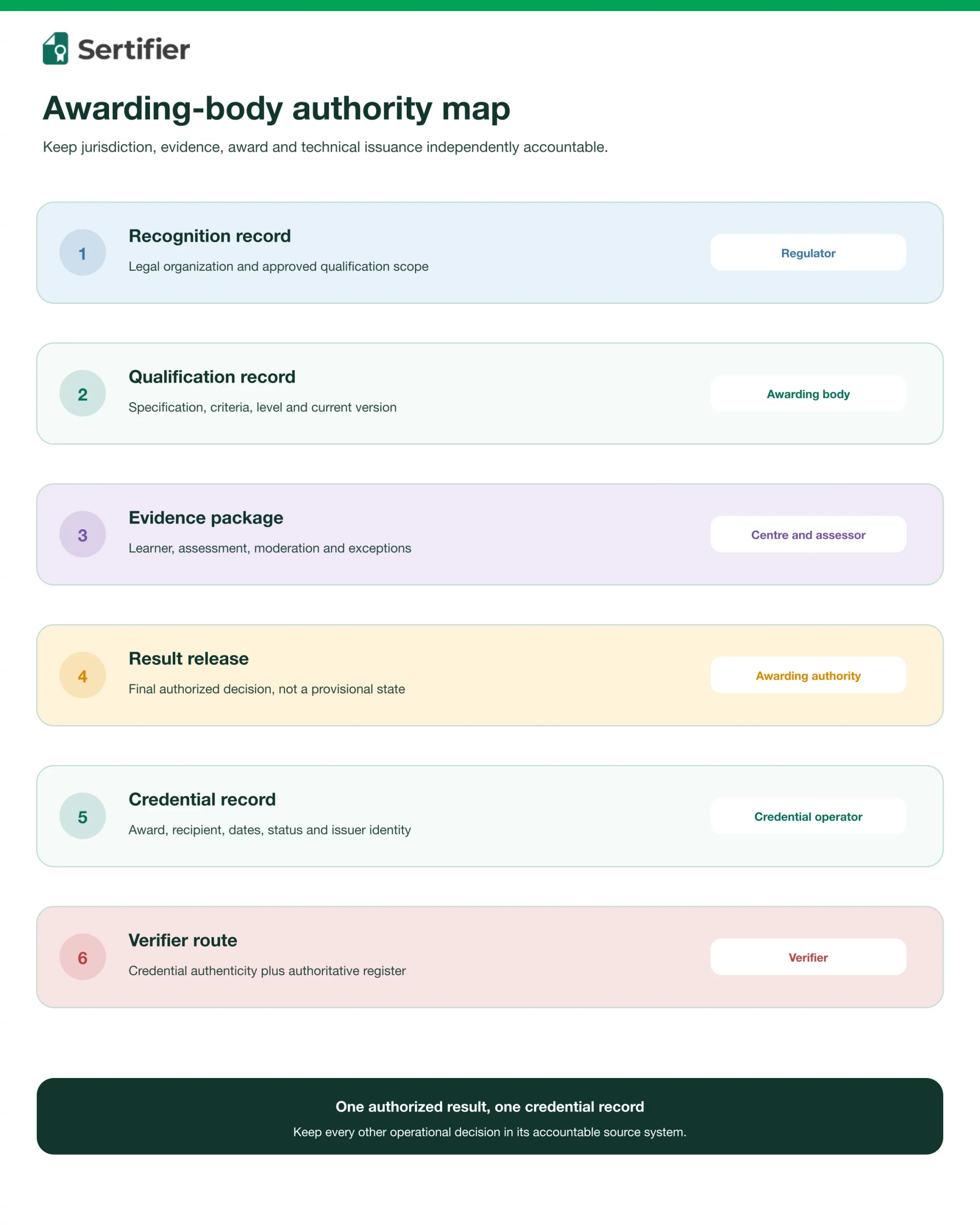
| Authority layer | Source of truth | Credential role | What the credential must not do |
|---|---|---|---|
| Regulator or recognition body | Recognition and permitted scope | Provide an authoritative route when relevant | Claim recognition the issuer does not hold |
| Awarding body | Qualification, assessment and result decision | Issue the approved qualification claim | Delegate the award silently to a training centre |
| Centre or training provider | Delivery and local evidence | Supply authorized evidence and learner records | Present delivery as awarding authority |
| Credential platform | Credential creation, delivery and status | Communicate and verify the approved result | Decide the qualification result |
| Verifier | Context-specific interpretation | Check authenticity and relevance | Treat the credential as the regulator’s live register |
Separate delivery, assessment, award and technical issuance
One organization may perform several roles, but the records should still distinguish them. Training delivery proves what learning activity occurred. Assessment evidence supports a result. The awarding decision authorizes the claim. Technical issuance creates and delivers the credential.
The Ofqual description of awarding organisations explains that awarding organisations design, develop, deliver and award qualifications, while schools, colleges and training providers can teach courses leading to those qualifications. This is a jurisdiction-specific model, not a universal rule. Its operational lesson is universal: identify who may approve the final claim.
Map the qualification record to one bounded claim
A qualification can contain more information than a credential should expose. Define which qualification title, level, subject, result, award date and identifier belong in the credential. Link to the authoritative qualification information when a verifier needs more context.
The public register search for recognized awarding organisations helps users check recognition in its jurisdiction. The credential can route a verifier there, but it must not copy a regulator badge or imply that a platform has independently confirmed every regulatory condition.
| Credential field | Authoritative owner | Acceptance rule | Failure to block |
|---|---|---|---|
| Awarding organisation | Recognized legal entity record | Exact approved issuer identity | Trading name cannot be traced to the authority |
| Qualification | Qualification specification or register | Exact title and version are current for the award | Generic title obscures the qualification |
| Learner | Authorized learner record | Identity matches the approved result | Shared or ambiguous recipient identifier |
| Result | Awarding decision | Final result is approved and released | Provisional or appealed result is treated as final |
| Dates | Award record and validity rule | Award and expiry dates match the claim | Platform default invents a validity period |
| Verification | Credential and authoritative routes | Current credential status is visible | Image or PDF is the only proof |
Decide who is the issuer and who is the awarding body
In some systems, the organization that makes the award is also the technical issuer. In others, a service provider or parent organization performs the signing or sealing step on behalf of the awarding body. The roles must be explicit.
The European Commission’s guidance on issuing European Digital Credentials for Learning distinguishes the awarding body from the issuing or signing organization and describes mandated issue. Use this as a role model, not as a claim that every credential uses an EU electronic seal.
Record the awarding body, technical issuer, authorization for the technical act, signing or platform identity where applicable, and the verifier route. A technology provider should not become the visible owner of the academic or professional claim unless it is actually authorized to make that claim.
Connect criteria, evidence and the final result
The credential should state or link to the criteria for the awarded achievement. The 1EdTech Open Badges conformance guide describes an achievement and an assertion that includes issuer, achievement date, expiry, results and supporting evidence. Those fields can inform a useful design even when the final format is not an Open Badge.
Do not expose confidential assessment material. Store the assessment instrument, marking evidence, moderation and exception decisions in their authorized systems. The credential needs enough information for the claim to be understood and verified, plus a controlled escalation route when more evidence is required.
Build a controlled centre-to-awarding-body handoff
Where centres or training providers submit learner evidence, define the data and authority boundary before automation. The centre can report delivery, identity and assessment evidence under an agreed contract. The awarding body decides whether that information is sufficient and whether a result can be released.
| Handoff state | Required evidence | Allowed action | Blocked action |
|---|---|---|---|
| Submitted | Centre identity, learner, qualification and evidence package | Validate structure and authorization | Issue a public credential |
| In review | Complete evidence and rule version | Assess, moderate or request correction | Treat a provisional result as final |
| Approved | Authorized final result and release decision | Create the credential record | Change the result during technical issuance |
| Held | Named reason and accountable owner | Resolve the exception | Repeated blind retry |
| Issued | Credential ID, status and delivery result | Reconcile with the award record | Create another active credential for the same award |
| Corrected | New authorized decision and relationship to prior record | Replace or update under policy | Erase the decision history silently |
Treat result release as the issuance trigger
The trigger should be an authorized result-release event, not course attendance, a file arrival or a payment confirmation. Define how appeals, moderation, identity corrections and late evidence affect release. If the awarding body uses a centre portal, the portal’s “complete” state should not be assumed to mean “approved to award” unless the contract says so.
Sertifier’s public guidance on credential automation supports manual, scheduled and integration-based operating choices. Apply automation only after the result-release contract, duplicate key and unknown-result workflow are defined.
Configure the credential record deliberately
Sertifier’s public credential management guide documents the product context for creating and managing credentials. The awarding body should define the template, issuer identity, qualification label, recipient fields, issue date, validity rule and verification copy before a live cohort is imported.
Use one stable credential identifier for the awarded result. A redesigned visual should not create a new qualification result. A corrected result should follow the awarding body’s correction policy and maintain an auditable relationship to the previous record.
Make verification useful without replacing registers
A verifier needs to confirm the credential is authentic, current and relevant. Sertifier’s verification page guidance shows the documented product surface for checking credential details. The page should identify the issuer, award, recipient reference, dates and status clearly.
When the qualification is regulated or accredited, provide the regulator or accreditation route separately. A credential platform can verify the credential record it serves. The regulator remains authoritative for recognition, scope and any current public register.
Handle expiry, withdrawal and correction as different states
An expiry date indicates the claim or its intended use is time-bounded. Withdrawal or invalidation indicates the awarding body no longer treats the credential as current under its policy. Correction indicates the published record contained an error or an authorized result changed. These are not interchangeable labels.
Sertifier documents the public behavior of an expiry date. Do not use expiry as a substitute for a regulator’s action, an appeal outcome or a qualification withdrawal process. The awarding body must define the decision and the platform should communicate only the state it can support accurately.
Test the award-to-verifier journey
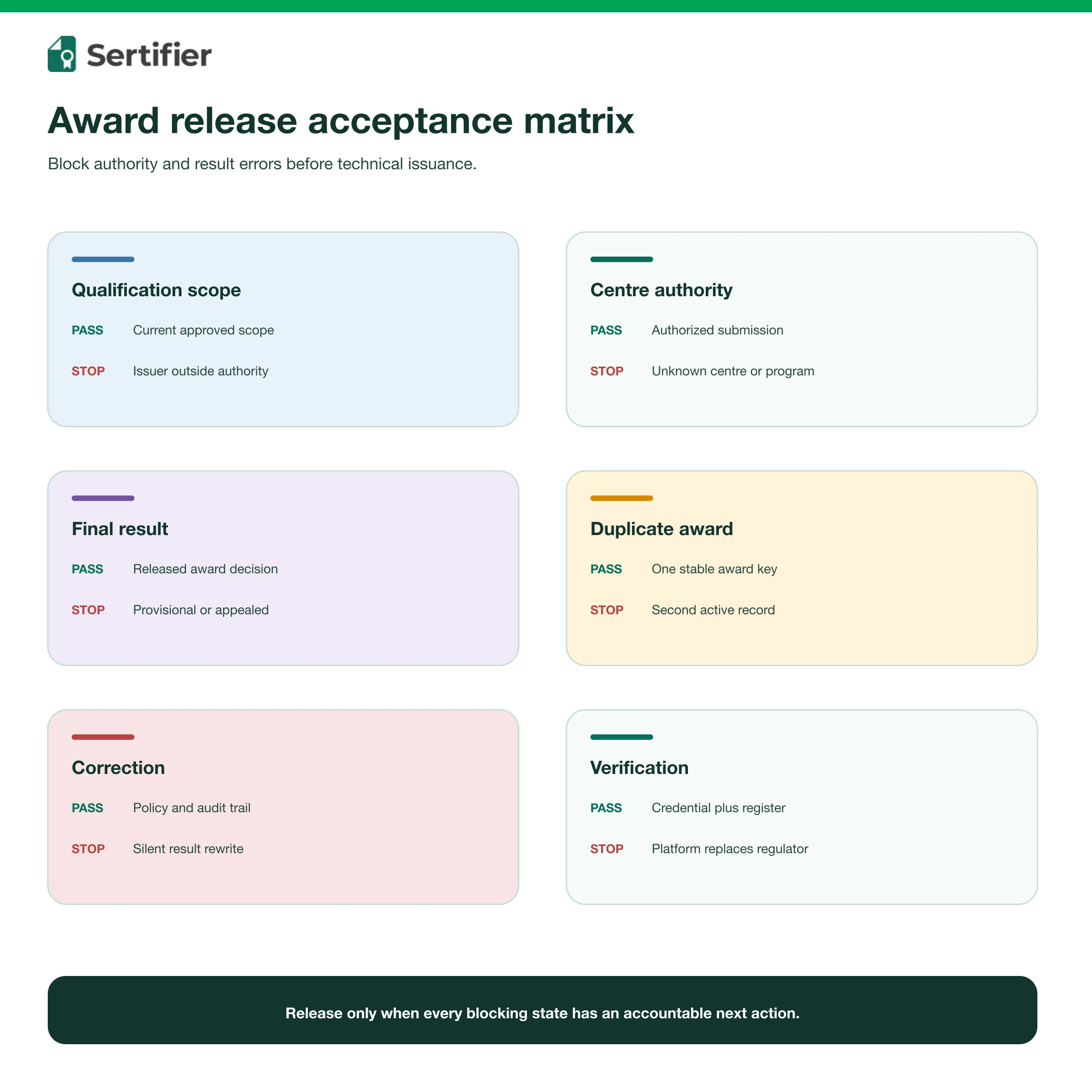
Before a live release, test a clean approved result, duplicate submission, provisional result, held decision, corrected learner identity, replacement credential and logged-out verification. Include a centre that is not authorized for the qualification, because authorization errors are more important than formatting errors.
| Acceptance test | Evidence to capture | Pass condition | Owner |
|---|---|---|---|
| Authorized centre | Centre and qualification scope | Submission is accepted only within scope | Awarding operations |
| Final result | Approval and release event | Credential cannot issue from a provisional state | Awarding authority |
| Duplicate award | Stable award key | One active credential represents the result | Credential operations |
| Correction | Authorized correction record | New state is traceable to the prior record | Quality and support |
| Verification | Normal logged-out check | Issuer, qualification, dates and status are clear | QA owner |
| Register route | Current authoritative URL | Recognition and scope remain externally checkable | Compliance owner |
Measure awarding operations and credential use separately
Assessment throughput, moderation, appeals and result release belong to awarding operations. Credential issuance, delivery, access, sharing and verification belong to the credential layer. Measure both, but do not combine them into a single success rate that hides where a failure occurred.
Start with acceptance evidence: authorized results received, correct credentials issued, exceptions resolved, recipients able to access their credentials and verifiers able to reach both the credential and any authoritative register. Commercial or learning-impact claims require additional joined evidence.
Use this pre-release checklist
- The jurisdiction and awarding authority are named.
- The qualification and recognition scope are current.
- Centre delivery, assessment, award and technical issuance roles are separate.
- The final result-release event is the issuance trigger.
- Provisional, held and appealed results cannot become public credentials.
- Recipient and award identifiers prevent duplicates.
- The credential claim matches the approved result exactly.
- Expiry, withdrawal and correction states are governed separately.
- Verification explains the credential without replacing a regulator’s register.
- One package can be restored without changing unrelated qualifications.
Build a bounded awarding-body workflow
Map qualification authority, evidence, result release, credential issuance and verification before automation.
Frequently asked questions
Is an awarding body the same as a training provider?
Not always. A training provider may deliver learning and collect evidence while a separate awarding body owns the qualification and final award decision. The roles depend on the jurisdiction and program contract.
Can a platform issue on behalf of an awarding body?
A platform can perform the technical issuance step when the awarding body has authorized the workflow. The credential must still identify the organization that owns the award and should not imply that the technology provider made the qualification decision.
Can a digital credential replace a qualification register?
No. It can communicate and verify an awarded result. The authoritative register remains the source for recognition, qualification scope and any regulator-controlled status.
Should every regulated qualification credential expire?
No. Expiry should follow the meaning and governing rule of the claim. A historical award may remain valid while a current authorization or endorsement has a separate time limit.
What should happen when a result changes after appeal?
Follow the awarding body’s result and correction policy. Record the authorized change, update or replace the credential under a controlled process, and keep an auditable relationship to the previous state.