Digital credentials for training providers: program evidence and issuance handoff
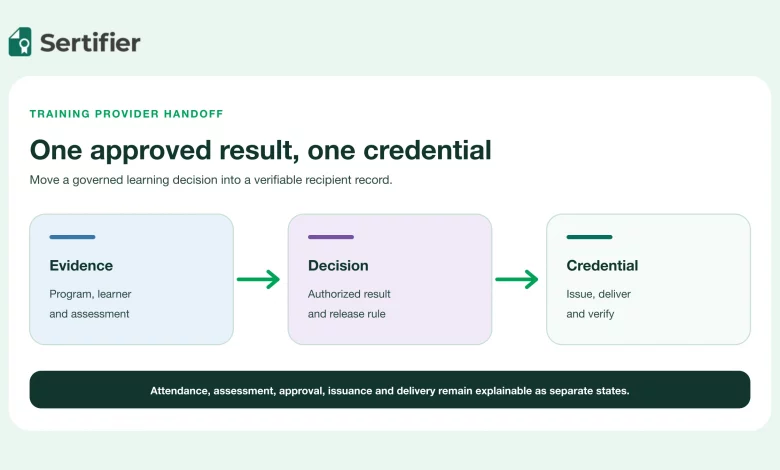
Short answer: A training provider should issue a digital credential only after it can connect a defined claim to the right participant, program version, evidence, assessment result and approval decision. Keep attendance, assessment, refunds, regulatory permission and live learner status in the systems that own them.
Short answer
A training provider should issue a digital credential only after it can connect a defined learning claim to the right participant, program version, evidence, assessment result and approval decision. The credential should make that approved result understandable and verifiable. It should not become the only record of attendance, assessment, refunds, regulatory permission or live learner status.
This article focuses on the handoff between the training operation and the credential layer. For the broader rules that make a training certificate credible, use the certificate of training governance playbook. For notification and recipient access, use the separate digital credential email delivery checklist.
Start with the provider’s exact role
“Training provider” can describe very different organisations. A provider may design a course, deliver instruction, assess learners, approve results, issue a credential or perform only some of those tasks. In a regulated qualification, the organisation that delivers learning may not be the organisation authorized to award the qualification.
The Ofqual explanation of awarding organisations makes this distinction concrete in England: awarding organisations design, deliver and award qualifications, while schools, colleges and training providers buy or teach the courses that lead to them. That jurisdiction-specific example should not be copied into every program. It shows why the operating roles must be named before a platform is configured.
| Program role | Decision it owns | Evidence it should retain | Credential implication |
|---|---|---|---|
| Learning provider | What was delivered and to whom | Enrolment, attendance and activity records | Supports participation or completion claims |
| Assessor | Whether evidence met the stated standard | Assessment instrument, result and assessor identity | Supports knowledge, skill or proficiency claims |
| Approver or awarding authority | Whether the final result is authorized | Approval event, rule version and exceptions | Authorizes issuance of the bounded claim |
| Credential operator | Whether the approved record was issued correctly | Template, recipient, issue event and status | Creates and maintains the credential record |
| Verifier | Whether the presented credential is authentic and relevant | Verification result and any escalation route | Uses the credential without becoming its source of truth |
Separate the learning record from the credential record
A learning management system or provider database normally explains what happened during a course. It may contain enrolment changes, attendance, module progress, assessment attempts, instructor notes and payment status. Most of that information does not belong in a public or shareable credential.
The credential record should communicate the approved outcome. At minimum, define the recipient, issuing organisation, achievement, criteria reference, issue date, current status and verification route. The 1EdTech Open Badges implementation guide describes an issuer as making a claim that a learner met the criteria for a defined achievement. That is a useful design boundary even when the program issues a certificate rather than an Open Badge.
Keep the join between the two layers explicit. A verifier should be able to understand the claim without seeing private operational records, while an authorized operator should be able to trace the credential back to the program version and approval evidence that produced it.
Define the claim before selecting a credential type
Participation, completion, knowledge, applied skill and authorization are not interchangeable. A participant who attended a workshop may have completed the activity without passing an assessment. A learner who passed an assessment may still require another approval before being authorized for a role.
Sertifier’s public guidance on choosing the right credential type can support the platform decision after the program team has defined the claim. The platform does not decide what the evidence proves.
| Intended claim | Minimum evidence | Approval question | Overclaim to avoid |
|---|---|---|---|
| Participation | Identified presence in a defined activity | Did this person participate under the program rule? | “Certified” without an assessment |
| Completion | Required components and completion rule | Did the person complete the stated program version? | Implied proficiency from course completion alone |
| Knowledge | Valid assessment and passing rule | Did the result meet the defined threshold? | Applied ability not tested by the assessment |
| Applied skill | Observed performance and rubric | Did authorized evidence demonstrate the skill? | Current workplace permission or licence |
| Authorization | All program conditions and current decision | Is the person currently approved for the bounded role? | Permanent permission when conditions can change |
Build the evidence handoff as a contract
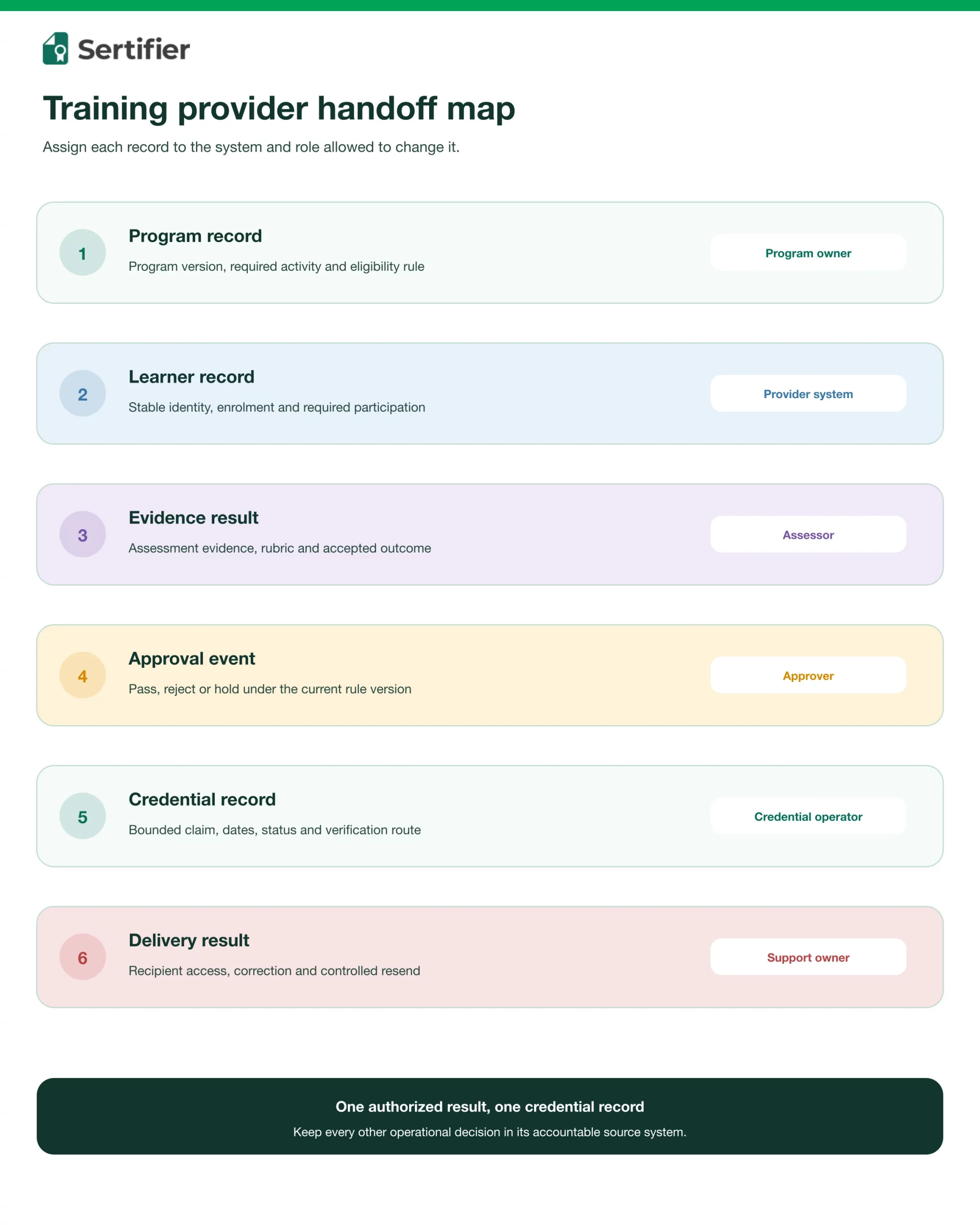
The handoff should be an explicit record, not an informal instruction to “send certificates.” Define which system sends the result, which fields are required, which identifiers are stable, who can approve an exception and what happens when the input is incomplete.
A useful handoff record contains:
- a stable program and version identifier;
- a stable participant identifier, with personal data limited to what issuance requires;
- the achieved claim and the criteria version that defines it;
- the evidence or assessment result that supports the claim;
- the approval decision, decision time and accountable role;
- the credential template and validity rule;
- a unique issuance key that prevents accidental duplicates;
- a result state that the source system can reconcile.
The credential platform should receive an approved result. It should not silently infer eligibility from a name appearing in a spreadsheet.
Choose a controlled issuance path
Manual issuance can be appropriate for a small pilot when the operator can review every record. Bulk upload can support a bounded cohort when the source file is validated and retained. Scheduled, integration-triggered or API issuance can reduce repeated handling only after the trigger and failure states are governed.
Sertifier documents public workflows for credential automation and credential creation and management. Use those capabilities only within the program’s approved contract. Automation should reproduce a decision the program already knows how to explain.
| Issuance path | Best fit | Required control | Stop condition |
|---|---|---|---|
| Manual | New or exceptional low-volume program | Second-person review or explicit approval | Operator cannot trace the record to evidence |
| Bulk | Defined cohort with stable fields | File validation, cohort count and duplicate key | Row count, identity or program version differs |
| Scheduled integration | Repeated stable program cycle | Source event, field contract and reconciliation | Source result is incomplete or delayed |
| API | High-volume or multi-system workflow | Idempotency, authorization and result logging | Response is unknown or cannot be reconciled |
Treat the recipient identity as an operational control
The credential must be issued to the correct person. Decide which identifier is authoritative, how name changes and email corrections are handled, and who can approve a correction. Avoid using an email address as the only identity key when it may change or be shared.
Separate identity correction from achievement correction. Correcting a typographical error should not silently change the approved result. Changing the achieved claim, criteria version or assessment outcome requires a new authorized decision and an auditable record of what changed.
Design the verification experience
A shareable image is not sufficient proof. A verifier needs a current page or compatible credential that can confirm the issuer, recipient reference, achievement, dates and status. Sertifier’s public verification page guidance shows the product route for checking credential details.
The embedded information should be understandable without disclosing private learner records. When the credential depends on a regulator, awarding body or separate authorization system, route the verifier to that authoritative source for the decision it owns.
Plan expiry and renewal from the underlying claim
Expiry should follow the meaning of the claim. A historical completion record may remain valid as evidence that an event occurred. A current authorization or time-bounded proficiency claim may need an expiry date and a renewal rule. Sertifier documents how an expiry date is represented, but the provider remains responsible for deciding whether the claim should expire and what evidence renewal requires.
Do not renew because the visual asset looks old. Renew when the underlying rule requires new evidence, reassessment or a fresh approval decision. Preserve the relationship between the replacement credential and the program version that authorized it.
Use pathways only when the learning relationship is real
A pathway can explain how several credentials relate, but it should not manufacture a progression that the program has not designed. Sertifier’s public explanation of Pathways provides the documented product context.
Define whether steps are required, optional, parallel or substitutable. If a final credential depends on several earlier achievements, record the aggregation rule and the authority that approves the final result.
Test the complete handoff before launch
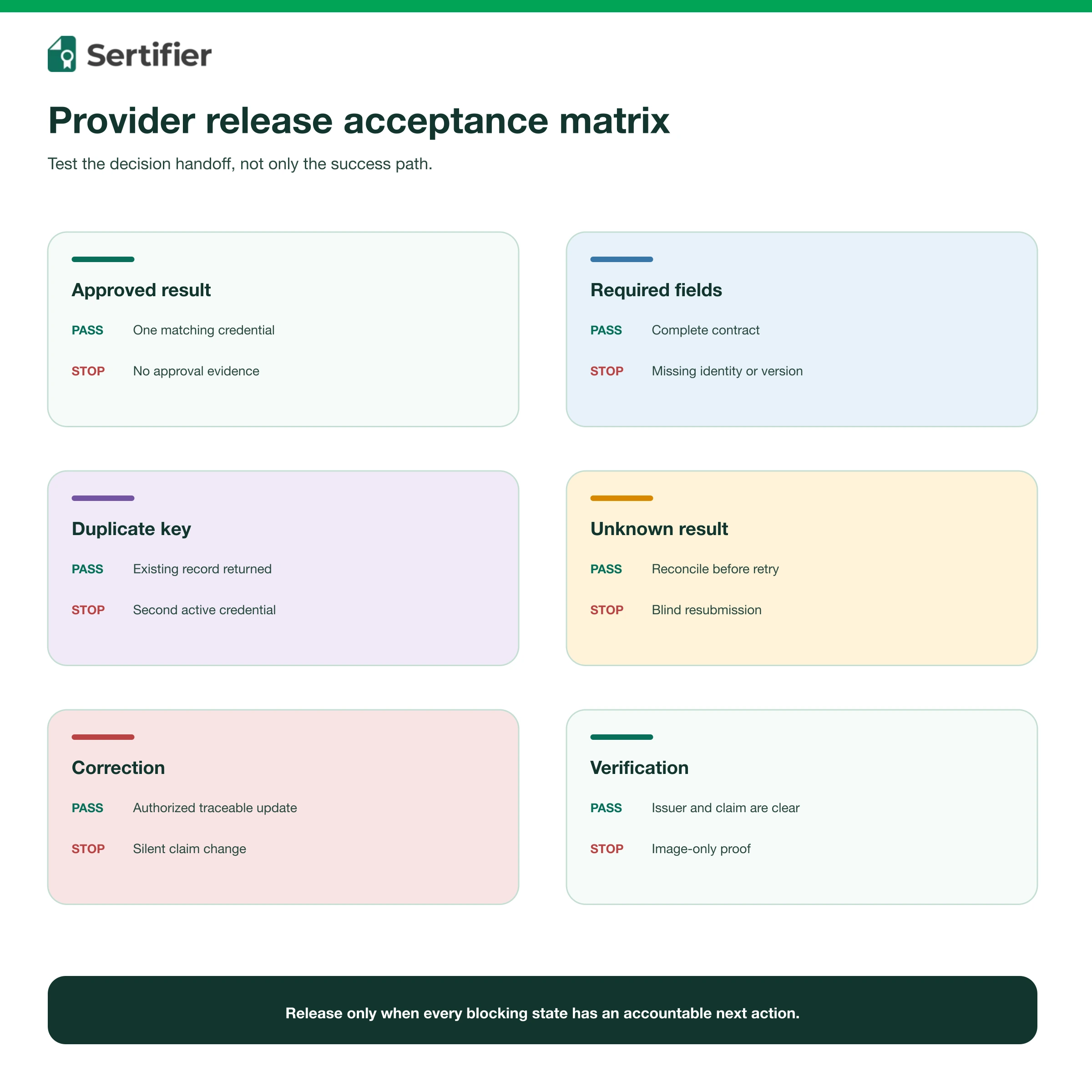
Run the exact provider-to-credential journey with controlled test records. Include a clean pass, missing field, duplicate, failed assessment, approval hold, corrected identity and unknown delivery result. The goal is to prove that every state produces a bounded next action.
| Acceptance test | Evidence to capture | Pass condition | Owner |
|---|---|---|---|
| Clean approved result | Source record and approval | One correct credential is issued | Program and credential operators |
| Missing required field | Rejection result | No credential is issued; reason is actionable | Data owner |
| Duplicate submission | Existing issuance key | No second active credential is created | Integration owner |
| Approval hold | Pending decision | Record remains non-public and unissued | Approver |
| Identity correction | Authorized correction record | Correct person receives the corrected credential | Support and program owner |
| Verification | Logged-out check | Issuer, claim, date and status are understandable | QA owner |
| Delivery exception | Provider and support evidence | Correction and resend do not duplicate issuance | Support owner |
Measure provider operations and credential outcomes separately
Course enrolment, attendance, assessment completion and learner support belong to the training operation. Credential issuance success, recipient access, verification and sharing belong to the credential layer. Keep these measures separate so a healthy issuance rate does not hide a weak learning experience, and a strong course completion rate does not hide broken credential delivery.
Start with operational acceptance: approved records received, valid records issued, exceptions resolved, recipients able to access the credential and verifiers able to interpret it. Add conversion or growth conclusions only when acquisition, behavior and product outcome data can be joined reliably.
Use this pre-release checklist
Before the first live cohort, confirm that:
- The provider, assessor, approver, issuer and verifier roles are named.
- The claim is no stronger than the evidence.
- The program and criteria versions are stable identifiers.
- Required fields and identity rules are documented.
- The issuance path has duplicate and unknown-result controls.
- Corrections and changes require an accountable approval.
- Expiry and renewal follow the underlying claim.
- The verification page communicates the bounded result.
- Delivery and access have a separate acceptance test.
- The program can restore or correct one package without changing unrelated credentials.
Build a governed training credential handoff
Map program versions, evidence, approval, issuance and verification before the first live cohort.
Frequently asked questions
Can a training provider issue a digital credential?
Yes, when it is authorized to make the claim and has evidence that the learner met the stated criteria. In some qualification systems, the training provider delivers learning while a separate awarding organisation authorizes the qualification. The credential must represent the actual role and authority.
Is a course completion record enough for a skill credential?
Not by itself. Completion can support a completion claim. A skill claim needs evidence and an assessment method that actually demonstrates the skill at the stated level.
Should a training credential expire?
Only when the underlying claim is time-bounded or renewal requires fresh evidence. Historical participation or completion may remain valid even when a current authorization expires.
Can automation decide whether a learner is eligible?
Automation can apply a defined eligibility rule and carry an approved result between systems. The program owner remains responsible for the rule, evidence, exceptions and approval authority.
What should a verifier see?
The issuer, recipient reference, achievement, criteria or scope, issue date, current status and a reliable verification route. Private learning records should remain in the systems authorized to hold them.