Digital credentials for professional licensing: status and verification workflow
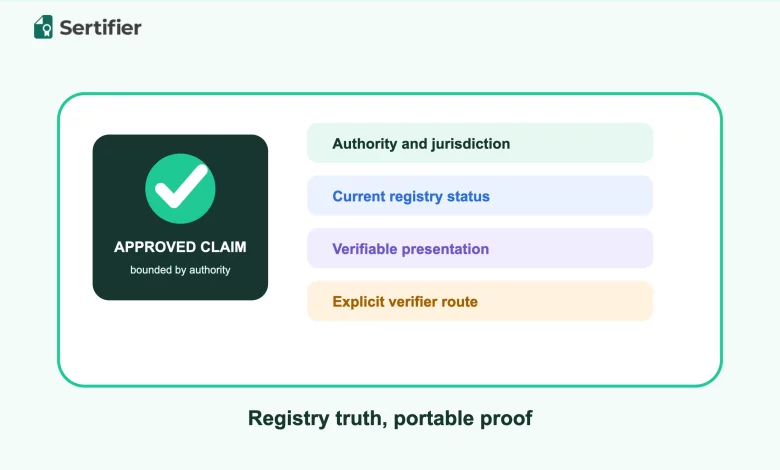
A professional licensing credential can make one approved status easier to present and verify. It should never become a substitute for the competent authority, official registry, jurisdiction rules or current permission to practise.
Design the workflow from the verifier’s decision backward. Name the authority, jurisdiction and licence class, keep eligibility and status in the official systems, issue a bounded digital record only after an authorized decision, and give every verifier a clear route to current status and exceptions.
Short answer: A professional licensing credential should present one approved, jurisdiction-bounded status. The competent authority and official registry remain authoritative for legal scope, conditions and current permission to practise.
Short answer
A reliable professional licensing credential workflow needs eight controls:
- Identify the competent authority and jurisdiction.
- Separate professional qualification, certification and legal licence claims.
- Define the exact licence class, scope and conditions.
- Keep applications, assessment, discipline and status in authoritative systems.
- Issue a digital credential only after an approved decision.
- Publish issuer, licence, dates, criteria and verification context clearly.
- Route current-practice decisions to the official registry.
- Test expiry, renewal, correction, replacement and loss of status before launch.
The digital credential is a portable presentation layer. The licensing body and its registry remain authoritative for whether the person may currently perform regulated work.
Start with the authority and jurisdiction
“Licensed professional” is not a complete claim. A licence is issued under a specific authority, profession, class and jurisdiction, and its meaning can change across borders. The European Commission’s current regulated professions guidance explains that requirements differ by country and that competent authorities may need to recognize qualifications before a person starts work.
Before choosing a badge, certificate or credential field, record:
- The legal or delegated authority that makes the decision.
- The jurisdiction and profession covered by the licence.
- The licence class, level, endorsement or restriction.
- The qualification, examination, experience and other evidence required.
- The effective date, expiry rule and renewal decision.
- The registry identifier and public or controlled lookup route.
- The conditions under which status can change.
- The system and owner that answer a current-practice question.
If these fields are unresolved, a polished credential can make an ambiguous claim look more authoritative than it is.
Separate qualification, certification and licence claims
These records can support each other, but they are not interchangeable.
| Record | What it can establish | What it must not establish by itself |
|---|---|---|
| Education or training record | Learning, attendance or completion under named rules | Legal permission to practise |
| Assessment record | A result against a defined exam, rubric or observed task | Current licence status in every jurisdiction |
| Person certification | A certification body’s decision under a named scheme | Government or regulator authorization unless the scheme has that authority |
| Professional licence | Authority-granted status for a profession, class and jurisdiction | Competence or permission outside its scope |
| Digital credential | A portable, verifiable presentation of one approved claim | Replacement of the official registry or scope decision |
| Employer authorization | Current permission to perform work for one organization | Transferable legal authority in another workplace |
That distinction matters when a certification supports a licensing application but the regulator still owns the legal decision.
For a broader definition of credential types, use Sertifier’s digital credential guide. This page focuses on the narrower authority and status workflow.
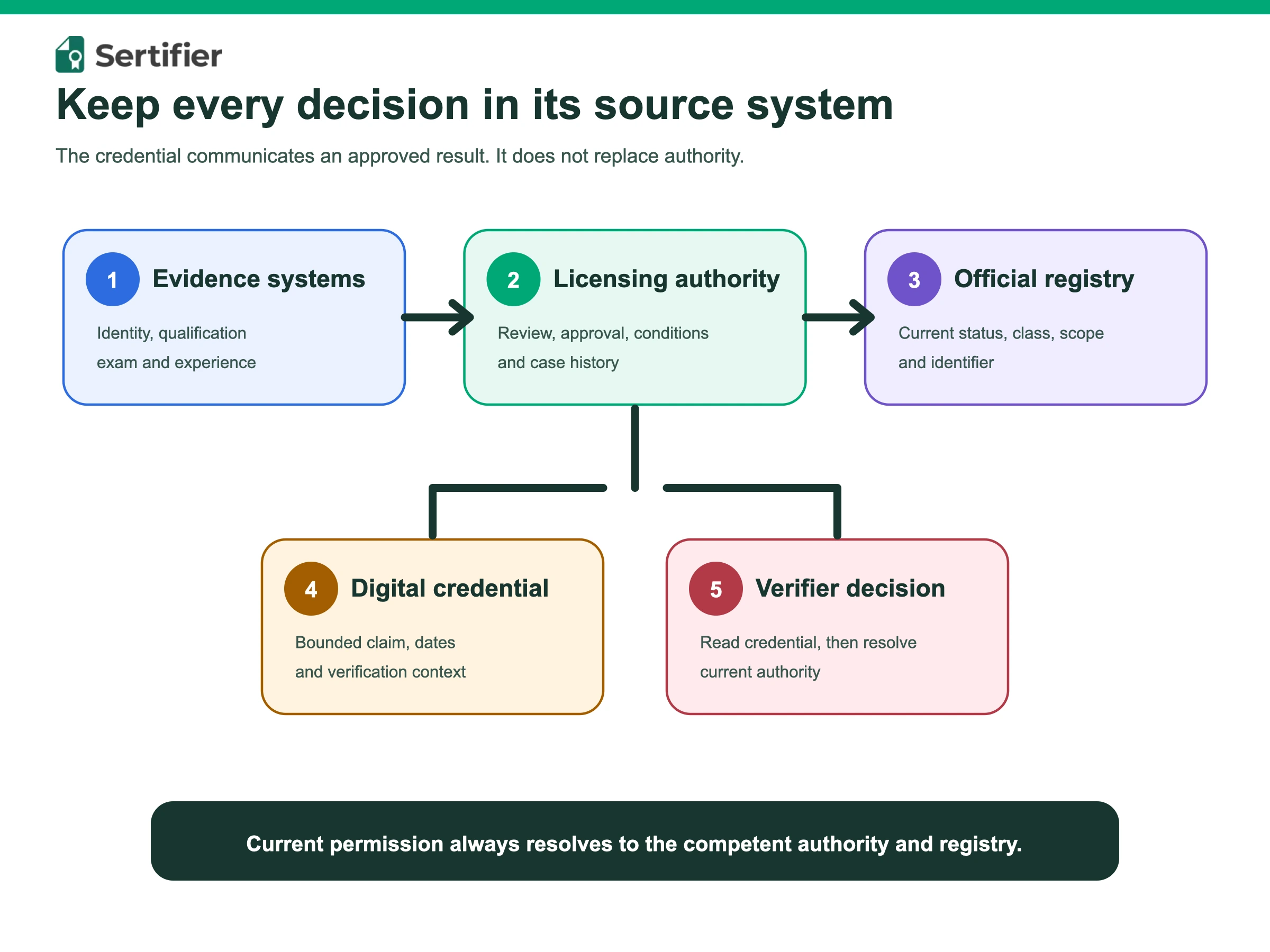
Map every source of truth
One professional status can depend on several systems. Assign each record to the system allowed to create or change it.
| System | Authoritative for | Credential layer may communicate | Boundary to preserve |
|---|---|---|---|
| Application and identity | Applicant, identity proof and submitted declarations | A stable recipient binding after approval | Do not publish sensitive identity evidence |
| Education and assessment | Qualification, exam, supervised practice or experience evidence | Criteria and approved result references | Do not turn a completion event into a licence decision |
| Licensing case system | Review, holds, conditions and decision history | Issuer, licence class, dates and decision identifier | Only authorized roles change status |
| Official registry | Current licence status, jurisdiction and public restrictions | A lookup or verification route | Registry remains authoritative for current practice |
| Digital credential service | Delivery, presentation and credential verification | The bounded approved claim and its lifecycle dates | It does not invent or widen legal authority |
| Employer system | Assignment, local access, supervision and workplace controls | The credential as one decision input | Employer permission is not the licence itself |
NCSBN’s current Nursys licence verification guidance shows this boundary in practice. Participating nursing boards supply licensure and publicly available discipline data to the regulator-operated database, while employers and nurses can look up, verify or monitor that information. The example is nursing-specific, not a universal licensing model.
Match the credential claim to approved evidence
Use the lowest claim strength that the authorized decision supports.
| Proposed claim | Minimum approval evidence | Overclaim to block |
|---|---|---|
| Training completed | All published learning conditions met | Implies certification or licensure |
| Examination passed | Approved result for a named exam and version | Implies the full application is approved |
| Professionally certified | Certification decision under a named scheme | Implies regulator-issued legal authority |
| Licence issued | Authorized licensing decision and registry record | Omits class, jurisdiction or effective date |
| Licence active on a date | Current registry status and validity check | Appears permanently active after the check |
| Renewal approved | Authorized renewal decision and updated registry record | Silently rewrites the history of the prior term |
Sertifier’s current credential campaign guide documents title, description, skills, earning criteria, expiry and supporting document fields. Use only the fields that the licensing authority can support, and keep restricted evidence outside a public credential page.
Design the status workflow before issuance
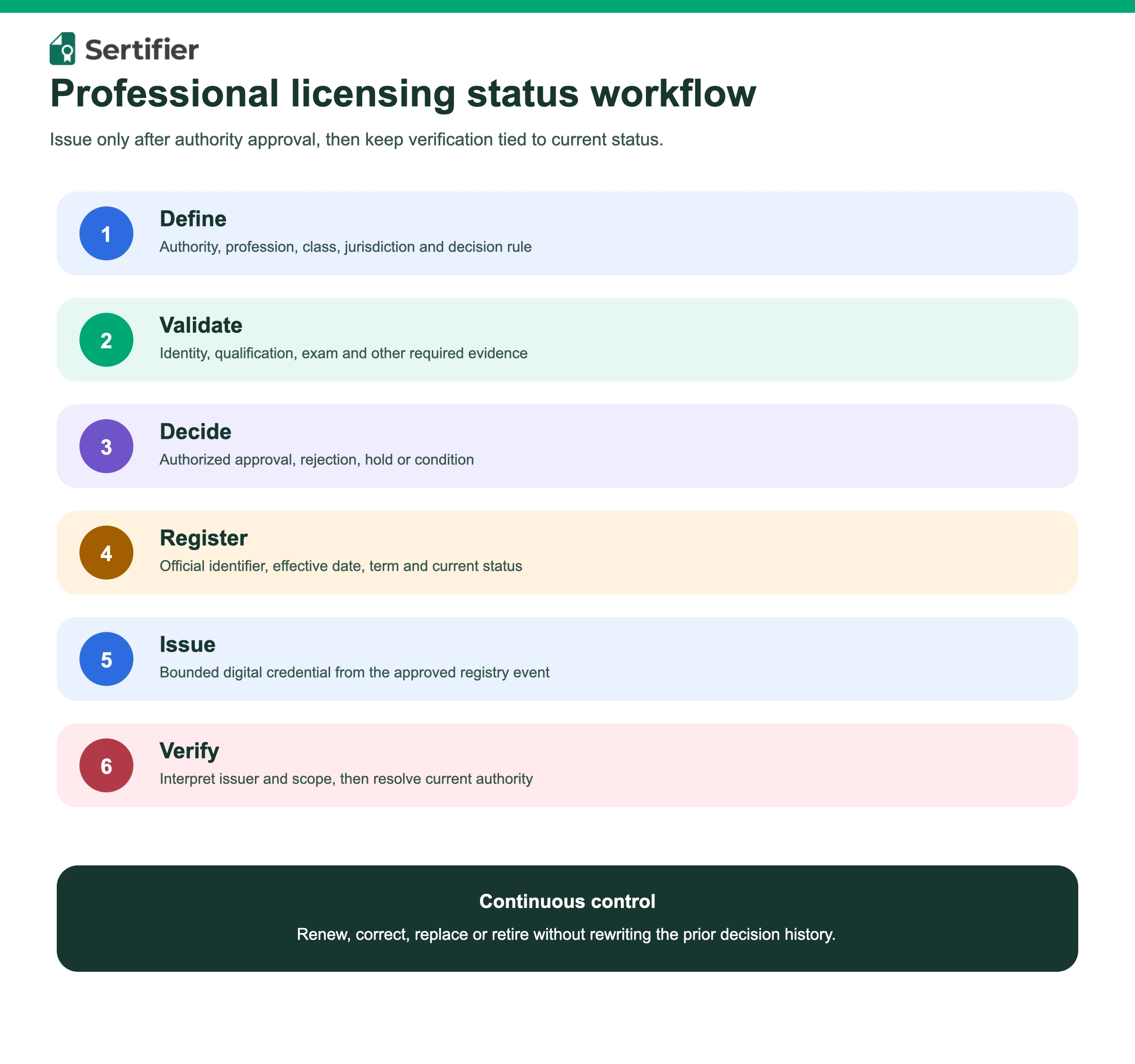
Treat issuance as one transition in a longer case and registry lifecycle.
- The authority publishes the profession, class, jurisdiction and current requirements.
- The applicant submits identity, qualification and other required evidence.
- Authorized reviewers validate evidence and record exceptions or holds.
- The decision owner approves, rejects or defers the licence application.
- The registry creates or updates the official status and identifier.
- A bounded digital credential is issued from the approved record.
- The recipient presents it and the verifier checks issuer, scope, dates and registry context.
- Renewal, correction, replacement or status loss updates the authoritative decision and presentation route.
Do not let an LMS completion, spreadsheet import or integration trigger bypass the licensing decision. If issuance is automated, use the credentialing automation workflow to define validation, approval, duplicate control and reconciliation before connecting a source event.
Publish enough context for a verifier
A verifier should be able to answer five questions without guessing:
- Who issued the credential, and under what authority?
- Which person, profession, licence class and jurisdiction are covered?
- Which decision and criteria support the claim?
- When did the status begin, and when must it be rechecked?
- Where is the authoritative current-status or exception route?
The W3C Verifiable Credentials Data Model 2.0 defines issuer, holder and verifier roles plus validity and credential-status concepts. The standard provides a data model. It does not decide which issuer has legal authority or whether a person may practise in a jurisdiction.
Sertifier’s current verification-page documentation supports a branded verification destination and custom-domain option. Test the exact public or controlled journey used by employers, clients and regulators. A static image, PDF or social post is not enough for a current-status decision.
Handle expiry, renewal and status changes explicitly
Expiry is useful only when it matches the underlying licence term or review rule. Do not add a marketing-driven date that conflicts with the registry.
Sertifier’s current expiry documentation describes fixed and recipient-specific expiry dates, an expired banner and reminder options. Those controls can communicate a known validity term. Any additional suspension, restriction, discipline or practice-status state must remain in the authority’s documented system unless the product capability and data contract have been verified separately.
Define what happens when:
- A renewal application is submitted but not yet decided.
- A licence expires before the renewal decision.
- The authority adds or removes a condition or endorsement.
- A name, identifier or jurisdiction field is corrected.
- A credential was sent to the wrong recipient.
- A prior term remains valid as history but not as current authority.
- A public verifier cannot reach the registry or credential page.
NCSBN’s regulator-operated licence monitoring example includes notifications for licence status, expiration, renewal and public disciplinary information. Use it as evidence that monitoring is a separate operating job, not as a claim that every profession follows the same model.
Use this pre-issuance acceptance checklist
| Gate | Acceptance evidence | Blocking failure |
|---|---|---|
| Authority | Named competent authority and accountable decision owner | Credential vendor appears to grant the licence |
| Jurisdiction | Profession, class, location and scope are explicit | Generic title implies universal permission |
| Evidence | Qualification, assessment and case records are traceable | Course completion silently becomes licensure |
| Decision | Approved, rejected, held and pending states are distinguishable | Issuance happens before authorized approval |
| Registry | Stable identifier and current-status route exist | Static credential becomes the only status record |
| Credential | Issuer, recipient, claim, dates and criteria match the decision | Public fields widen or contradict the licence |
| Lifecycle | Renewal, expiry, correction and replacement rules are tested | Historical record remains presented as current |
| Verification | Normal external journey reaches clear status and escalation | Verifier cannot resolve ambiguity or outage |
Run the checklist with a non-production test record. Save the source evidence, decision, registry result, issued fields and verifier observation separately.
Measure licensing and credential layers separately
Credential delivery is not evidence that the licensing program improved public safety, workforce access or regulatory outcomes.
- Application layer: submissions, completeness, evidence exceptions and review time from the case system.
- Decision layer: approved, rejected, held, conditioned and renewed records from the licensing authority.
- Registry layer: active, expired and other documented current statuses from the official registry.
- Credential layer: issued, delivered, viewed, expired, corrected and replaced presentations.
- Verification layer: successful lookups, unresolved exceptions and escalation outcomes from the verification systems.
- Workforce or public outcome layer: only from the authoritative employer, regulator or research source with a trustworthy join.
For association-issued membership and certification claims, use the professional association credential guide. For machine-to-machine verification, use the credential verification API workflow without assuming that an API response replaces the official licensing source.
Build a bounded licensing credential workflow
Map authority, evidence, approval, registry status, credential fields and verifier routing before automating issuance.
Frequently asked questions
Can a digital credential replace a professional licence registry?
No. It can present an approved claim in a portable and verifiable form, but the competent authority and official registry remain authoritative for current status, jurisdiction, conditions and permission to practise.
Should a professional licensing credential expire?
Use the same validity rule as the underlying approved licence term or status policy. If the registry requires a fresh check rather than a fixed term, direct the verifier to that current-status route.
Is professional certification the same as professional licensure?
Not necessarily. A certification body can attest that a person met a defined scheme, while a regulator or delegated authority makes the legal licensing decision. Some programs connect the two, but the authority and jurisdiction must be explicit.
What should happen while renewal is pending?
Follow the licensing authority’s documented rule. Do not infer that the old credential remains active or that a submitted renewal extends permission. The presentation should direct the verifier to the authoritative current status.
What is the safest first automation?
Automate from an approved registry or decision event after identity, evidence and status validation. Keep a reconciliation path for duplicates, corrections, failed deliveries and records whose authoritative status cannot be confirmed.