Partner training credentials: channel enablement records and renewals
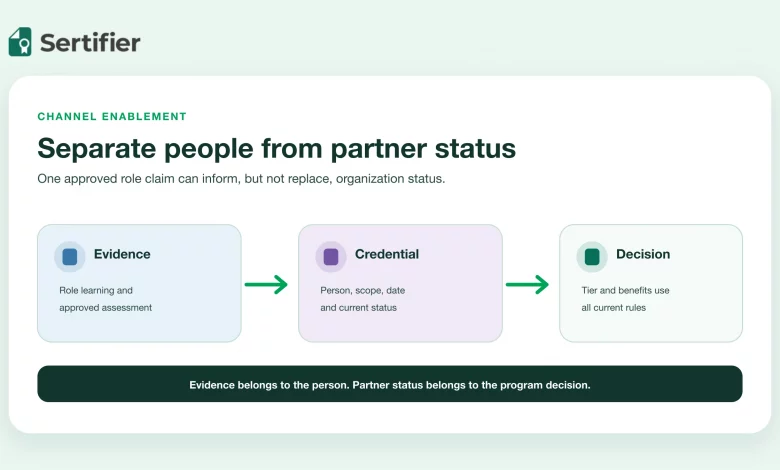
Partner training credentials can make a reseller, distributor, service partner or implementation specialist’s approved capability easier to understand and verify. They should not silently turn one person’s course completion into an organization-wide partner tier, sales authorization or commercial benefit.
Design the system from the channel decision backward. Define the partner role, identify the person and organization, name the required evidence, record the authorized approval, issue a bounded credential, and keep renewal and status changes visible to the systems that make partner-program decisions.
Short answer: A partner training credential should communicate one approved, time-bounded capability claim for one person. Keep partner-organization status, tier eligibility and authorization in the systems that own those decisions, then connect the credential to clear criteria, evidence, verification and renewal rules.
Short answer
A reliable partner training credential workflow needs eight controls:
- Define the partner role and the decision the credential will support.
- Separate the individual learner from the partner organization.
- Publish the training, assessment and experience requirements.
- Keep evidence and approval in their authoritative systems.
- Issue one bounded credential only after an approved result.
- Connect the credential to a current verification route.
- Recalculate organization eligibility from current people and other program requirements.
- Define expiry, renewal, reassignment and departure handling before launch.
The digital credential is a portable person-level record. The partner program, partner relationship management system and other commercial controls remain authoritative for organization status, tier and benefits.
Start with the channel decision
“Partner certified” is too vague for an operating rule. A channel program may need different evidence for sales discovery, solution design, implementation, support, security, industry specialization or program administration. Write the decision first: which person may perform which role, for which product or version, through which date, and under which partner-program rule?
Current Microsoft Partner Center documentation shows why this distinction matters. Its skilling measures count certified people in a partner organization, while the organization-level designation has its own eligibility logic. Current AWS Partner Central guidance similarly explains that training and certification achievements can support tier progression and program eligibility after the individual’s record is associated with the company.
These are program examples, not universal rules. For the exact channel program, record:
- Partner type and legal organization identifier.
- Person, role and relationship to that organization.
- Product, service, market or version in scope.
- Training and assessment requirements.
- Experience, customer or audit evidence when required separately.
- Approval owner and effective date.
- Renewal, replacement and departure rules.
- The system that makes the final partner-status or authorization decision.
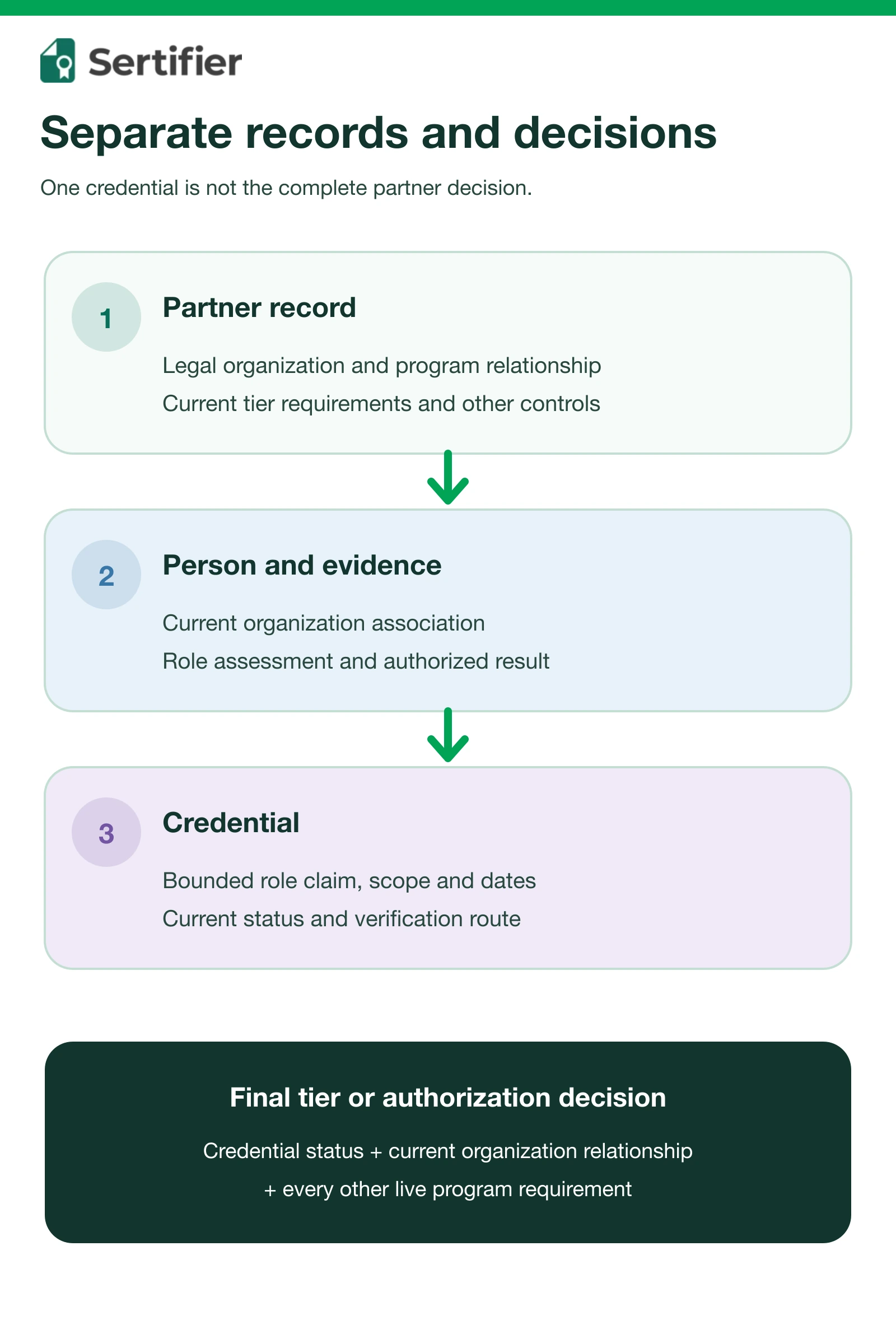
Separate person, organization and authorization records
One partner program can contain several valid records. Treating them as one badge creates avoidable errors.
| Record | What it establishes | What it should not establish by itself |
|---|---|---|
| Partner organization record | The legal entity and its current program relationship | That every employee is trained or authorized |
| Person-to-organization association | Which person currently belongs to or represents the partner | That the person has passed a role requirement |
| Learning record | Course, lab or pathway activity | Independent assessment or commercial authorization |
| Assessment and approval record | An approved result against named criteria | The organization’s full tier or benefit eligibility |
| Digital credential | A portable, verifiable person-level capability claim | A permanent right to sell, implement or support |
| Partner status or tier record | Current organization-level decision across all requirements | Ownership of the person’s learning evidence |
Microsoft’s current profile-linking guidance describes a learner linking a Microsoft Learn profile so certifications can appear in Partner Center and contribute to an organization’s skilling record. AWS documents separate training and certification association rules for company domains and personal certification email addresses. Both examples show that identity association is an explicit control, not something a credential image can prove on its own.
Match the claim to the evidence
Use the lowest claim strength the evidence can support. A broad badge title can outlive its real meaning, especially when products, exams and partner rules change.
| Claim | Minimum supporting evidence | Overclaim to block |
|---|---|---|
| Training participation | Recorded attendance or activity in a named program | Implies completion or proficiency |
| Course completion | All published course conditions met | Implies independent assessment or customer readiness |
| Knowledge | Approved assessment against named objectives | Implies live implementation capability |
| Applied capability | Lab, project, simulation or observed task against criteria | Expands beyond the product, version or task assessed |
| Current role credential | Approved evidence plus an active validity rule | Appears permanent after expiry or organizational departure |
| Organization authorization | Current partner-program decision across people and other requirements | Is reduced to one person’s credential |
The Open Badges 3.0 conformance guide describes achievement information and recipient-specific data such as issuer, achievement date, expiry, results and evidence. Use those concepts to make the person-level claim interpretable. Keep restricted assessment, customer and commercial evidence in the approved source systems.
Define role-based requirements
A single generic pathway rarely fits every partner. Segment requirements by the work a person will perform.
- Sales and discovery: audience, product scope, qualification boundaries and
- Solution or presales: architecture, use-case fit, limitations and handoff.
- Implementation: configuration, integration, testing and change control.
- Support: diagnosis, evidence collection, escalation and customer
- Specialist: industry, security, compliance or product-domain criteria.
- Partner administrator: identity association, reporting and renewal
escalation rules.
communication.
operations.
Sertifier’s current Pathways documentation describes connecting multiple credential campaigns, setting prerequisites, tracking recipient progress and optionally sending credentials after those prerequisites are met. Use a pathway only after the partner program has defined the real role requirements. The existence of a prerequisite feature does not prove that the underlying evidence is sufficient.
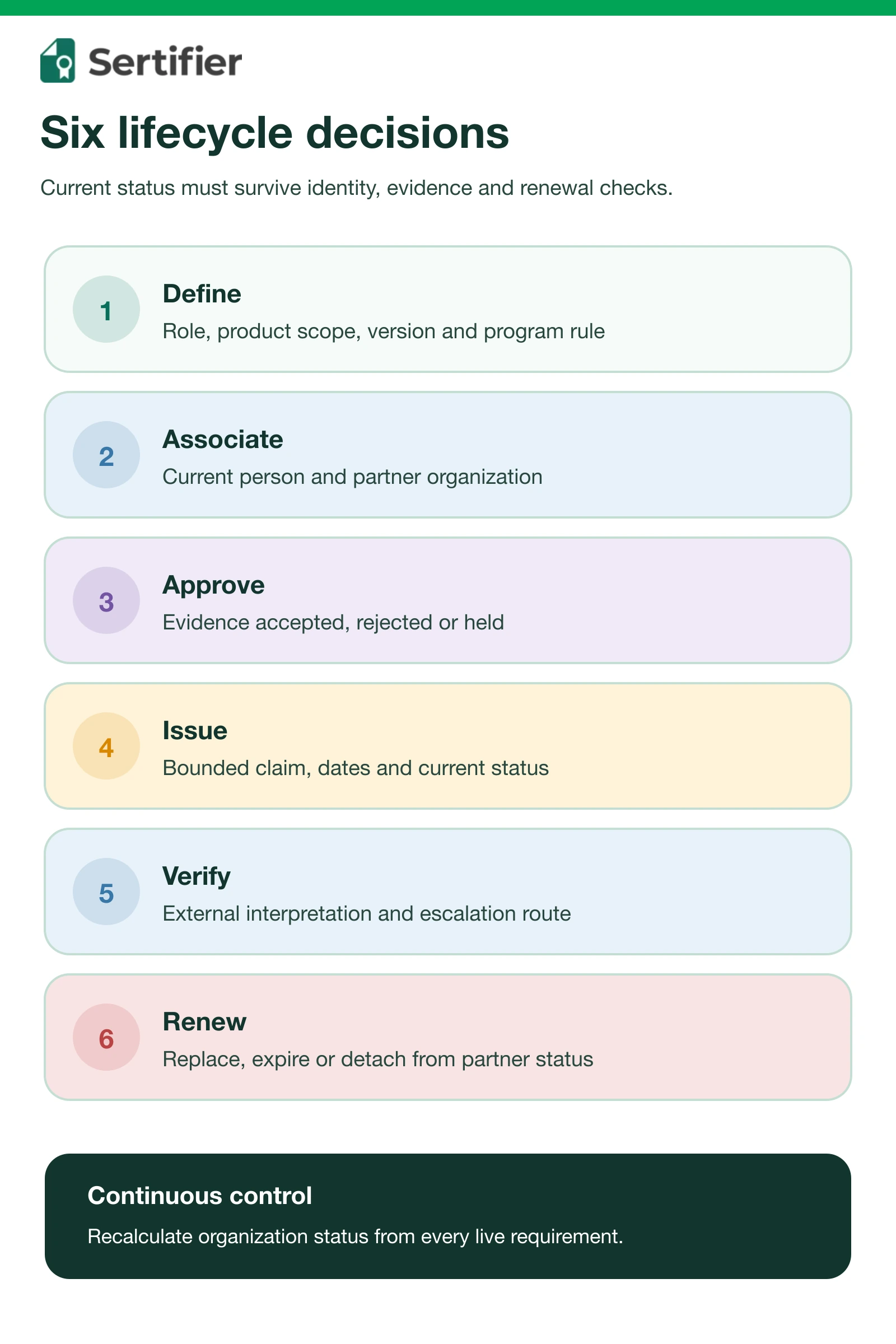
Design the credential lifecycle before launch
Treat issuance as one state in a longer operating cycle.
- The partner program publishes the current role and version requirements.
- The person and partner organization are associated through an approved identity rule.
- Learning, assessment and other evidence arrive from their source systems.
- The authorized owner approves, rejects or holds the result.
- One credential is issued with the bounded role, scope, dates and issuer.
- The recipient accesses the credential and a verifier checks its current status.
- The partner system recalculates organization eligibility from all current requirements.
- Renewal, correction, replacement, departure or program change updates the decision.
Current AWS Partner Scorecard documentation describes organization progression across partner paths and tier requirements. That is a useful boundary: a person-level credential can feed a decision, but the scorecard or partner system owns the organization-level result.
For automated issuance, use the companion credentialing automation workflow to define triggers, validation, duplicate control and reconciliation. Never let a course-completion webhook bypass a required assessment or approval.
Make expiry and renewal explainable
Use expiry when the underlying role, product version, assessment or program rule is time-bounded. Do not add an arbitrary expiry date merely to create renewal activity.
Sertifier’s current expiry-date documentation describes fixed and recipient-specific expiry dates, expired status display and reminder options. Configure those controls only when they match the channel program’s actual validity rule.
Define what happens when:
- The credential approaches expiry.
- The person renews before or after expiry.
- The product or assessment version changes.
- The person changes roles inside the same partner.
- The person leaves the partner organization.
- The organization changes tier or exits the program.
- A credential was issued with incorrect identity or evidence.
An expired credential can remain a useful historical record, but the current partner decision must not treat it as active authorization.
Test verification in the real partner journey
Ask a reviewer outside the credential team to inspect the exact public record and answer:
- Who earned the credential and which organization are they associated with?
- Who issued it and what authority does the issuer have?
- Which partner role, product, version and scope are covered?
- What criteria and approval event support the claim?
- Is the record current, expired, replaced or historical?
- Does organization tier or authorization require other people or evidence?
- Where should a questionable record be escalated?
Sertifier’s current verification-page documentation describes a branded verification destination and custom-domain option. Test the normal partner-portal, customer and recipient routes rather than assuming that a screenshot, PDF or social post communicates current status.
Use this pre-issuance acceptance checklist
| Gate | Acceptance evidence | Blocking failure |
|---|---|---|
| Role | Named partner job, product scope and version | Generic “partner certified” claim |
| Identity | Current person and organization association | Shared email or unverified employer relationship |
| Criteria | Published training, assessment and other requirements | Course completion silently substitutes for assessment |
| Approval | Approved, rejected and held results are distinguishable | Issuance happens before the authorized decision |
| Record | Issuer, role, scope, dates and status are clear | Verifier cannot tell what the person may claim |
| Organization decision | Tier and authorization use all current requirements | One badge grants organization status by itself |
| Lifecycle | Expiry, renewal, reassignment and departure rules exist | Departed or expired person still counts as current |
| Verification | Normal external journey confirms authenticity and status | Only a static image or forwarded file is available |
Run the checklist with a non-production record. Save the source evidence, approval outcome, issued fields, verification observation and organization decision separately.
Measure channel, credential and business layers separately
Do not use credentials issued as proof that the partner program generated revenue or customer value.
- Learning layer: starts, completions, assessments and evidence quality from
- Credential layer: approved, issued, delivered, viewed, expired, corrected and
- Partner layer: associated people, current role coverage, tier requirements
- Customer layer: qualified opportunities, implementations, support quality or
- Commercial layer: pipeline and revenue only from CRM with a trustworthy join.
the learning and assessment systems.
replaced records.
and authorization from the partner system.
customer outcomes only from their authoritative systems.
For internal workforce certification, use the employee certification tracking guide. For customer-learning programs, use the customer education certification guide. Partner enablement needs its own identity and organization boundary because the learner is external to the issuer’s workforce and the organization decision may depend on several people.
Build a verifiable partner enablement workflow
Map partner roles, evidence, approval, credential status and renewal before automating issuance.
Frequently asked questions
Can one person’s credential change a partner organization’s tier?
Only if the partner program’s current rules explicitly make that credential part of the organization decision. Even then, the partner system should verify the person’s current association and all other requirements before changing the organization’s status.
Should partner credentials expire?
Use expiry when product versions, assessments, authorization or program rules are time-bounded. Historical participation or completion records may remain valid as history without being treated as current capability.
What happens when a certified person leaves the partner?
Keep the person’s credential history accurate, but remove the former person-to-organization association from current partner eligibility and role coverage. Do not delete or rewrite the original achievement merely to update the organization record.
Is a digital badge enough for partner verification?
Not if it is only an image. The verifier needs the issuer, recipient, role, criteria, scope, dates and current status, plus a route to the authoritative partner-program decision when organization authorization is involved.