Badging meaning: what digital badging is and how it differs from certificates
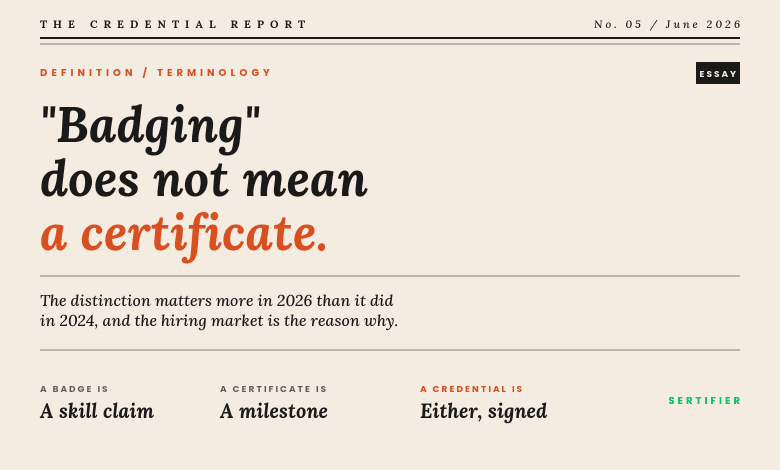
The word “badging” gets used as a synonym for “certificate” by people who issue both and a synonym for “credentialing” by people who write about either. Neither is right. Badging is a specific term with a specific meaning, and the distinction has become more important in 2026 than it was in 2024 because the hiring market started reading the difference.
This essay defines the term, compares it to certificates and credentials, and explains why the precision matters now.
What badging means
Badging is the issuance of a digital badge: a structured, machine-readable claim about a specific skill, competency, or achievement, issued by a recognized authority, backed by evidence, and designed to be displayed by the recipient. The structure matters as much as the claim. A badge is not a picture file. A badge is a JSON-LD document with a visible image attached.
The modern badge specification is Open Badges 3.0 from 1EdTech, which builds on the W3C Verifiable Credentials Data Model. A correctly issued badge under this specification is cryptographically signed by the issuer, owned by the recipient, and verifiable in one click by any third party.
Two things are inherent to badging that are not inherent to issuing a certificate. First, badges are skill-focused (they claim demonstrated competency, not just completion). Second, badges are machine-readable (the metadata can be parsed and acted on by applicant tracking systems, LinkedIn, and AI screening). For the broader explainer on what a digital badge contains, see our digital badges field guide.
Badge vs certificate vs credential
The three terms get conflated. Here is the working distinction.
A certificate recognizes a milestone: a course completed, an event attended, an achievement reached. It can be paper, PDF, or digital. It is typically broader than a single skill (a “Certificate of Completion in Project Management” implies many sub-skills). It can be issued as text content without machine-readable structure.
A badge recognizes a skill: a specific, named, demonstrated competency. It is digital-native. It has machine-readable metadata. It is backed by evidence (assessment, project, work product). Under Open Badges 3.0, it is cryptographically signed.
A credential is the umbrella term covering both. A signed verifiable credential under the W3C VC Data Model can be expressed as either a badge (for skills) or a broader certificate. Every modern badge is a credential. Most modern certificates can be issued as credentials. The terms become precise at the format level, not the conceptual level.
For the underlying field-guide treatment of what a credential is, see our digital credential field guide.
Why the distinction matters more in 2026
Through 2023 and 2024, the hiring market mostly treated badges and certificates as interchangeable. Both were tokens on a resume. A recruiter glanced at either and moved on.
That changed in 2025. As reported by TestGorilla’s State of Skills-Based Hiring 2025, 85% of employers now say they use skills-based hiring, and 53% have publicly removed degree requirements (up from 30% the prior year). The hiring market wants signals about specific demonstrated skills, not just completion of broader programs. Badges, by their definition, supply that signal. Certificates often do not.
The implication for issuers: programs that ship badges in 2026 give their recipients something the hiring market is actively reading. Programs that ship certificates without skill-level granularity give their recipients something the hiring market acknowledges but does not weight. For the broader argument on skills-based hiring and how the gap between policy and practice is closing, see the 85% vs 0.14% paradox.
What badging looks like in practice
A well-designed badging program has six elements.
First, the badge specification is Open Badges 3.0. Anything older sacrifices long-term portability. See Open Badges 3.0 explained for the structural reasons.
Second, the badge names a specific skill, not a course title. “Python Data Manipulation with Pandas” is a skill. “Data Science Bootcamp Week 4” is a course milestone. The first is a badge; the second is a certificate.
Third, the badge is backed by evidence. The recipient passed an assessment, submitted a project, or completed a peer-reviewed work product. The evidence is referenced in the badge metadata.
Fourth, the badge stacks. A single badge is a line item. Five related badges in a domain are a portfolio. Programs designed for stackability outperform programs that issue isolated badges. See our 2026 micro credentials guide for the stackability design pattern.
Fifth, the badge is portable. The recipient can add it to LinkedIn under Licenses and Certifications, embed it in an email signature, link it from a portfolio, and present it on a resume. The portability is enforced by the spec.
Sixth, the badge is verifiable. Any third party who clicks the verification link can confirm authenticity in one click. This is the feature that turns a badge from “a token” into “evidence.”
Common mistakes in badging programs
Three patterns separate badging programs that work from badging programs that quietly fail.
Issuing badges as decorative images. A PNG with the word “Achievement” overlaid is not a badge under the modern definition. It carries no metadata, no signature, no verification path. Recipients save it to a folder and forget. Programs that do this conflate visual design with the credential.
Using badge platforms that issue Open Badges 2.0 in 2026. The 2.0 format depends on the issuer’s URL staying live to verify. If the URL changes, the badge breaks. The 3.0 format signs the credential at issuance so it verifies offline. Programs running 2.0 in 2026 are locking recipients into fragile infrastructure.
Naming badges after courses instead of skills. “Module 3 Complete” is a course event. “Excel Pivot Table Construction” is a skill. Recruiters value the second; the first reads as completion attendance.
Where badging fits in the credential family
If you think of credentials as a family of formats, badging sits at the granular end. Micro credentials are the format-level cousin, and the term overlaps significantly with badging (a modern micro credential is typically expressed as a badge under Open Badges 3.0). Certificates sit one level broader. Degrees sit several levels broader still.
For an issuer planning a 2026 credentialing program, the rule of thumb is to ship badges for individual skills, certificates for completion of broader programs, and stackable badges that roll up into pathways that compete with certificates in scope but exceed them in verifiable granularity.
Frequently asked questions
Is “badging” the same as issuing a digital badge?
Yes. Badging is the verbed form of “issuing a digital badge.” A badging program is a program that issues digital badges to recipients, typically as part of a structured curriculum or training pathway.
Are badges and certificates interchangeable?
No, although they are often presented as such. A badge recognizes a specific skill backed by evidence. A certificate recognizes a milestone or completion. Both can be issued as verifiable credentials, but the format and the implied claim differ. In 2026, hiring teams read the difference.
Does badging require Open Badges 3.0?
For new programs in 2026, yes. The 2.0 format is still functional but loses long-term portability if the issuer URL ever changes. 3.0 verifies offline and is the modern default. See Open Badges 3.0 explained for the structural reasons.
Who issues badges?
Any authoritative body that wants to recognize specific skills. Training providers, universities, corporate L&D teams, professional associations, employer programs, and continuing education providers are the largest categories of badge issuers in 2026.
Next steps
If you are designing a credentialing program in 2026, the rule that matters most is: name the unit. If it is a skill, ship a badge. If it is a completion, ship a certificate. If both, ship both, in the right format for each. See how digital badges work, Open Badges 3.0 explained, or Sertifier pricing if your program is ready to issue verifiable badges this quarter.