Micro credentials in 2026: an issuer’s guide
Reviewed by Arda Helvacılar, CEO of Sertifier, a platform that has issued more than 10 million digital credentials across 70+ countries. Last updated July 2, 2026.
Micro credentials sit in the gap between a course and a degree. They certify one narrow skill, demonstrated through evidence, in a few to a few dozen hours of learning. For an L&D leader, university, or association running short-form credentialing in 2026, the question is not whether to issue them, but how to design a program that learners want, employers trust, and the issuing organization can run at scale.
This guide walks through what a micro credential is and is not, the standards it runs on, how to design a program, how to make recipients want to share it, and how to measure return on investment.
What a micro credential is
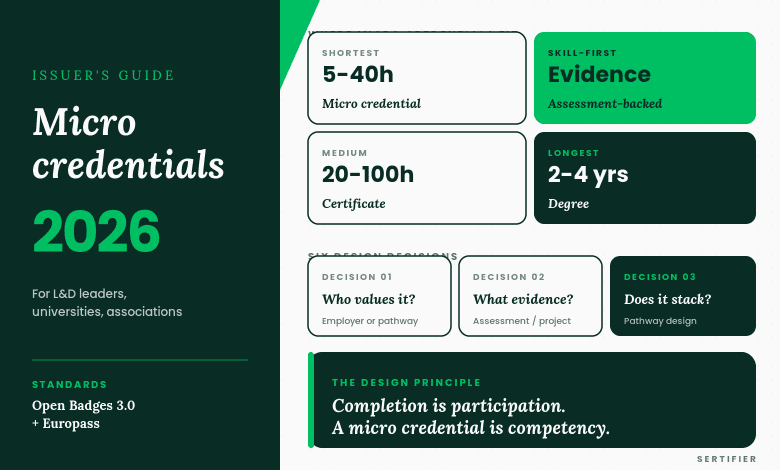
A micro credential is a verifiable assertion that a learner has demonstrated proficiency in a narrowly defined skill or competency, typically through evidence of practice or assessment, and usually completed in 5 to 40 hours of learning. The credential is issued by an authoritative body (training provider, university, employer, professional association) and carries machine-readable data about what was demonstrated.
Three things distinguish micro credentials from adjacent formats. They are narrow rather than broad, evidence-backed rather than attendance-based, and verifiable rather than self-asserted. A degree, by contrast, is broad and integrative. A certificate of completion is often broader and less evidence-driven. A self-listed LinkedIn skill is neither evidence-backed nor verifiable.
The 2026 landscape: who is issuing them and why
The most active issuers of micro credentials in 2026 fall into four categories. Corporate L&D teams use them to recognize specific skill acquisition tied to roles and career paths. Universities use them for continuing education, professional development, and as on-ramps to longer programs. Professional associations use them to recognize continuing professional development and specialty designations. Training providers and bootcamps use them as the primary unit of credentialing for short-form learning.
The driver across all four is the same: skill-based hiring is rising. Employers increasingly select on demonstrated skill rather than degree alone, and micro credentials are the format that maps to this shift.
Anatomy of a micro credential
A well-designed micro credential carries seven elements. The issuer’s identity ties the credential to a recognized body. The recipient’s identity ties the credential to a specific person. The competency or skill name describes what was demonstrated. The criteria describe what the recipient had to do. The evidence references the work product, assessment, or proof reviewed. The issuance date and any expiry date set the temporal boundaries. The signature and verification method allow third parties to confirm authenticity.
When all seven are present and machine-readable, the credential is genuinely portable. Platforms, employers, AI systems, and other institutions can read and act on the credential without further context.
Standards: Open Badges 3.0, W3C Verifiable Credentials, Europass
Three standards are doing the work in 2026. Open Badges 3.0 from 1EdTech is the dominant micro credential standard for skill-based credentials, with cryptographic signing built in. The W3C Verifiable Credentials Data Model is the broader credential standard that Open Badges 3.0 builds on. Europass is the European Union’s framework for credential portability across member states, and Europass-compatible credentials interoperate with Open Badges 3.0.
For an issuer choosing a platform in 2026, Open Badges 3.0 support is the floor. Platforms that issue badges in the older Open Badges 2.0 format limit recipients to hosted-assertion verification, which is fragile. Platforms that issue 3.0 give recipients a credential that verifies offline and ports across systems.
How to design a micro credential program
A program designed around six decisions. First, what are the credentials for, and who values them? An employer or pathway has to want to read them. Second, what is the unit of credentialing? One skill per credential is the safe default. Third, what evidence counts? Assessment, project, peer review, work product. Fourth, what is the assessment rigor? Loose criteria devalue the credential; impossibly strict criteria block adoption. Fifth, what is the time investment for the learner? 5 to 40 hours of learning is typical. Sixth, does the program stack? Five micro credentials in a domain can roll up to a higher-level credential.
The single most common design mistake is conflating completion with competency. A learner who finished the modules of a course has demonstrated participation. A learner who passed an assessment or submitted a reviewed project has demonstrated competency. Only the latter belongs in a skill-based micro credential.
Stackability: from one micro credential to a meaningful pathway
The promise of micro credentials breaks down when each credential is a one-off. The promise compounds when credentials stack into recognizable pathways. A learner who earns five data engineering micro credentials has a portfolio that means something to a hiring manager. A learner with one isolated micro credential has a line item.
Stacking can be designed in two ways. Issuer-defined pathways group credentials into a named track (for example, “Data Engineering Foundations: 5 micro credentials”). Recipient-defined portfolios let the recipient assemble their own collection across multiple issuers, presented through a wallet or profile.
Measuring ROI of a micro credential program
Five measurable outcomes are worth tracking. Issuance volume tells you adoption. Recipient share rate (percentage who add the credential to LinkedIn or share elsewhere) tells you whether recipients see value. Verification rate (how often third parties check the credential) tells you whether downstream consumers value it. Pathway completion rate (for stackable programs) tells you whether the program design holds together. Career-impact correlation (for corporate L&D, internal mobility tied to credential earning) tells you the strategic outcome.
For a credentialing platform to support these metrics, it needs analytics on issuance, recipient activity, and verification events. Without these, ROI conversations remain hand-waved.
Common pitfalls
Programs that fail at scale share a small set of patterns. Issuing certificates of completion and calling them micro credentials. Using a platform that does not support Open Badges 3.0, locking recipients into a closed ecosystem. Skipping evidence and assessment rigor in favor of attendance. Treating micro credentials as marketing collateral rather than as portable assertions about skill. Not designing for stackability from the start, then needing to retrofit pathways after credentials are already issued.
Frequently asked questions
Are micro credentials the same as digital badges?
Digital badges are the visual representation; micro credentials are the underlying credential. A modern micro credential is typically expressed as a digital badge built on the Open Badges 3.0 spec, with the badge image carrying the verifiable claim. The terms are often used interchangeably in practice.
Do micro credentials replace degrees?
No. They complement degrees. Degrees signal broad domain mastery built over years. Micro credentials signal specific demonstrated competencies built over hours or weeks. Both formats serve different decisions and audiences.
How long should a micro credential take?
Typically 5 to 40 hours of learning, with evidence-based assessment. Shorter than that risks trivializing the credential; longer typically belongs in a course-completion certificate or full course credential.
What evidence should back a micro credential?
The evidence should match what a future employer or evaluator would want to see. Passing an assessment, completing a project, peer-reviewed work product, or instructor evaluation are all defensible. Attendance alone is not.
Next steps
For organizations planning a micro credential program in 2026: choose a platform that supports Open Badges 3.0 natively, design for evidence over attendance, design for stackability from day one, and measure recipient share rate as the leading indicator. See what a digital credential is for the underlying mechanics, how digital certificates work, or Sertifier pricing if you are ready to issue micro credentials at scale.
For the hiring-side driver that makes micro credentials matter, see why skills-based hiring closes the policy-practice gap in 2026.