Corporate training courses: 8 types and a selection framework

Short answer: Build a small course portfolio around verified capability, risk and role gaps. Define the behavior, audience, practice, assessment and follow-up evidence before selecting a format or provider.
Direct answer
The most useful corporate training portfolio is not a long catalog. It is a small set of courses tied to verified capability, risk and role gaps. Common course types include onboarding, role-specific skills, leadership, sales and customer success, cybersecurity and privacy, safety and compliance, communication, and digital or AI fluency. Select each course by the behavior it must change, the audience, practice format, assessment method and follow-up evidence.
Start with a learning needs analysis rather than a fashionable topic list. CIPD distinguishes an ongoing learning needs analysis from a one-off training needs exercise and recommends aligning capability gaps with organizational strategy. That principle keeps the portfolio focused on work that must actually improve.
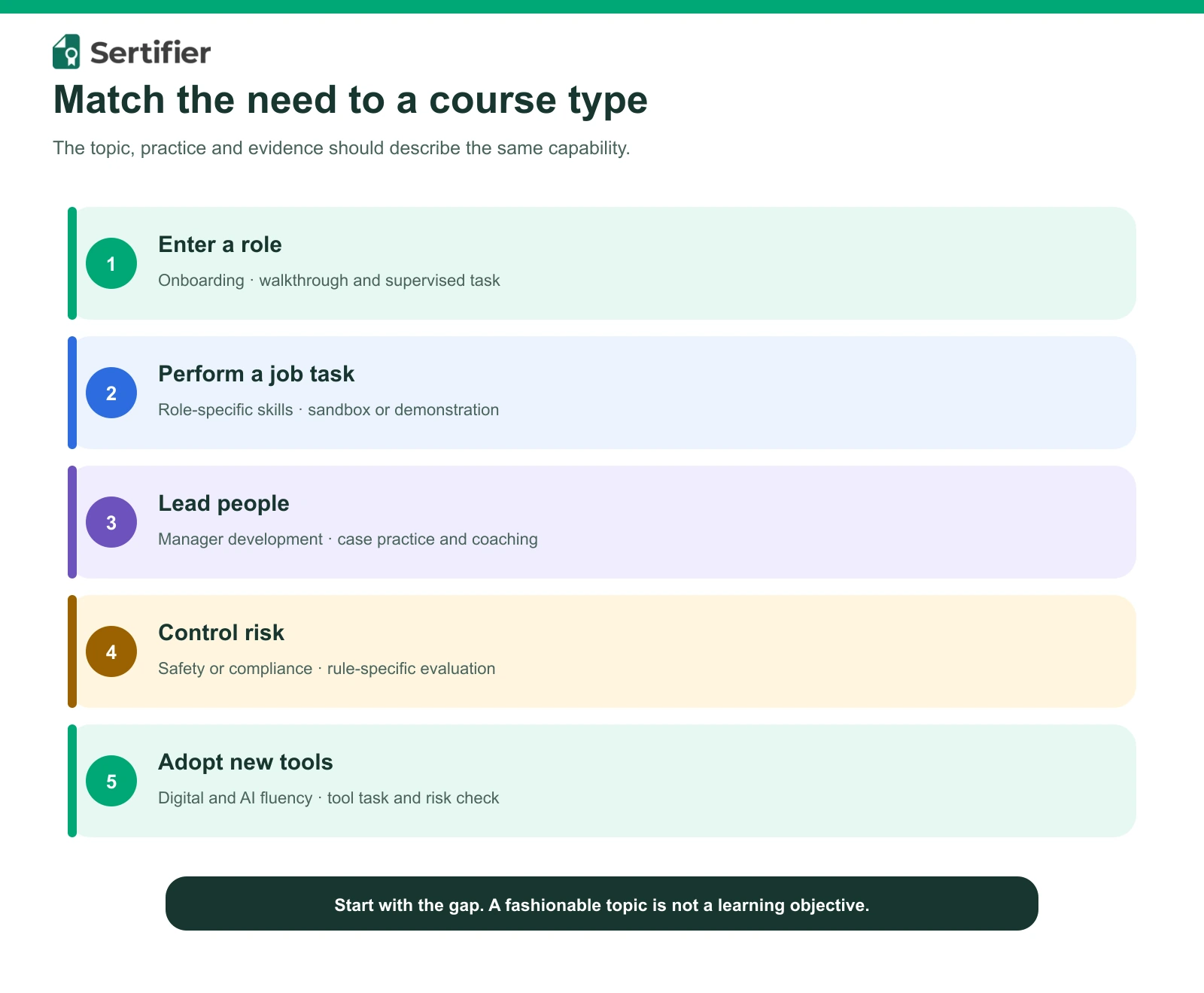
Corporate training course types at a glance
| Course type | Use it when | Useful practice | Evidence to retain |
|---|---|---|---|
| Onboarding | A person is entering a role or organization | Role scenarios, process walkthroughs and supervised tasks | Assigned curriculum, completed steps and manager sign-off |
| Role-specific skills | A job task or tool has a defined proficiency gap | Demonstration, sandbox task or work sample | Rubric, result and assessor |
| Leadership and manager development | Managers need better coaching, delegation or decision habits | Case discussion, role-play and observed coaching | Practice rubric and follow-up observation |
| Sales and customer success | Teams need a defined conversation or account behavior | Call simulation, deal review or account plan | Scored practice and manager reinforcement |
| Cybersecurity and privacy | Risk analysis requires role-appropriate awareness or skill | Phishing simulation, incident scenario or role-based exercise | Version, audience, completion and assessment result |
| Safety and compliance | A law, standard, policy or task requires instruction | Demonstration and job-specific evaluation | Required fields for the applicable rule, not a generic certificate alone |
| Communication and collaboration | Teams need a specific interaction behavior | Feedback exercise, meeting simulation or written work sample | Observable rubric and follow-up |
| Digital and AI fluency | Roles are changing because of tools, data or automation | Tool-based task, output review and risk scenario | Versioned curriculum, task evidence and acceptable-use criteria |
How to choose corporate training courses
1. Start from performance and risk
Define the current state, desired state and people affected. A request such as communication training is too broad. A statement such as managers need to give documented, actionable feedback in monthly reviews identifies the behavior, audience and point of use.
Use several inputs: business priorities, incident and quality data, role changes, employee feedback, manager observation, assessment results and legal or contractual requirements. An isolated course request should not outrank a larger verified gap automatically.
Source: https://www.cipd.org/uk/knowledge/factsheets/learning-needs-factsheet/
2. Define the learning objective before the format
Write what a learner should be able to explain, decide or perform. Then choose self-paced, instructor-led, cohort, simulation, coaching or on-the-job practice. Video length and platform features are secondary to whether the learner can practice the target behavior.
3. Separate attendance from competence
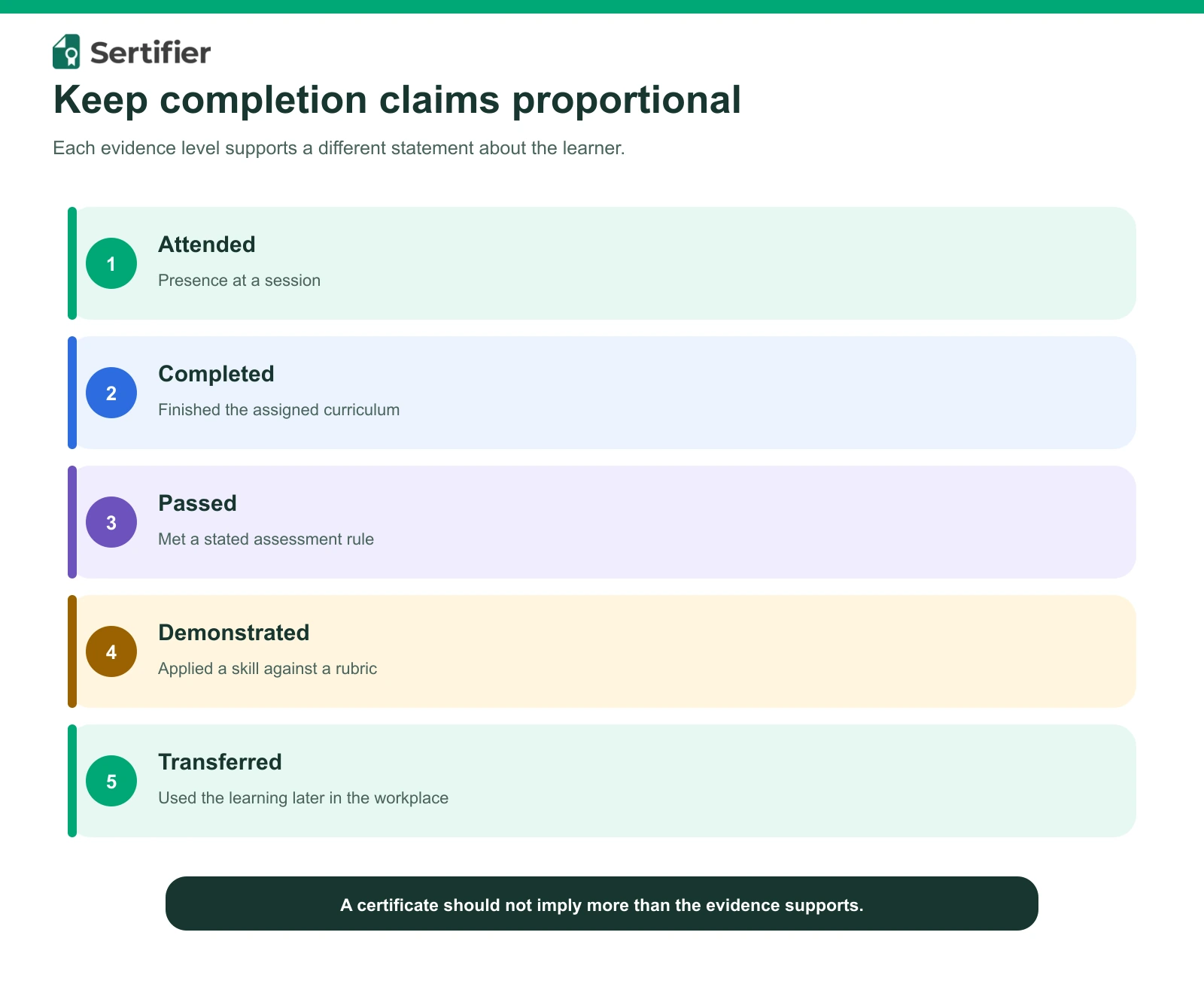
Attendance proves presence. Lesson completion proves completion of assigned content. A quiz can test recall or judgment. A demonstration or work sample can test application. Record the strongest claim supported by the actual evidence and avoid turning participation into a mastery claim.
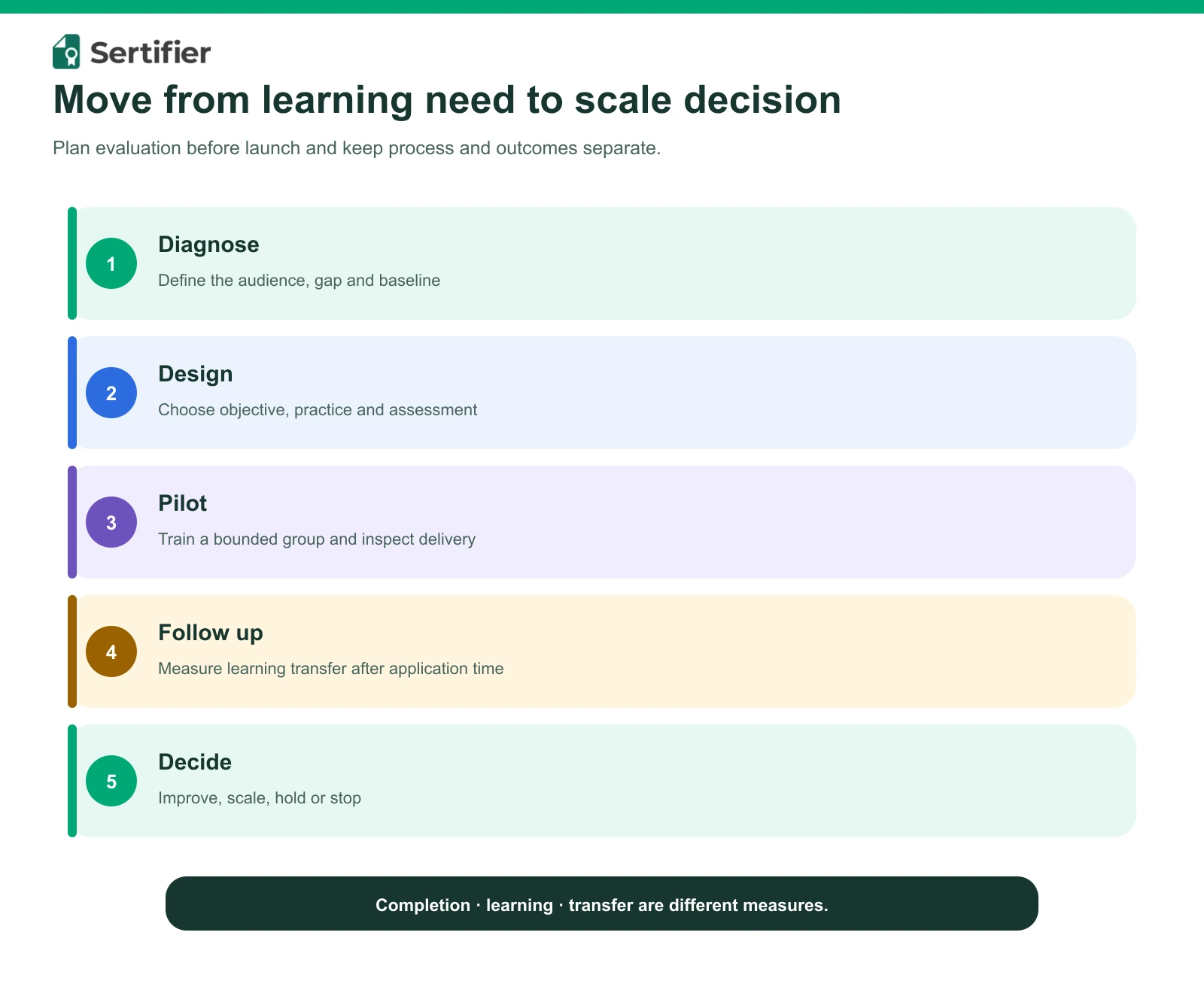
4. Plan evaluation before launch
The CDC recommends deciding the evaluation purpose, questions and data methods early. It distinguishes process questions about content and delivery from outcome questions about learning and transfer to work. Use pre/post assessment where change matters, and delayed follow-up when learners need time to apply a skill.
Sources:
- https://www.cdc.gov/training-development/php/about/evaluate-training-building-an-evaluation-plan.html
- https://www.cdc.gov/training-development/php/about/evaluate-training-measuring-effectiveness.html
5. Define the completion and credential rule
Decide whether the learner must finish lessons, pass an assessment, submit a work sample, receive manager approval or renew later. A certificate or digital badge should expose the issuer, learner, criteria, issue date and verification status needed to understand the claim.
Eight corporate training course types
1. Onboarding training
Onboarding should help a new employee understand the organization, role, systems, policies and early performance expectations. Use a common foundation for everyone, then branch into role-specific tasks. A checklist can show that content was assigned and completed, while manager sign-off or a work sample can support a stronger readiness claim.
Avoid treating orientation attendance as proof that a person can perform the job independently.
2. Role-specific and technical skills
These courses cover the tools, procedures and decisions that belong to a job. They can include product operation, data analysis, equipment use, service delivery or quality processes. The assessment should resemble the work whenever possible: a sandbox task, demonstration, simulation or reviewed output is more informative than a generic satisfaction survey.
Version the curriculum when tools or procedures change so a completion record can be interpreted later.
3. Leadership and manager development
Leadership training can focus on coaching, feedback, delegation, decision quality, conflict response or change leadership. Pick one or two observable manager behaviors per program. Reinforcement matters because managers need opportunities to apply a new behavior with their teams.
Use practice rubrics and delayed observation rather than claiming leadership impact from course completion alone.
4. Sales and customer-success training
Sales and customer-success programs can address discovery, value communication, negotiation, account planning, onboarding or renewal conversations. Link the course to a named stage and behavior. For example, a discovery program might assess whether a learner identifies a customer’s goals, constraints and agreed next step in a simulated conversation.
Keep provider selection and pricing in the dedicated corporate sales training comparison. This owner explains portfolio design rather than repeating that vendor list.
Related guide: https://sertifier.com/blog/corporate-sales-training-programs/
5. Cybersecurity and privacy training
Cybersecurity learning should be risk-based and role-aware. NIST SP 800-50 Rev. 1 describes a life-cycle approach to cybersecurity and privacy learning, including behavior change, metrics and regular improvement. Organization-wide awareness may be paired with deeper role training for people who administer systems, handle sensitive data or respond to incidents.
Do not issue a broad cybersecurity expert claim for completing an awareness module. Describe the actual curriculum and assessment.
Source: https://csrc.nist.gov/pubs/sp/800/50/r1/final
6. Safety and compliance training
Compliance training is not one universal course. Requirements depend on jurisdiction, industry, role, hazard and policy. OSHA notes that many standards require employers to train workers in job-related safety and health topics and that required training must be presented in language and vocabulary workers can understand. EEOC guidance similarly emphasizes understandable policies, responsibilities and complaint procedures for workplace conduct training.
Use the applicable primary rule and legal review to define audience, timing, language, assessment and record fields. Do not infer legal compliance from a generic completion certificate.
Sources:
- https://www.osha.gov/training/compliance
- https://www.eeoc.gov/employers/small-business/employee-training-tips
7. Communication and collaboration training
This category can include feedback, meetings, writing, presentations, negotiation and cross-functional work. Narrow the course to a context and behavior. Run a decision meeting with an agenda, owner and next step is easier to teach and observe than communicate better.
Use scenarios, peer review and manager follow-up. A completion record should name the covered behavior without suggesting that one course proves every communication skill.
8. Digital and AI fluency
Digital and AI training can cover tool use, data literacy, prompt and output review, acceptable use, privacy, bias and escalation. The World Economic Forum’s 2025 employer survey identifies AI and big data, networks and cybersecurity, and technological literacy among the fastest-growing skill areas. Treat that as survey evidence about employer expectations, not a forecast for every company.
Because tools and policies change quickly, use versioned content and short renewal cycles. Assess a realistic task and the learner’s ability to recognize risks, not merely whether a video played to completion.
Source: https://www.weforum.org/publications/the-future-of-jobs-report-2025/in-full/3-skills-outlook/
Build a corporate training portfolio
Use a simple portfolio record for every proposed course:
- business, risk or capability gap;
- target audience and prerequisites;
- learning objective and practice method;
- assessment and passing rule;
- owner, version and review date;
- delivery language and accessibility requirements;
- reinforcement owner and follow-up date;
- completion or credential claim;
- evaluation question and data source.
Prioritize mandatory risk controls and role-critical gaps first. Pilot the course with a defined group, inspect both learning and transfer evidence, then decide whether to improve, scale or retire it.
From completion evidence to a verifiable credential
An organization can issue a credential when the completion rule and evidence are clear. Keep the claim proportional: completed the 2026 manager feedback workshop and passed the scenario assessment is more useful than leadership certified when no broader certification standard was applied.
Sertifier supports the issuance and verification layer for digital certificates and badges after the program owner defines criteria. Relevant reader routes:
- Employee training: https://sertifier.com/solutions/employee-training
- Digital certificates: https://sertifier.com/digital-certificates/
- Digital badges: https://sertifier.com/digital-badges
- Request a demo: https://sertifier.com/request-a-demo
Connect training evidence to a verifiable result
Define the completion and assessment rule first, then issue a credential that communicates the result accurately.
Frequently asked questions
What are the most common corporate training courses?
Common categories include onboarding, role-specific skills, leadership, sales, cybersecurity, safety and compliance, communication, and digital or AI fluency. The right mix depends on verified organizational needs rather than a universal list.
How do you choose a corporate training course?
Define the performance or risk gap, audience, learning objective, practice, assessment and follow-up evidence. Compare formats and providers only after those requirements are clear.
How should corporate training be measured?
Measure delivery, learning and workplace transfer separately. Completion rate shows delivery. Assessments show what learners know or can demonstrate. Delayed observation or work data can show whether learning transferred to the job.
Should every corporate course issue a certificate?
No. Issue a certificate or badge only when the organization has a clear claim, completion rule and evidence worth retaining or sharing. The credential must not overstate attendance as competence or business impact.