Mentoring program certificates: separate mentor and mentee records
A mentoring program can end with several different achievements. A mentor contributed their time. A mentee completed the program’s agreed activities. Someone else finished mentor training but has not yet supported a mentee. Giving everyone the same completion certificate makes those distinctions difficult to understand.
This guide helps workplace and university program coordinators prepare mentoring certificates at the end of a cohort. Use it to decide what each record should say, handle changed pairings and prepare a consistent batch. If you only need a short appreciation sentence, start with the certificate wording examples.
Choose the record before choosing the design
Write the eligibility rule for each recipient group before collecting names for the ceremony. A shared program logo does not make mentor service and mentee completion the same achievement.
| Record | What the coordinator confirms | What it should communicate |
|---|---|---|
| Mentor contribution | The person’s actual role and contribution period | Recognition for mentoring within the named program |
| Mentee completion | The participant met the program’s stated completion requirements | Completion of that program, not automatic professional certification |
| Mentor training | The person completed the specified training requirements | The training completed, without implying a completed mentoring placement |
For example, the University of South Florida’s Relate-A-Bull program links its mentor certificate to attendance at five of six training sessions. That is a program-specific rule, not a universal requirement for mentoring certificates. It shows why a certificate’s title needs the underlying criteria.
Close the program before closing the recipient list
A certificate is one part of a program ending. It cannot replace a final conversation about the mentoring relationship. MENTOR’s youth mentoring closure guidance addresses both planned and unexpected endings, reflection and realistic plans for continued contact. Apply your own program’s closure process before issuing recognition.
For your cohort, separate that relationship review from the administrative decision to issue a certificate. A useful internal closeout record includes the participant’s approved name, role, program edition, relevant dates, decision and the coordinator who confirmed it. Keep personal reflections and private discussions out of the public certificate.
Resolve changed arrangements individually:
- A mentor was replaced: recognize each person’s confirmed contribution period. Do not credit both with the entire program automatically.
- A mentee changed partners: assess completion against the program’s requirements. A change of mentor is not, by itself, evidence of failure or success.
- The relationship continues informally: state the completed program period. Avoid wording that promises continued support from the organization.
- A participant left early: decide whether an accurate participation or contribution record is appropriate under your policy. Do not silently rename it program completion.
Use role-specific certificate wording
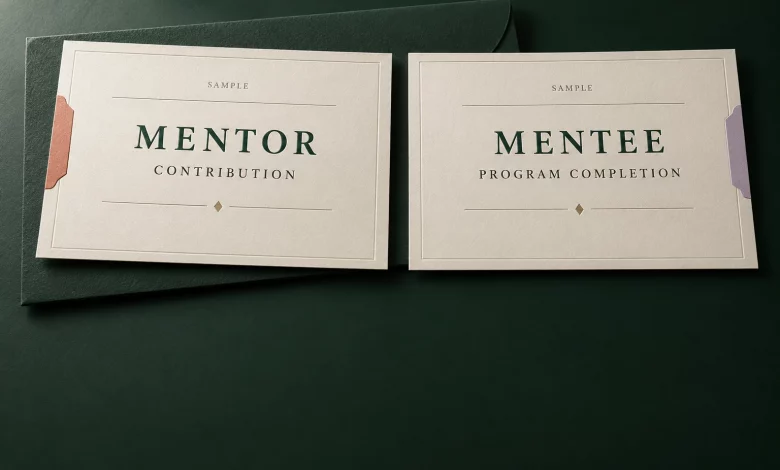
The following samples illustrate two different claims. Replace every bracketed field with approved information. They do not assert measured career progress, promotion or competence.
SAMPLE A
Mentor contribution
[Organization] recognizes [Name] for contributing as a mentor in [Program and cohort] from [Start date] to [End date]. Thank you for supporting the program through [Confirmed contribution].Issued on [Issue date] by [Authorized program representative].
SAMPLE B
Mentee program completion
[Organization] confirms that [Name] completed [Program and cohort] on [Completion date], meeting the program requirements for [Approved activities or milestones].Issued on [Issue date] by [Authorized program representative].
For training, use a title such as “Mentor training completion” and name the course or module set actually completed. If a person both completed training and contributed as a mentor, keep those claims clear even if your program chooses to recognize both.
Build and check the certificate batch
Prepare separate approved recipient groups for distinct wording. Keep unresolved records outside the send list until the coordinator makes a decision. A shared spreadsheet row should never make someone a mentor and a mentee by accident.
Sertifier’s custom attributes guide describes text, date and number fields and matching their values during recipient upload. Use those fields for approved program information; the platform does not decide whether a participant met your criteria.
- Confirm names, recipient roles and the correct cohort.
- Match the wording to contribution, program completion or training.
- Check changed pairings and different participation periods.
- Preview examples with long names and long program titles.
- Open the resulting credential and check the role, dates and statement as a recipient would.
- Keep a contact route for corrections after delivery.
Do not include a mentee’s name on a mentor’s public certificate merely because it appears in the internal pairing record. The program and contribution can often explain the recognition without exposing the other person’s participation.
Keep recognition separate from program outcomes
Certificates issued can tell you how many approved records were delivered. They do not establish that mentoring caused a promotion, improved retention or developed a particular skill. Use your program’s own evaluation to assess those outcomes.
Start with a clear distinction between the roles and a small reviewed batch. For a recurring mentoring program, request a demo to discuss how approved cohort records can become consistent digital certificates.