Medical certificate template: format, wording, verification
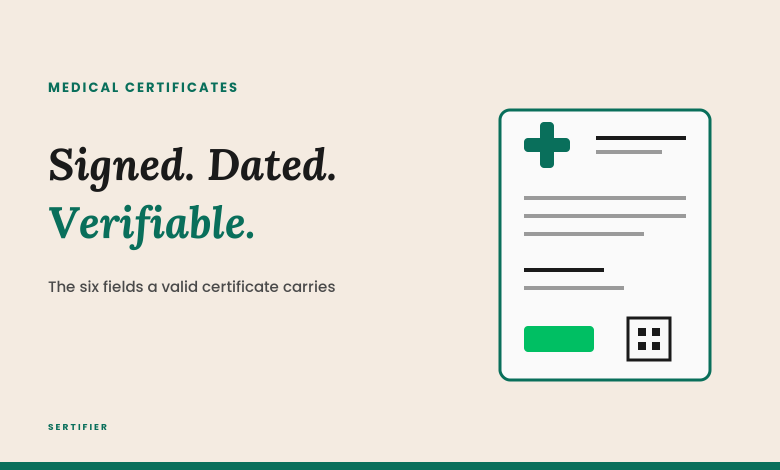
Short answer: a medical certificate is a signed statement from a licensed medical practitioner confirming the result of an examination, most often a person’s fitness for work, school, or sport, or the need for leave. A usable template needs six elements: the practitioner’s details and license number, the patient’s name, the examination date, the medical statement itself, a validity period, and a signature with stamp or verification method. The wording samples below cover the common cases.
What a medical certificate is
A medical certificate documents a professional medical opinion at a point in time. Employers ask for one to justify sick leave or confirm a return to work, schools and sports organizations ask for one to confirm fitness to participate, and licensing bodies ask for one as part of occupational health checks.
Only a licensed practitioner can issue one: a physician, and in many jurisdictions dentists, and other regulated clinicians within their scope. The certificate’s authority comes from the license, which is why the practitioner’s registration details belong on the document.
The medical certificate format
- Practitioner’s full name, clinic or hospital, and license or registration number
- Patient’s full name (and date of birth where local practice requires it)
- Date of the examination, which can differ from the date of issue
- The medical statement: fit, unfit, or fit with restrictions, and for what activity
- Validity or leave period with clear start and end dates
- Signature, official stamp, and ideally a digital verification method
Keep the statement minimal. A certificate for an employer usually does not need a diagnosis, only the practitioner’s conclusion and the period it covers. In the United States, health information in the workplace is protected, and employers’ access to it is limited; the HHS guidance on employers and health information is the reference point. When in doubt, state the conclusion, not the condition.
Wording you can copy
Sick leave
“I examined [patient name] on [date] and certify that they are unfit for work from [start date] to [end date] inclusive. They may resume normal duties on [date].”
Fitness for work
“I examined [patient name] on [date] and certify that they are medically fit to perform the duties of [role]. This certificate is valid until [date] unless their condition changes.”
Fitness with restrictions
“[Patient name] is fit to return to work from [date] with the following restrictions: [restrictions]. These restrictions should be reviewed on [date].”
School or sports participation
“I examined [patient name] on [date] and found no medical condition that prevents participation in [activity]. This certificate is valid for [period] from the date of issue.”
Common mistakes that get certificates rejected
The most frequent failure is a missing examination date, or a certificate that only shows the issue date. The receiver needs to know when the practitioner actually saw the patient. A close second is an open-ended leave period: “until further notice” forces the employer to chase a second document, so state an end date and re-certify if needed.
Two more: an illegible or absent license number, which makes the certificate impossible to verify against a register, and volunteering a diagnosis where only a fitness conclusion was needed, which overshares the patient’s health information.
Paper vs verifiable digital at a glance
| Attribute | Paper or flat PDF | Verifiable digital certificate |
|---|---|---|
| Tampering | Editable, hard to detect | Tamper-evident record |
| Checking authenticity | Phone call to the clinic | Scan the QR code, seconds |
| Status changes | Reprint and resend | Issuer updates the live record |
| Issuing 100 at once | Manual signing and scanning | Bulk issuance from a list |
| Storage for audits | Filing cabinets and inboxes | Issuer dashboard, searchable |
How clinics issue certificates at volume
Occupational health providers running pre-employment checks or periodic screenings issue dozens to hundreds of certificates per week, and the workflow matters more than the layout. The pattern that works: design the certificate once with the fields above, keep the recipient list in a spreadsheet or pull it from the scheduling system, issue in bulk, and let each recipient receive a link they can forward to their employer.
The practitioner still signs off on each examination result; the platform only removes the document assembly, sending, and later the “can you confirm this certificate” calls.
Why clinics are moving to verifiable certificates
Paper medical certificates are easy to alter and hard to check: an employer who wants to confirm one has to call the clinic. A verifiable digital certificate carries a QR code or link that resolves to the issuing clinic’s live record, so the receiver can confirm the issuer, the dates, and the validity without a phone call. It also cannot be edited after issue, which protects the practitioner as much as the employer.
For occupational health providers and clinics that issue certificates at volume, platforms like Sertifier automate this: upload the recipient list, apply the certificate design, and every document goes out as a verifiable digital certificate. If you are new to the concept, start with what a digital credential is, then design your own layout in the certificate template library or with the AI certificate maker.
Frequently asked questions
Who can issue a medical certificate?
A licensed medical practitioner acting within their scope of practice. The certificate should always show the practitioner’s name, workplace, and license or registration number, because that license is what gives the document its authority.
Does a medical certificate need to state a diagnosis?
Usually not. For employers and schools, the conclusion (fit, unfit, or fit with restrictions) and the period are what matter. Health details are sensitive information, and sharing less is the safer default for the patient.
What dates should a medical certificate show?
Three where relevant: the examination date, the issue date if different, and the validity or leave period with a clear start and end. Backdating beyond what the practitioner can clinically justify undermines the certificate.
Are digital medical certificates valid?
Acceptance depends on the receiver and local rules, but a digitally issued certificate with a verification link is generally harder to dispute than paper, because the receiver can confirm it against the issuing clinic’s record instantly.
Next steps
Adapt the wording samples to your letterhead, check the six fields against your current form, and drop anything that overshares. If your clinic issues at volume, a verifiable workflow pays for itself in avoided confirmation calls: Sertifier’s free tier covers small programs, with per-recipient pricing beyond that.