Credential fraud in 2026: 8 numbers L&D and HR teams should know
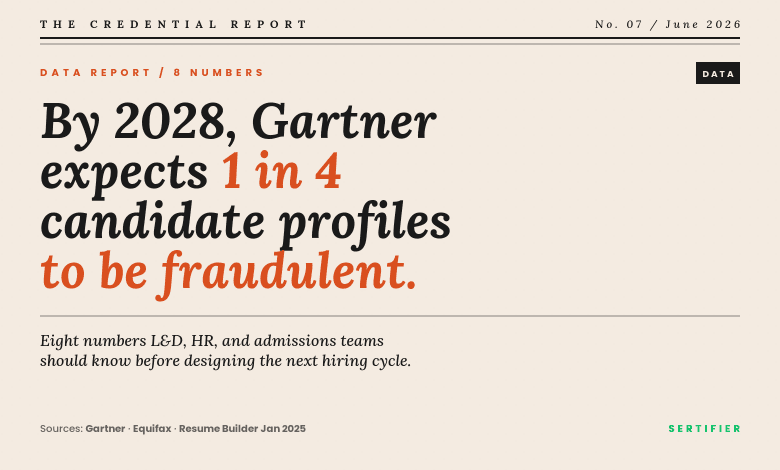
Resume Builder’s January 2025 survey found that 44% of job-seekers admitted to lying during the hiring process. Equifax found 71% of HR professionals have encountered fabricated or misleading candidate information; only 20% of those professionals are confident they can detect it. Gartner now forecasts that by 2028, an estimated 25% of all candidate profiles worldwide may be fraudulent, with some using AI-generated audio and video to bypass screening. The credential side of this problem is the worst-handled and the most fixable.
This data report presents eight numbers L&D, HR, and admissions teams should keep in front of them when designing the next hiring cycle, plus what the data means for credential issuers.
Number 1: 44% admit to lying during the hiring process
Resume Builder January 2025 survey. The figure is candidate self-report (the actual rate is likely higher; people under-report misbehavior in surveys). The implication is that for every 100 candidates entering a pipeline, somewhere between 44 and 60 have included at least one untruth in their application materials.
Not every untruth is a credential. Embellished job titles, overstated years of experience, and fabricated technical skill claims are the most common. But credential fabrication is the highest-stakes subset because it converts to a hiring decision based on a specific, verifiable claim.
Number 2: 24% specifically falsify their resume
Resume Builder January 2025. This is the subset of the 44% above whose lie was on the resume itself (rather than only in interviews). Roughly one in four candidate resumes contains material misrepresentation.
The takeaway for HR teams: pre-interview screening should treat the resume as untested input. The 76% honest-resume rate is good news; the 24% material-misrepresentation rate is the operational floor every hiring system has to handle.
Number 3: 29.6% have lied about their college degree
Standout CV / Resume Builder research. This is the credential-specific subset: of all resume lies, the college-degree lie is one of the most common. The reason is structural: the degree is treated as a hard filter at the top of the funnel. Removing the lie removes the filter.
The corollary number: 54% of the people who lied about their college degree told employers they had a degree when they did not. The other 46% misrepresented the institution, the field, or the date of conferral.
Number 4: 71% of HR pros have encountered fabricated information
Equifax research. This is the lifetime-exposure number. Among working HR professionals, more than 7 in 10 have personally seen at least one candidate submission with material fabrication.
The number is high because the experience aggregates across the career. But it confirms that fraud is not a tail risk; it is a routine operational concern.
Number 5: Only 20% of HR pros are confident in their ability to detect fraud
Equifax research. This is the most damaging number in the dataset. 80% of HR professionals are not confident that the screening process they run will catch fraud when present. The mismatch between encounter rate (71%) and detection confidence (20%) is structural and is the reason fraud rates persist.
Closing the gap requires verification infrastructure that does not depend on HR judgment. Verifiable credentials under Open Badges 3.0 close it directly: the verification is cryptographic, not interpretive. For the structural explainer, see what a digital credential is.
Number 6: over 3 in 4 employers found candidate discrepancies in screening
HireRight’s 2025 Global Benchmark Report, based on responses from more than 1,000 HR, risk, and talent acquisition professionals, found that more than three quarters of businesses uncovered candidate discrepancies during screening in the past 12 months. Discrepancies range from mismatched employment dates and overstated tenure to undisclosed criminal records and unearned degrees.
The implication: background checks work, when run. The gap is the share of hires that do not get a check before offer, which is meaningful for non-regulated industries and roles below the executive tier.
Number 7: 23.2% of job applicants flagged as a potential fraud risk in Q4 2025
September-November 2025 screening data reported by Huntress. Nearly one in four applicants triggered at least one fraud signal during automated screening. This is current rate, not lifetime exposure, and it has been trending upward.
The upward trend is the troubling part. AI-driven application automation is making fabrication easier and cheaper to produce at scale; the same AI tools detect a meaningful fraction but not all of it.
Number 8: Gartner forecasts 25% of candidate profiles will be fraudulent by 2028
Gartner forecast. This number includes AI-generated synthetic identities (deepfake video interviews, fabricated entire careers, manufactured references). If the forecast is right, the next 24 months will be when verification infrastructure shifts from optional to mandatory for any role with meaningful credential requirements.
The argument for verifiable digital credentials becomes urgent in that light. A signed Open Badges 3.0 credential is one of the few signals that survives the synthetic-identity threat, because it carries cryptographic proof tied to the issuer’s controlled key. Forgery in the AI-generation sense becomes mathematically impractical.
What the eight numbers mean for issuers
For credential issuers (universities, training providers, professional associations, employers running internal L&D), the strategic implication is straightforward. The recipients of your credentials in 2026 are operating in a hiring market where 1 in 4 applicants is at fraud risk and only 1 in 5 HR pros is confident in detection. The credential you issue is either part of the verification solution or part of the noise.
Programs that issue Open Badges 3.0 verifiable credentials give recipients a signal that survives the fraud problem. Programs that issue PDFs or 2.0 hosted assertions give recipients a signal that does not. For the platform-selection angle, see our 2026 buyer’s guide on which platforms actually ship genuine 3.0 with cryptographic signing.
What the eight numbers mean for HR teams
Three operational changes follow from the data.
First, treat resumes as untested input. The 24% material-misrepresentation rate is the operational floor. Do not let the resume be the load-bearing element of any hiring decision; let verification be.
Second, weight verifiable credentials higher than unverifiable claims. A LinkedIn-listed skill carries no verification load; a signed Open Badges 3.0 credential does. Closing the 20% detection-confidence gap means weighting the credentials that come with proofs.
Third, build verification into the workflow at the screening tier, not the offer tier. By the time you are at offer stage, you have invested interview hours in a candidate; reversing on credential fraud at that point is expensive. Catching it at screening is the operational efficiency win.
For the broader argument on how the hiring market is rewriting around verifiable credentials, see the 85% vs 0.14% paradox.
Frequently asked questions
How common is credential fraud in 2026?
Common enough to be operational. 44% of candidates admit lying during the hiring process (Resume Builder Jan 2025), 29.6% have lied about a college degree specifically, and more than 3 in 4 employers found candidate discrepancies during screening in the past year per HireRight. Gartner forecasts 25% of candidate profiles globally will be fraudulent by 2028.
Why is HR detection rate so low?
Equifax research shows only 20% of HR professionals are confident in their ability to detect fraud. The reason is structural: the screening process depends on HR judgment about documents that look credible. Verifiable digital credentials remove the judgment requirement by replacing it with cryptographic verification.
Are verifiable credentials immune to fraud?
No credential is immune. But Open Badges 3.0 credentials are signed by the issuer’s controlled cryptographic key, which makes forgery mathematically impractical without compromising the issuer’s key infrastructure. This is a meaningfully higher bar than forging a PDF or fabricating a 2.0 hosted assertion.
What should HR teams do this quarter?
Add credential verification to screening, not just to offer. Weight verifiable credentials higher than unverifiable claims. Train recruiters on the explicit rule that an Open Badges 3.0 credential carries the same evidentiary weight as a degree requirement when verified.
Next steps
For HR teams: write the explicit weighting rule that gives verifiable credentials parity with degree requirements. For credentialing programs: ship Open Badges 3.0 with cryptographic signing so your recipients carry signals that survive the fraud problem. See our buyer’s guide for platform selection or Sertifier pricing if your organization is ready to issue verifiable credentials this quarter.