Corporate training trends for 2026: six evidence-based signals
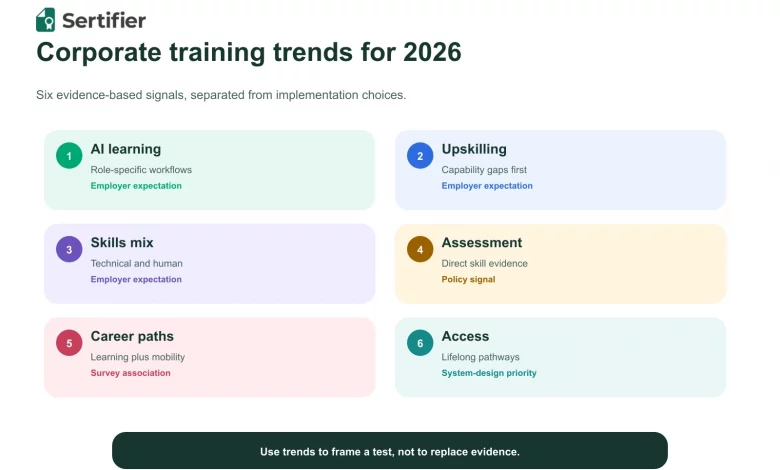
Short answer: The strongest 2026 signals are role-specific AI learning, continued upskilling, technical and human skills together, skills-first assessment, career-linked learning and accessible lifelong-learning pathways. Treat them as evidence-bounded signals, not universal outcomes.
Direct answer
The most defensible corporate training trends for 2026 are role-specific AI learning, continued investment in upskilling, a combined focus on technical and human skills, skills-first assessment, stronger links between learning and career development, and more accessible lifelong-learning pathways. These are signals, not universal outcomes.
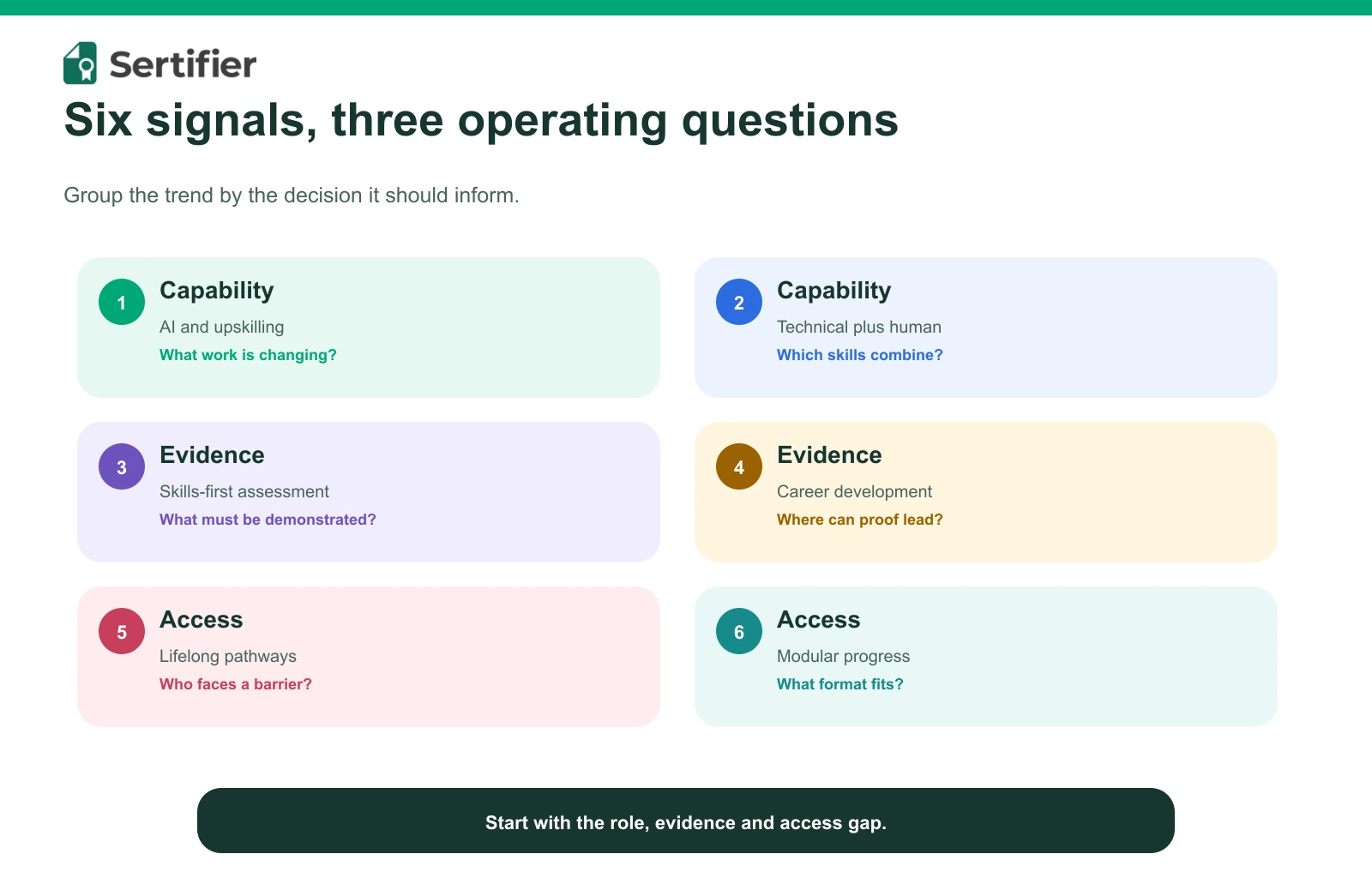
The practical shift is from publishing a large course catalog to building a measurable capability system: define the work that is changing, identify the people who need support, provide practice, assess the intended skill, record the evidence and review whether the learning transfers to work.
How this trend review was built
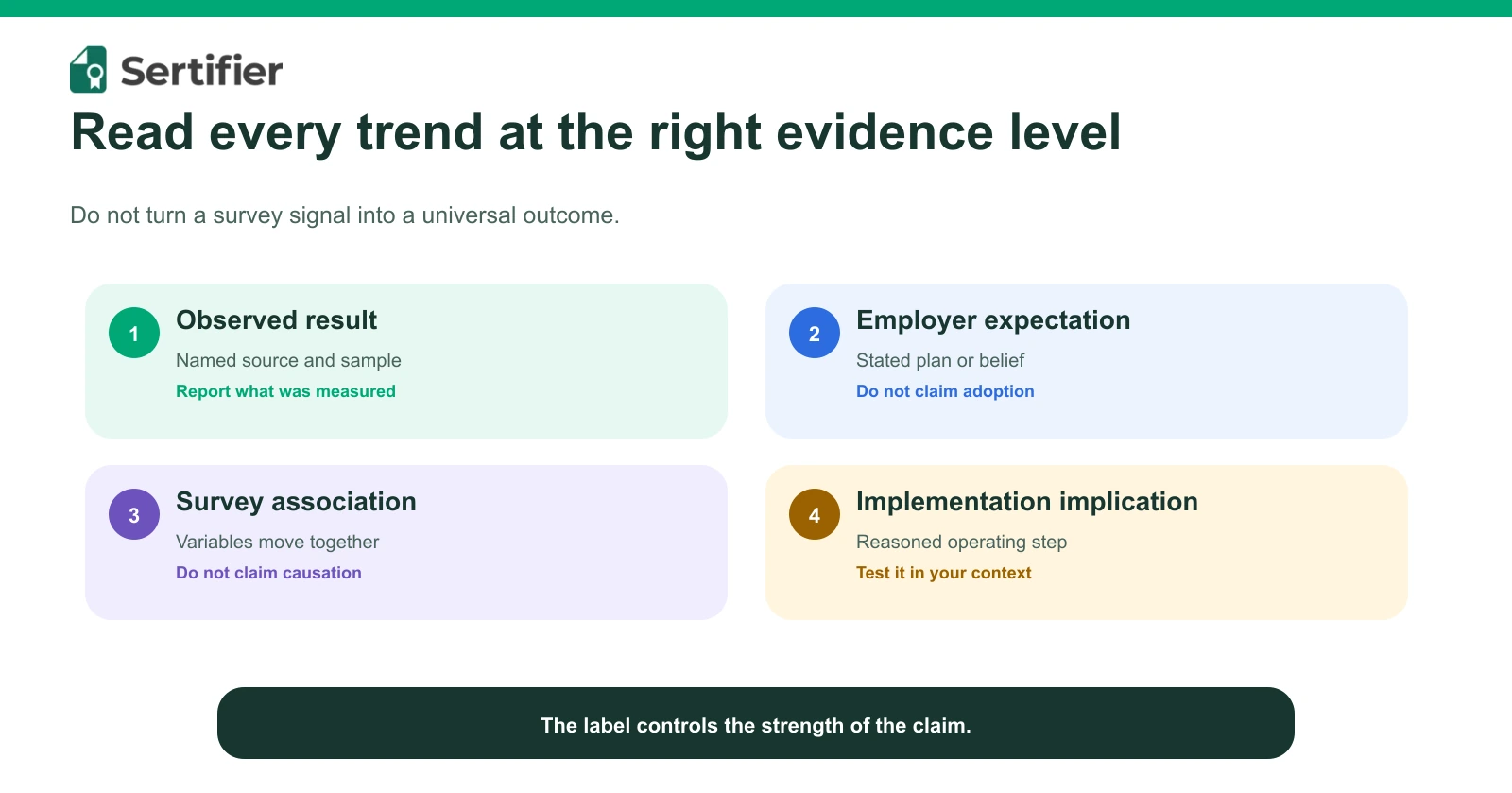
This article uses current reports from the World Economic Forum, OECD, LinkedIn Learning and Microsoft. Each signal is labeled by evidence type:
- Observed: a published result from the named source.
- Employer expectation: what surveyed employers or leaders say they plan
- Implementation implication: a reasoned action for an L&D team, not a
or expect, not proof that every organization has adopted it.
measured market fact.
Survey samples, definitions and dates differ. Figures should not be combined as if they came from one population, and associations should not be described as causal results.
Corporate training trends at a glance
| Signal | Evidence type | What it means for an L&D team | Confidence |
|---|---|---|---|
| Role-specific AI learning | Employer expectations and cross-source survey evidence | Train for real tasks, controls and judgment instead of generic tool tours | High that demand is rising; impact depends on role and implementation |
| Upskilling as a workforce strategy | Employer expectation | Connect learning investment to an explicit capability gap and target population | High for stated plans, not universal execution |
| Technical and human skills together | Employer expectation | Pair technology learning with analysis, communication, leadership and resilience | High for expected skill direction |
| Skills-first assessment | Employer expectation and policy analysis | Use work samples or assessments when the claim is proficiency, not attendance alone | Medium to high; practices vary by role and market |
| Learning linked to career development | Survey association | Connect learning paths to coaching, mobility and visible opportunities | Medium; reported association is not proof of causation |
| Accessible lifelong-learning pathways | Policy and adult-learning evidence | Reduce time, cost, information and accessibility barriers; support modular progress | High as an access and system-design priority |
1. AI learning becomes role-specific
The World Economic Forum’s Future of Jobs Report 2025 says surveyed employers expect AI and big data to be the fastest-growing skill area through 2030. Microsoft’s 2025 Work Trend Index reports that leaders expect work involving AI agents to expand and argues that organizations need employee training alongside tool adoption.
Those sources support increased attention to AI capability. They do not prove that one AI course, one vendor or one learning format improves performance in every organization.
Implementation implication: define a small number of role workflows before selecting training. For each workflow, specify acceptable inputs, human review, security or privacy boundaries, failure cases and the evidence a learner must produce. A completion record can show participation; a scored work sample is better evidence when the intended claim is applied proficiency.
Sources:
- https://www.weforum.org/publications/the-future-of-jobs-report-2025/in-full/3-skills-outlook/
- https://blogs.microsoft.com/blog/2025/04/23/the-2025-annual-work-trend-index-the-frontier-firm-is-born/
2. Upskilling remains a central workforce strategy
In the World Economic Forum’s employer survey, upskilling the workforce was the most commonly anticipated workforce strategy for the 2025 to 2030 period. The same report says respondents viewed skills gaps as a major barrier to business transformation.
These are employer expectations from the report’s sample. They are useful for planning, but they are not evidence that every employer has funded, delivered or measured an upskilling program.
Implementation implication: start with a capability gap rather than a course count. Record the affected role, current evidence, desired behavior, practice environment, assessment and owner. This turns more training into a decision that can be evaluated.
Source: https://www.weforum.org/publications/the-future-of-jobs-report-2025/in-full/4-workforce-strategies/
3. Technical and human skills are planned together
The Future of Jobs Report 2025 places technological literacy, AI and big data, and networks and cybersecurity among skills expected to grow in importance. It also highlights analytical thinking, creative thinking, resilience, flexibility, leadership and lifelong learning.
The signal is not that technical learning replaces human capability. The reported direction suggests that job performance increasingly depends on both.
Implementation implication: avoid pathways made only of software features. For example, an AI-supported customer workflow may require tool operation, source evaluation, communication, escalation and judgment. Map each assessment to the actual skill claim.
Source: https://www.weforum.org/publications/the-future-of-jobs-report-2025/in-full/3-skills-outlook/
4. Skills-first assessment receives more attention
The World Economic Forum reports that work experience remains a common expected assessment mechanism and that surveyed employers also expect to use direct skills assessments. The OECD Skills Outlook 2025 discusses skills-first labor market practices, transparent assessment, recognition and credential portability as part of improving mobility.
This does not make every short course or digital credential equivalent to a degree, license or workplace performance result. The strength of a credential depends on its issuer, criteria, assessment and evidence.
Implementation implication: separate four records:
- enrollment;
- participation or completion;
- assessed knowledge or skill;
- application or performance in work.
Issue a certificate or badge whose description matches the layer actually verified. Do not use attendance evidence to imply demonstrated mastery.
Sources:
- https://www.weforum.org/publications/the-future-of-jobs-report-2025/in-full/4-workforce-strategies/
- https://www.oecd.org/en/publications/oecd-skills-outlook-2025_26163cd3-en.html
5. Learning connects more closely to career development
LinkedIn Learning’s 2025 Workplace Learning Report combines survey and platform data in a career-development index. It reports that organizations classified as career-development champions are more likely to describe themselves as further ahead in generative-AI adoption.
That is an association in LinkedIn’s analysis, not proof that career programs caused AI adoption or business performance.
Implementation implication: show learners where a pathway can lead. Connect learning to coaching, internal roles, projects or mobility criteria. Give managers a clear reinforcement role and make the evidence required for the next step visible.
Source: https://learning.linkedin.com/resources/workplace-learning-report/share-insight-1
6. Access and lifelong learning become design requirements
The OECD Skills Outlook 2025 argues for strong adult-learning systems and notes that people who could benefit most may face barriers involving time, cost and information. Its Trends in Adult Learning report also warns that short, compliance-led participation may be insufficient for deeper upskilling needs.
The implication is not that short learning is inherently ineffective. A short module may be appropriate for a narrow task. The learning design and evidence should match the capability gap.
Implementation implication: provide realistic time, accessible formats, clear prerequisites and modular progress. Monitor participation and completion by relevant learner groups so an average rate does not hide an access problem.
Sources:
- https://www.oecd.org/en/publications/oecd-skills-outlook-2025_26163cd3-en/full-report/widening-opportunities-by-investing-in-21st-century-skills_762bbcca.html
- https://www.oecd.org/en/publications/trends-in-adult-learning_ec0624a6-en.html
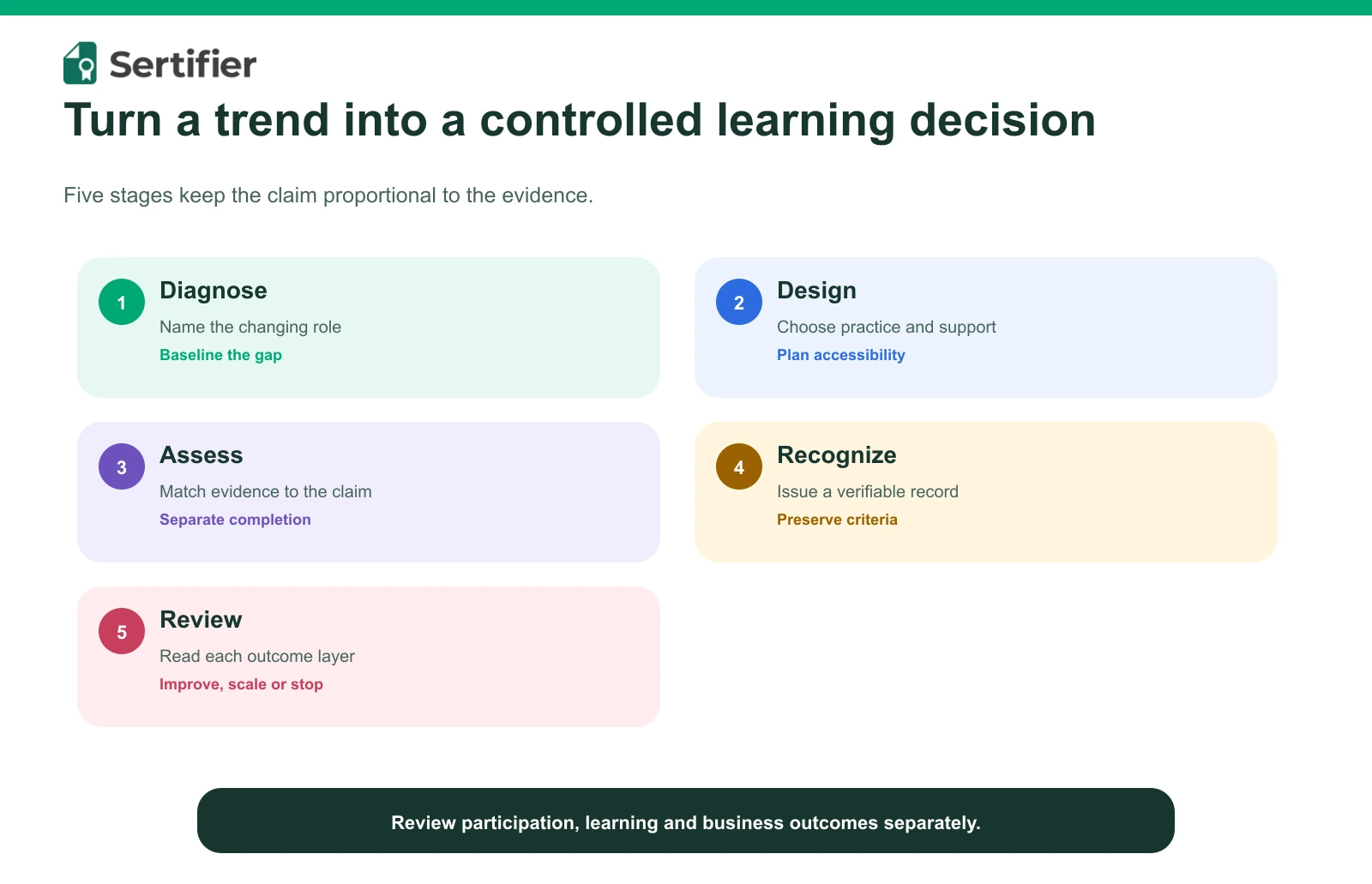
A practical corporate training operating model
Use the trend signals to improve a real program rather than to create a trend checklist.
1. Diagnose
Name the business process or role that is changing. Establish a baseline with the evidence already available and document what it cannot prove.
2. Design
Choose learning and practice that match the task. Define accessibility, language, privacy and manager-support needs before rollout.
3. Assess
Decide whether the program verifies attendance, completion, knowledge, skill or workplace application. Use a proportionate assessment and publish the criteria.
4. Recognize
Issue a certificate or badge only when its title and metadata accurately describe the verified achievement. Preserve issuer, recipient, criteria, dates and a current verification route.
5. Review
Read participation, completion, assessment, application and business measures separately. Improve, scale, hold or stop the program based on evidence rather than the trend label.
Questions to ask before investing
- Which role, task or capability is changing?
- Is the signal an observed behavior, a survey expectation or a vendor claim?
- What evidence will show that the learner met the intended requirement?
- Who provides practice, feedback and reinforcement?
- Which groups face access or completion barriers?
- What will be reviewed after 30, 60 and 90 days?
- What does the credential claim, and can another person verify it?
Build verifiable learning pathways
Connect the capability gap, practice, assessment and approval evidence to a credential that communicates the result accurately.
Frequently asked questions
What is the biggest corporate training trend for 2026?
No single trend applies to every employer. Current cross-source evidence most clearly supports rising attention to AI and technology skills, continued upskilling plans, human skills, direct skill evidence, career development and accessible lifelong learning. Prioritize the signal tied to a measured role or capability gap.
Is AI replacing corporate trainers?
The sources reviewed here support changing tasks and rising AI-skill demand, not universal replacement of trainers. Organizations still need people to define outcomes, design practice, review evidence, manage risk and support learners.
Are digital badges a corporate training trend?
Digital badges can provide a portable record of an achievement, but the badge itself does not prove the quality of a program. Evaluate the issuer, criteria, assessment, evidence and verification route.
How should a company measure training?
Track participation, completion, assessment, workplace application and business outcomes as separate layers. A rise in one layer should not be reported as proof of another without a defensible link.
Build verifiable learning pathways
Explore how Sertifier supports employee training and how to design digital credentials. For a program-specific workflow, request a demo.