Skill taxonomy crosswalks: map competency frameworks without changing meaning
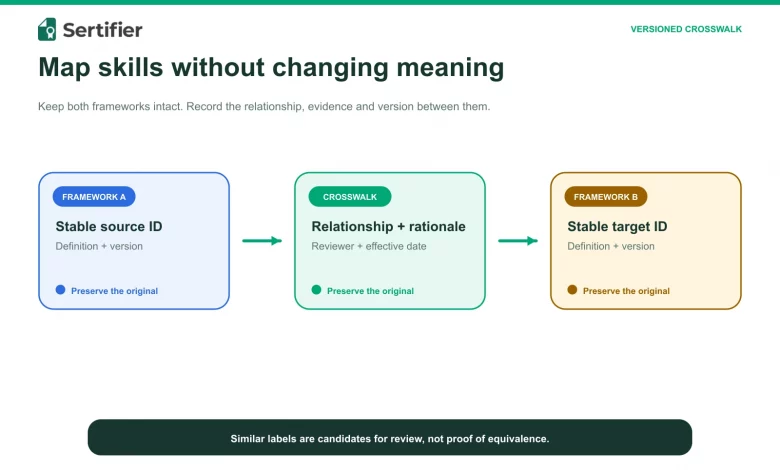
Organizations often describe the same area of work with different skill names, levels and identifiers. A skill taxonomy crosswalk records how concepts in one maintained framework relate to concepts in another. It should help systems and people interpret the relationship without pretending that similar labels are automatically equivalent.
This guide is for credential-program architects, learning-data owners and taxonomy stewards. It covers the operating decisions behind a versioned crosswalk. It does not replace a framework steward’s definitions, a job analysis or the evidence required to award a credential.
Short answer: Preserve framework identifiers, define relationship types, retain review evidence and version every mapping so changes never silently alter an issued credential.
Short answer
A defensible skill taxonomy crosswalk preserves the source and target identifiers, assigns an explicit relationship type, records the evidence and reviewer behind the mapping, keeps unmapped concepts visible and versions every approved change. A label match is a candidate for review, not proof that two skills mean the same thing.
What a skill taxonomy crosswalk is
A taxonomy organizes concepts inside one system. A crosswalk connects concepts across two systems while keeping both systems intact.
For example, a training provider may use an internal skill such as “prepare a stakeholder update,” while a workforce framework uses a broader communication concept. The crosswalk can record the relationship and its limits. It should not silently rename past credentials or claim that one assessment proves every concept attached to the broader framework term.
The 1EdTech CASE 1.1 specification defines standardized exchange for frameworks, competencies or skills, associations and related models. CTDL-ASN provides a schema for describing competencies and their relationships. These standards can structure data exchange, but the program still owns the meaning and approval of each mapping.
Keep this task separate from taxonomy design
Crosswalking begins after each participating framework has an accountable source. Do not use the mapping process to repair an undefined internal catalog.
| Task | Primary question | Output |
|---|---|---|
| Taxonomy design | Which concepts and hierarchy should our program maintain? | One governed framework |
| Skill assessment | What evidence demonstrates a learner’s capability? | Criteria, rubric and result |
| Credential design | Which approved claim should the credential communicate? | Credential definition and issuance rule |
| Framework crosswalk | How does one maintained concept relate to another? | Versioned relationship record |
| Job or role architecture | Which capabilities are required for a role? | Role-to-skill requirement map |
For credential fields and internal skills alignment, see the verification-ready credential structure guide. Here, the focus is the framework-to-framework mapping contract and its change controls.
Start with authority and scope
Write a short crosswalk charter before mapping any concepts. It should name:
- The business or interoperability decision the crosswalk supports.
- The source and target framework stewards.
- The exact framework versions or release dates in scope.
- The team allowed to propose, review and approve relationships.
- The downstream systems or credentials that consume the result.
- The events that trigger review, such as a framework release or changed program criteria.
The charter prevents a convenient spreadsheet from becoming an unowned source of truth. It also makes rejection legitimate. A concept can remain unmapped when the evidence does not support a useful relationship.
Preserve identifiers before comparing labels
Use the framework’s stable concept identifier whenever one exists. Store the human-readable label and definition as reviewed evidence, but do not make the label the only join key.
O*NET competency frameworks are available in human-readable files and machine-readable CTDL-ASN JSON-LD. ESCO publishes a maintained hierarchy of skill, competence and knowledge concepts with preferred and non-preferred labels. These examples show why a mapping record should keep the framework, version and concept identifier together.
Use a contract such as this:
| Field | Purpose | Reject or hold when |
|---|---|---|
| Source framework and version | Identifies the authority used for comparison | The version is unknown |
| Source concept identifier | Keeps the relationship stable when labels change | Only a free-text label exists and no local identifier is approved |
| Target framework and version | Identifies the destination authority | The target release is not recorded |
| Target concept identifier | Points to the exact reviewed concept | The identifier resolves to a different concept |
| Relationship type | States what the mapping means | The team uses one generic “match” value |
| Evidence and rationale | Explains why the relationship was selected | The rationale repeats only the labels |
| Confidence and reviewer | Supports human review and later triage | No accountable reviewer is recorded |
| Effective and review dates | Limits the mapping to an approved period | The mapping has no change trigger |
Define relationship types that do not overpromise
Use a small controlled set of relationship types. The labels below are an operating model, not a claim that every framework uses the same vocabulary.
| Relationship | Use when | Do not use when |
|---|---|---|
| Equivalent for this use case | Scope, level and evidence expectations align for the stated decision | Labels look similar but definitions or assessment expectations differ |
| Source is narrower | The source covers a bounded part of the target concept | The source proves the entire target concept |
| Source is broader | The source combines multiple areas, including the target concept | The target can stand in for the complete source claim |
| Related | The concepts are useful together but neither contains the other | A downstream system expects equivalence |
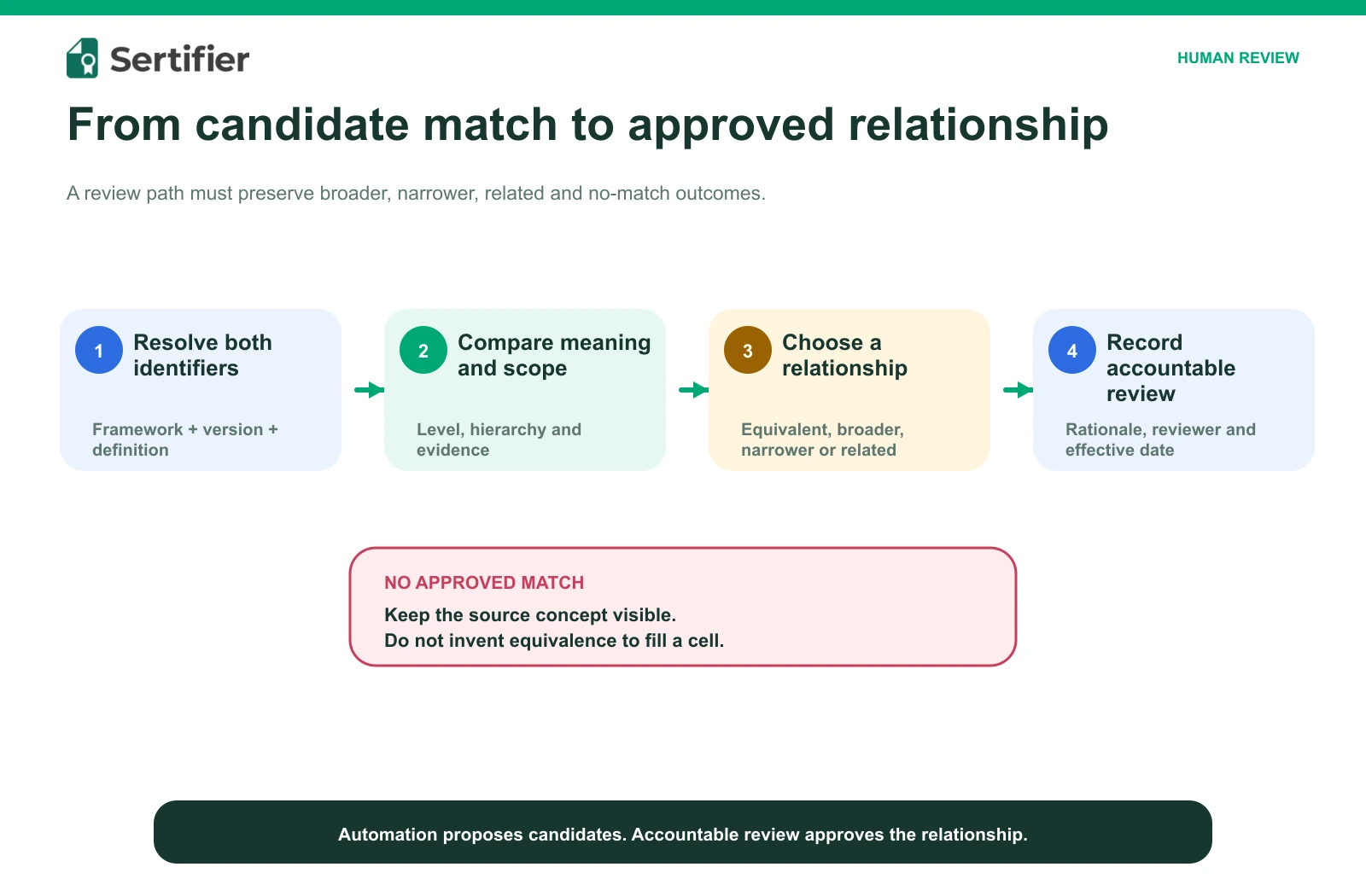
| No approved match | Review found no defensible relationship | The team wants to avoid an empty cell |
If a relationship is valid only for one program or one reporting task, record that scope. Do not publish a local equivalence as a universal fact.
Build the crosswalk in reviewable stages
1. Freeze the input versions
Record a checksum, release identifier or dated source reference where the framework makes one available. Do not mix concepts from different releases in one unlabelled mapping run.
2. Normalize for comparison, not replacement
You may normalize case, punctuation or whitespace to find candidates. Keep the original label, definition and identifier in the final record. A normalized string is a search aid, not the source concept.
3. Generate candidate relationships
Use exact identifiers, steward-provided associations, definitions, hierarchy and supporting examples to find candidates. Automated similarity can order the review queue, but it should not approve equivalence.
4. Review meaning, level and evidence
Compare what a person must know or do, the context in which the concept applies, its position in the hierarchy and any proficiency or assessment expectation. SFIA’s mapping guidance distinguishes mapping learning from mapping credentials as evidence of skill or competency. That distinction matters when a crosswalk feeds a credential.
5. Record uncertainty and no-match outcomes
Keep ambiguous and unmapped concepts in the output with a reason. Hiding them makes downstream coverage look better than it is and removes the queue for future framework updates.
6. Approve a versioned release
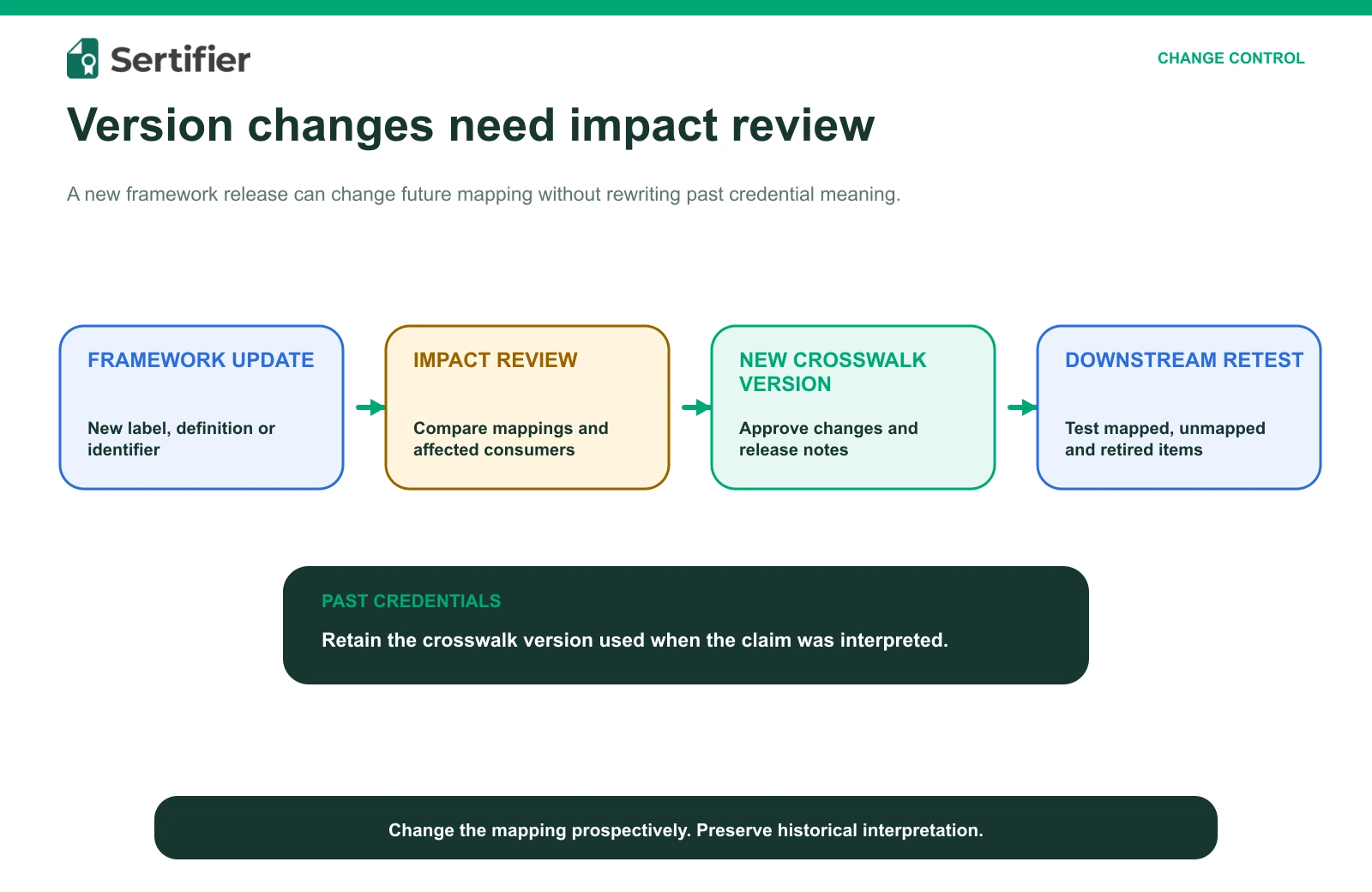
Publish an immutable crosswalk version with its source versions, effective date, reviewer and release notes. A later correction creates a new version. It should not rewrite the evidence used by an already issued credential.
7. Test downstream consumers
Check the systems that read the crosswalk. Test a direct mapping, a broader or narrower relationship, an unmapped concept, a retired target and a changed label with a stable identifier. Confirm what the user sees and what the API or export stores.
Protect previously issued credentials
A crosswalk update should not silently change the meaning of a past award. A credential records the approved claim at issuance time. If a downstream profile later displays a new external relationship, retain the crosswalk version used to produce that view.
Use this change-impact register:
| Change | Existing credential treatment | New issuance treatment | Required evidence |
|---|---|---|---|
| Label changes, identifier stable | Preserve the issued claim and record the display update policy | Use the current approved label | Steward release and owner approval |
| Concept definition changes materially | Keep the historical crosswalk version | Reassess relationship before use | Old and new definitions plus review rationale |
| Concept is retired or replaced | Preserve historical traceability | Map only after replacement review | Deprecation or successor notice |
| Relationship confidence falls | Flag affected downstream uses for review | Hold new use until approved | Review record and affected-consumer list |
| No target match remains | Keep the source claim without invented equivalence | Publish as unmapped if permitted | No-match decision and reviewer |
This is also why the crosswalk needs a rollback plan. Rolling back means restoring the last approved mapping version for downstream use. It does not mean deleting the history of a decision that influenced an issued record.
Use automation as triage, not authority
String similarity, embeddings or language models can suggest candidates and surface definition differences. They can also overvalue shared words and miss scope, level or assessment distinctions.
For each automated suggestion, retain:
- The source and target identifiers.
- The input framework versions.
- The proposed relationship and confidence.
- The evidence shown to the reviewer.
- The human decision and reason.
- The model or ruleset version when it materially affects reproducibility.
Sample a mix of accepted, rejected and low-confidence mappings. A review of only accepted candidates cannot reveal the unmapped concepts or false matches that matter most.
Connect the crosswalk to digital credentials carefully
A crosswalk can support search, reporting, pathway design or a verifier’s interpretation. It does not prove that a learner demonstrated the target skill. The credential’s own criteria, assessment and evidence remain authoritative for the award.
Sertifier’s current Europass digital credentials guide documents that each skill entered in Credential Details becomes a separate learning outcome. In the documented Europass flow, Sertifier may add a related ESCO reference while preserving the original skill wording. That is a useful product route for programs working with ESCO. It is not evidence that Sertifier provides arbitrary CASE, CTDL-ASN or framework-to-framework crosswalks.
If your team needs to structure skills for credential issuance, review the current Skills Management route and product documentation against the exact workflow you intend to operate. Keep mapping governance outside the sales claim until the capability is directly documented.
Acceptance checklist
Before a crosswalk version enters production, confirm that:
- Every mapping retains source and target framework versions and identifiers.
- Relationship types have written definitions and downstream behavior.
- Reviewers can approve no-match and uncertain outcomes.
- Automated suggestions never bypass accountable review.
- Past credentials retain the claim and crosswalk context used at issuance.
- Framework updates trigger an impact review instead of a blind overwrite.
- Downstream systems have passed broader, narrower, unmapped and retired-item tests.
- Product and standards claims are limited to current documentation.
- Personal data and learner evidence are not copied into a taxonomy mapping when identifiers and definitions are sufficient.
Measure crosswalk quality
Do not report one coverage percentage without explaining its denominator and decision use. Track measures that expose uncertainty and maintenance work.
| Measure | Numerator | Denominator | Decision supported |
|---|---|---|---|
| Reviewed coverage | Concepts with an approved relationship or approved no-match | Concepts in the declared source scope | Whether the review is complete |
| Exact-equivalence rate | Concepts approved as equivalent for the stated use | Reviewed concepts | How much of the crosswalk can support that specific equivalence use |
| Unmapped rate | Concepts with no approved target | Reviewed concepts | Where the target framework does not cover the source |
| Changed-mapping rate | Relationships changed in the new release | Relationships in the prior release | How much downstream retesting is required |
| Downstream acceptance | Test cases producing the expected result | Test cases executed | Whether a consumer can use the release safely |
These are operating measures, not proof that credentials caused a business or employment outcome. Organic performance should be evaluated through Google Search Console after publication, while downstream product outcomes require verified analytics or CRM evidence.
Connect skill outcomes to a documented credential workflow
Review how Sertifier represents skills and related ESCO references in its Europass flow before defining your implementation.
Frequently asked questions
Is a skill taxonomy crosswalk the same as competency mapping?
No. Competency mapping often connects capabilities to roles, people, learning or assessments. A taxonomy crosswalk records relationships between concepts in two maintained frameworks. One process can use the other, but their authorities and outputs are different.
Can two skills be matched when their labels are identical?
Identical labels are useful candidate evidence, not approval. Compare the definitions, scope, level, hierarchy, framework version and intended use before assigning a relationship.
Should every source skill have a target?
No. An approved no-match is safer than an invented equivalence. Keep unmapped concepts visible and review them when either framework changes.
Can AI create the crosswalk automatically?
AI can generate and prioritize candidates. Accountable human review remains necessary when the mapping affects credential meaning, assessment, reporting or learner opportunities.
What happens when a framework releases a new version?
Freeze the new inputs, compare identifiers and definitions, assess affected relationships, retest downstream consumers and publish a new crosswalk version. Do not overwrite the version used to interpret past credentials.