Digital credentials for professional associations
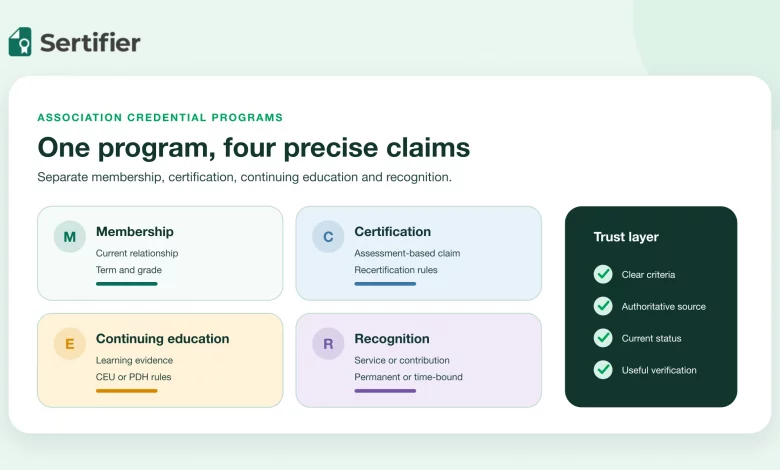
Professional associations can use digital credentials to represent four different things: current membership, professional certification, continuing education and contribution to the professional community. These records may look similar when displayed as a badge or certificate, but they should not be managed as one undifferentiated program.
A reliable association credential system connects each credential to an authoritative eligibility decision, makes its current meaning clear to a viewer and gives staff a repeatable way to issue, renew, expire and report on it. The badge or certificate is the visible layer. The operating rules behind it determine whether members, employers and other stakeholders can trust it.
Short answer: Treat membership, certification, continuing education and recognition as separate claims. Give each claim an eligibility source, validity rule, verification experience and accountable owner.
Short answer
Start by separating four program types:
- Membership credentials show a person’s current relationship with the
- Certification credentials show that a person met defined assessment and
- Continuing-education credentials record a completed learning experience,
- Recognition credentials acknowledge service, leadership, speaking,
association and may change when a membership term ends or a grade changes.
experience requirements and may require recertification.
contact hours, CEUs, PDHs or another approved measure.
volunteering or another contribution that may not expire.
For each type, define the system that decides eligibility, the evidence that supports the decision, the date and status rules, the person or team that owns changes and the verification experience presented to an outside viewer.
Do not treat membership and certification as the same claim
A professional certification and association membership can coexist, but they answer different questions. Membership usually describes a current relationship with an organization. Certification usually describes an assessment-based achievement governed by a certification program.
Combining them into one label can leave a viewer unsure whether the person is a current member, passed an assessment, completed education or simply attended an event. Keep the claim type visible in the title, description, criteria and dates.
| Credential type | What it should prove | Typical source of truth | Date rule to define |
|---|---|---|---|
| Membership | Current membership category or grade | Association member record | Membership term or grade effective dates |
| Certification | Defined certification requirements were met | Certification or assessment record | Certification and recertification cycle |
| Continuing education | A named learning activity was completed | Learning, attendance and assessment evidence | Completion date and any program-specific validity rule |
| Recognition | A documented contribution or achievement occurred | Committee, event or staff approval | Permanent or explicitly time-bounded recognition |
The table is a design framework, not a universal policy. Association bylaws, certification rules, accreditation requirements and applicable regulations determine the actual decision process.
Define the claim before choosing the badge or certificate
Write one sentence that states exactly what the credential means. Then test whether a member, employer and association staff member would interpret it the same way.
For example:
Active professional member for the 2026 membership termis a membershipMet the assessment and experience requirements for the ABC certification- `Completed the named learning activity and earned the recorded continuing
Served as a conference program reviewer for the stated eventis a
claim.
is a certification claim.
education measure` is a learning claim.
contribution claim.
Avoid broad labels such as expert, certified or accredited unless the documented criteria justify that wording. A digital format does not strengthen an unclear claim. It makes the claim easier to distribute, so precision matters more.
Build an eligibility record for every issuance
The credential platform should receive an approved decision, not invent one. Keep the authoritative eligibility logic in the association process that owns the underlying relationship or achievement.
Minimum eligibility fields
Record:
- Member or recipient identifier.
- Credential type and program version.
- Eligibility decision and effective date.
- Evidence reference, assessment result or approved completion record.
- Approver or decision source.
- Issue date and, when applicable, expiry or renewal date.
- Current status and reason for the latest status change.
Collect only the personal data needed for the program and apply the association’s access and retention rules. A public verification page should not expose internal notes, payment records or unrelated member information.
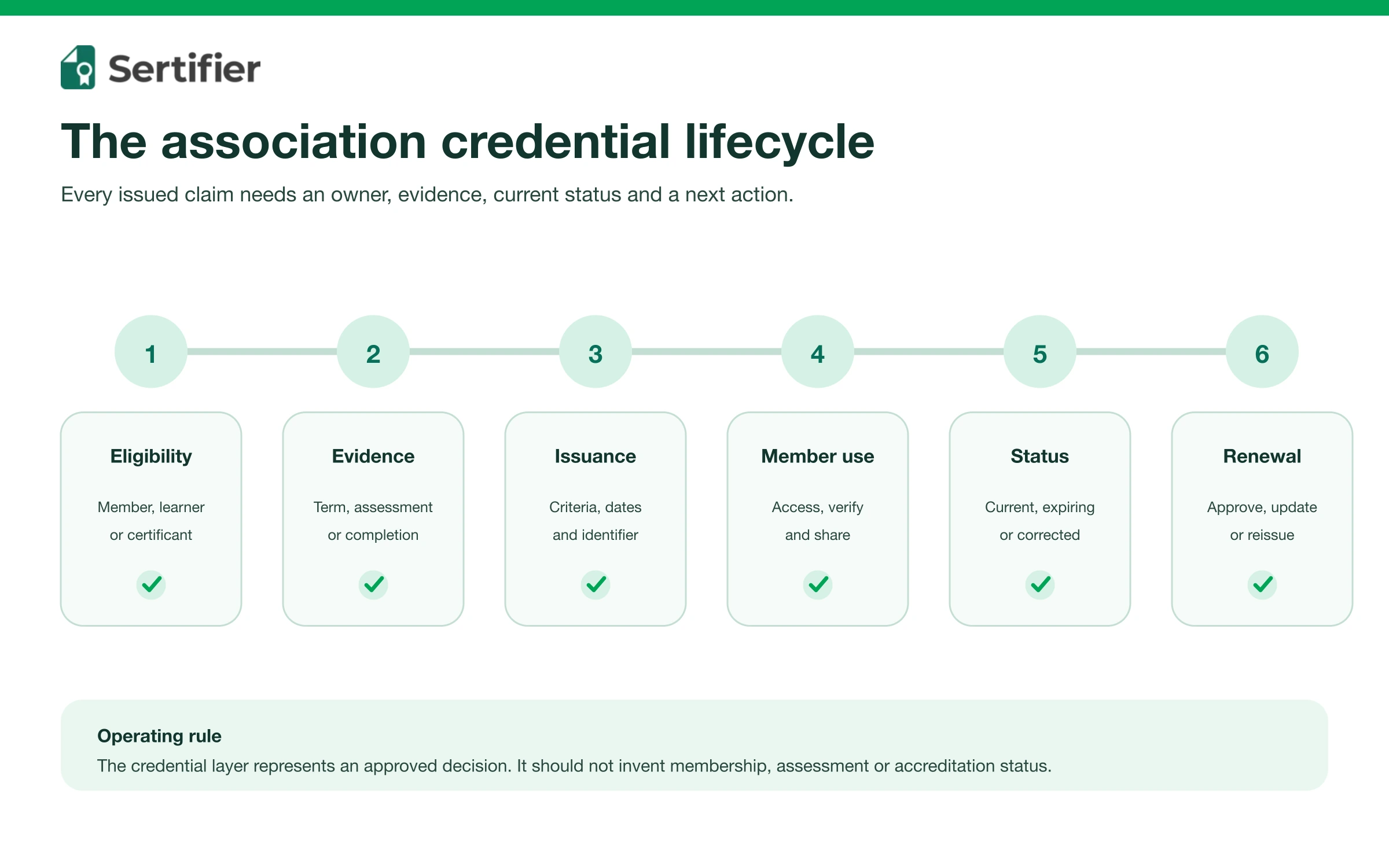
Design the renewal and expiry workflow deliberately
Membership and certification cycles create different renewal work. A member may renew annually, move to another grade or leave the association. A certification holder may need continuing education, an assessment, a fee or a documented attestation before recertification.
Define the workflow before configuring reminders:
- What event starts renewal?
- What evidence must be complete?
- Who evaluates that evidence?
- When does the current credential stop representing an active status?
- What should a verifier see after expiry?
- Is the next term an update to the existing record or a newly issued
credential under a new program period?
CIPD provides a current association example: eligible professional members receive a digital badge and certificate annually on renewal or when they gain a new membership level. That is CIPD’s program design, not a universal rule for every association. Review the CIPD member credential model as one implementation example.
Sertifier’s current public documentation describes fixed and recipient-specific expiration dates, automated expiry reminders and a view for credentials approaching expiry. Compare those expiry controls and reminder workflows with the association’s own eligibility and escalation rules.
Keep CEUs, PDHs and completion evidence precise
Continuing-education terms are not interchangeable. Define the unit, approved provider rules, learning requirements, assessment expectations and evidence that apply to the specific program.
IACET describes one CEU as ten contact hours of participation in an organized learning experience delivered under responsible sponsorship, capable direction and qualified instruction. It also distinguishes a broadly used CEU from an Accredited CEU backed by third-party review against the ANSI/IACET standard. Use the current IACET CEU explanation when that standard is relevant. Do not label every course hour an Accredited CEU.
IEEE demonstrates another association use case by offering credentialing for learning events and conferences, including CEUs, PDHs and microcredentials. Its credentialing program shows how a professional organization can connect learning recognition with licensing, career development and online sharing. Each association still needs to define which measures it is authorized to award.
Make verification useful to employers and peers
A viewer should be able to understand the credential without calling the association or trusting a screenshot. The verification experience should make the following clear:
- Credential title and claim type.
- Recipient identity at the level permitted by the program.
- Issuing association.
- Criteria and evidence description.
- Issue and expiry dates when applicable.
- Current status.
- Stable credential identifier or verification URL.
ASAE’s CAE digital recognition provides a practical example. Its public FAQ describes web-enabled recognition that can be shared and verified online, with information about what the person did to earn it. Review the ASAE digital recognition FAQ as an example of a professional certification presentation, not as a template for every association.
For the underlying issuer, holder and verifier model, use Sertifier’s digital credential guide. For badge-specific criteria, evidence and sharing decisions, use the digital badges guide.
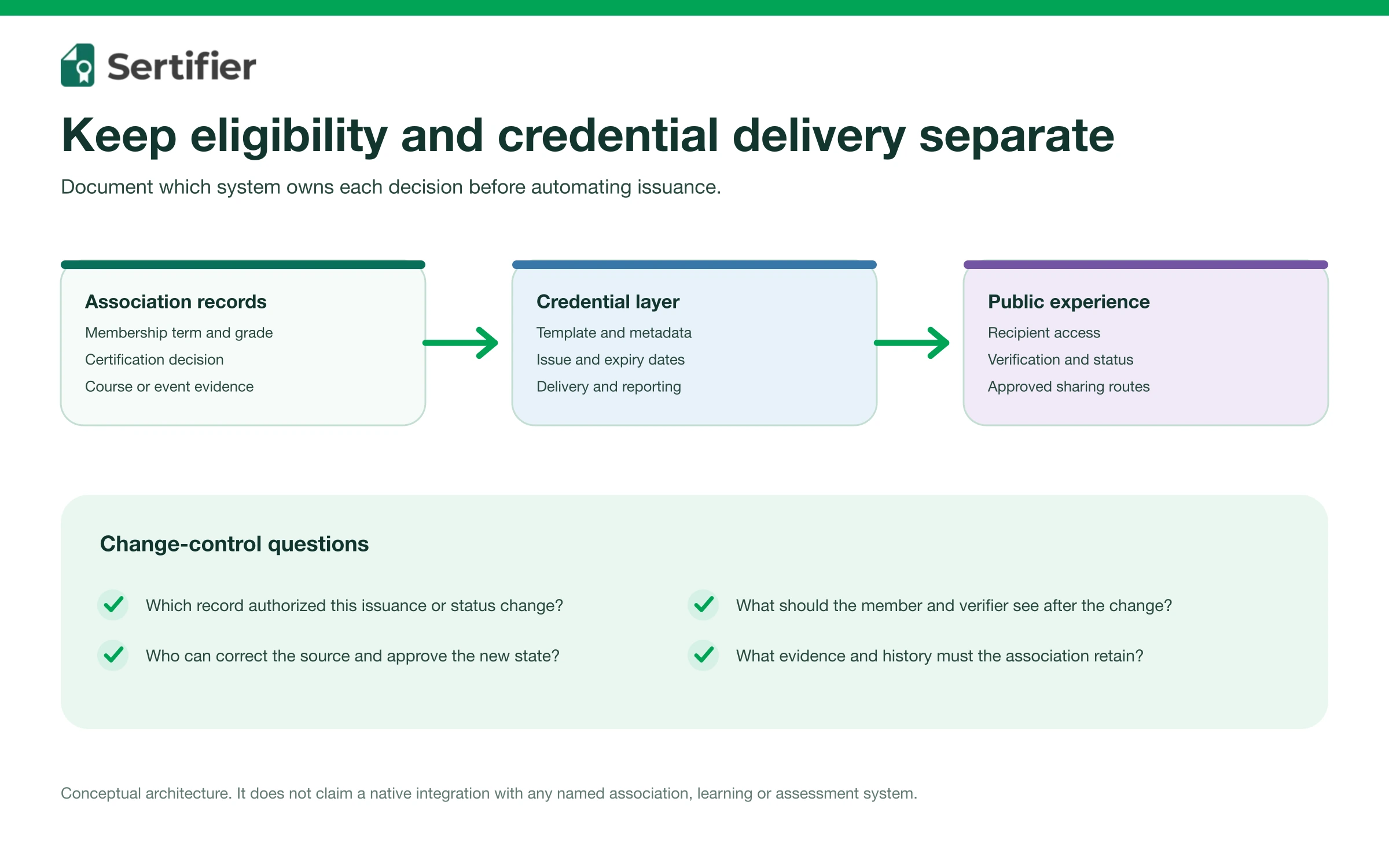
Separate systems of record from the credential layer
Associations often already have member, learning, assessment and event data. Document which system owns each decision before connecting any issuance workflow.
| Data or decision | Recommended owner | Credential-layer responsibility |
|---|---|---|
| Membership category and term | Governed member record | Represent the approved current claim |
| Assessment and certification decision | Certification program record | Issue the approved certification and show its status |
| Course completion and learning measure | Learning or event record | Represent the approved completion and measure |
| Credential design and metadata | Credential program owner | Apply the correct template, criteria and dates |
| Public verification and sharing | Credential platform | Present the issued record and current status |
| Renewal exception or appeal | Authorized association process | Reflect only the final approved decision |
This separation prevents a design tool or email workflow from becoming an unofficial source of eligibility. It also makes corrections more controlled: staff can identify the authoritative record, approve the change and then update the credential representation.
Sertifier’s public help documentation describes scheduled or integration-triggered credential issuance. Use the current automation overview to evaluate available delivery patterns. It does not by itself prove a native integration with a particular association management, learning or assessment system.
Plan the member experience
The operational workflow is incomplete until a member can receive, understand and use the credential.
Before launch
- Explain what the credential means and what it does not mean.
- Show members how to access, verify and share it.
- Define privacy choices and the process for correcting an error.
- Explain expiry and renewal behavior.
- Prepare support responses for missing email, identity mismatch and status
questions.
After issuance
- Confirm successful delivery.
- Track acceptance or access separately from social sharing.
- Make the verification URL easy to find.
- Send renewal communications from a governed work queue.
- Preserve an audit trail for corrections and reissues.
ASAE also uses digital badges within its own microcredential programs. The ASAE microcredential program illustrates how an association can connect a defined learning objective with a visible badge rather than treating every form of participation as the same achievement.
Measure the program by stakeholder outcome
Do not judge an association credential program by the number issued alone. Separate operational, member and external-use signals.
Operational measures
- Eligible records issued without exception.
- Failed or delayed deliveries requiring staff action.
- Corrections and reissues by cause.
- Renewals completed before the current term ends.
- Time spent resolving verification questions.
Member measures
- Credential access or acceptance.
- Verification-page visits.
- Shares or profile additions.
- Renewal progression after a governed reminder.
- Support requests by topic.
Employer and ecosystem measures
- Verification activity from outside the association.
- Common verifier questions.
- Partner recognition or acceptance evidence.
- Qualitative feedback on whether the credential communicates the intended
competence or status.
Sertifier’s current credential-report documentation describes issued-credential records, filtering and export. Treat those fields as one input to the program’s measurement model, not as proof of member value or employer acceptance.
Use a controlled rollout
Start with one credential type whose eligibility source and owner are already clear. A membership-term credential or one established continuing-education program may be easier to govern than launching membership, certification, events and volunteer recognition at once.
Pilot checklist
- Approve the claim, criteria, evidence and date rules.
- Map the eligibility source and correction owner.
- Test the credential and verification experience with non-public records.
- Confirm delivery, privacy and support instructions.
- Issue to a bounded pilot group.
- Review operational exceptions and member comprehension.
- Expand only after the source-to-verification chain works consistently.
Questions to ask a credential platform
- Can each credential type carry distinct criteria, evidence and date rules?
- How does a recipient access and share the credential?
- What does a verifier see before and after expiry?
- How are corrections, reissues and status changes recorded?
- Which reporting fields can staff filter and export?
- Which delivery and integration methods are currently documented?
- How are privacy, access and data retention controlled?
- Can the program preserve a stable verification experience through renewal?
These questions help the association evaluate its operating needs without assuming that one platform owns member eligibility, certification decisions or accreditation rules.
Build the workflow around the claim
Digital credentials can make association membership, certification, continuing education and contribution recognition easier to understand and verify. They do not replace the policies and evidence that make those claims valid.
Start with one precise claim, one authoritative eligibility source, one named owner and one useful verification experience. Then add renewal, automation and measurement only where the association can govern the full lifecycle.
If your association is mapping membership, certification or continuing education records into a credential workflow, you can discuss the workflow with Sertifier.
Build your association credential workflow
Map membership, certification, renewal and continuing-education claims to a verifiable credential program.
Frequently asked questions
What is a membership credential?
A membership credential is a digital record representing a person’s current membership category, grade or term with an association. Its criteria and date rules should be distinct from professional certification or course completion.
Should an association issue a new credential every year?
That depends on the program’s claim, verification design and record policy. Some associations issue a credential for each membership term, while others update a current record. Define what a viewer must understand about historical and current status before choosing the model.
Can a digital badge represent CEUs or PDHs?
It can represent an approved continuing-education record when the issuing organization has defined the applicable measure, evidence and authority. The badge format does not itself establish that an activity qualifies for a CEU, PDH or accredited continuing-education claim.
Is a membership badge the same as professional certification?
No. Membership describes a relationship with an association. Professional certification usually represents defined assessment, experience and recertification requirements. A person may hold both, but the credentials should communicate the difference.
What should an employer see when verifying an association credential?
At minimum, the employer should be able to understand the recipient, issuer, credential title, criteria, issue and expiry dates when applicable, current status and a stable verification reference, subject to the program’s privacy rules.