Skill-based hiring in 2026: 85% claim it, 0.14% live it
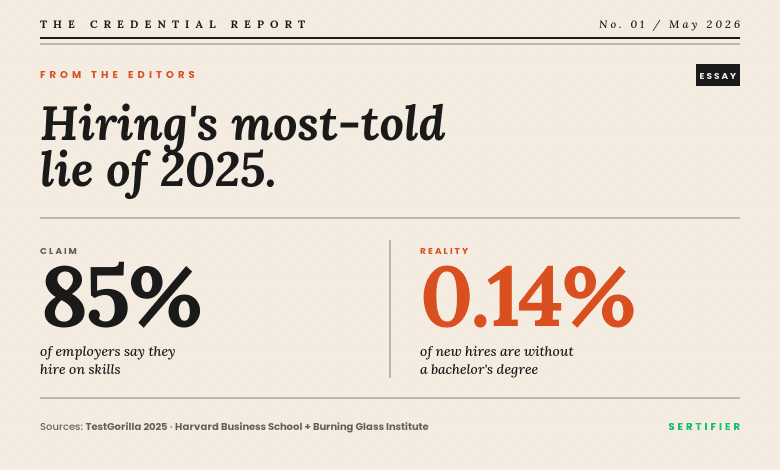
In 2025, 85% of employers told TestGorilla they were using skills-based hiring. In the same year, Harvard Business School and the Burning Glass Institute studied actual hiring data at the firms that had publicly removed degree requirements. The finding: fewer than 1 in 700 new hires were workers without a bachelor’s degree. The headline number for skills-based hiring is 85%. The hiring-data number is 0.14%.
This is not a story about lying. Most of those employers genuinely intend to hire on skills. The gap exists because skills-based hiring needs an infrastructure layer that did not exist five years ago and only became standardized in 2023. The infrastructure layer is verifiable credentials, and the standard is Open Badges 3.0 from 1EdTech, built on the W3C Verifiable Credentials Data Model.
This essay is for the people who issue credentials (training providers, universities, L&D teams, professional associations) and the people who hire on them (HR leaders, talent acquisition). The argument is that 2026 is the inflection point where the talk becomes the practice, and the only credentials that will count are the ones that verify.
Why the gap exists
Removing a degree requirement from a job description costs nothing. Replacing the degree requirement with a defensible alternative costs work. When an HR team drops the “Bachelor’s required” line, the recruiter still has to make a decision in the next 48 hours about whether to advance a candidate. If the only thing in the resume that signals “this person can do the work” is the degree, the recruiter advances the degree-holder, regardless of the official policy.
The honest version of what the recruiter needs: a signal that does the work the degree used to do. The degree signaled three things at once. It signaled completion (this person finished something hard). It signaled domain knowledge (this person was exposed to the field). It signaled vetting (an institution evaluated them).
Self-reported LinkedIn skills do none of those things. A candidate can list “Python” on LinkedIn without ever having opened a Python script. A resume bullet “led cross-functional team” is an unverifiable claim. The default replacement for the degree, in most resumes today, is a list of self-asserted skills. A recruiter screening for a senior role cannot rationally weigh self-asserted skills against a degree.
This is the gap. The policy says skills-based. The toolchain available to the recruiter does not yet contain anything that can do the work the degree was doing.
What “verifiable” means in 2026
A verifiable credential is a signed claim about a person, issued by a recognized authority, that any third party can confirm in one click. The signature is cryptographic. The verifier does not have to call the issuing institution; the signature itself confirms authenticity.
The 2026 standards are Open Badges 3.0 (from 1EdTech) and the W3C Verifiable Credentials Data Model, which Open Badges 3.0 builds on. The same standards underpin Europass, the European Union’s framework for credential portability. A credential issued correctly under these standards verifies offline, ports across platforms and wallets, and travels with the recipient for the lifetime of the credential. See the full digital credential field guide for the underlying mechanics.
What this gives the recruiter is the missing piece. A candidate’s resume lists a verifiable skill credential. The recruiter clicks the verification link. The page confirms that an issuer (a recognized training provider, a university, a former employer) signed a specific claim (this person demonstrated a specific competency by passing a specific assessment) on a specific date. The decision moves from “do I believe the resume” to “do I believe the issuer.”
The inflection point: why 2026, not 2030
Three things happened in the last 18 months that compress this timeline.
First, Open Badges 3.0 shipped in 2023 and has been adopted in production by the major credentialing platforms through 2024 and 2025. The standard is mature enough that recruiters can rely on the verification flow being consistent across issuers. Open Badges 3.0 explained covers what changed from 2.0 and what to evaluate in a platform.
Second, applicant tracking systems and LinkedIn began surfacing verifiable credential data in resumes and profiles. A recruiter scanning a profile now sees a verifiable badge with a one-click verification link, where five years ago they saw an unverifiable self-asserted skill. The infrastructure that makes the credential visible at the point of decision is in place.
Third, AI-driven resume screening is being recalibrated to weight verifiable credentials more heavily than unverifiable claims. This is a side effect of the same AI systems being trained to detect inflated resumes. A verifiable credential is the cleanest signal an AI screener can use to weight a candidate, because it is the only signal that comes with a cryptographic proof attached.
The combination of standard maturity, distribution infrastructure, and AI screening incentives makes 2026 the year the policy-practice gap closes. Employers that say they hire on skills will start doing it because the toolchain finally supports it.
What this means for issuers (the work to do this year)
Training providers, universities, employers running internal L&D programs, and professional associations are all credential issuers. The work to do in 2026 falls into three buckets.
The first bucket is moving from completion credentials to skill credentials. Most current programs issue certificates of completion: “this person finished the course.” The 2026 hiring market will weight skill credentials: “this person demonstrated a specific competency through assessment or work product.” Same course, different credential. The change is in what the certificate actually claims.
The second bucket is moving from PDF certificates to verifiable digital credentials. A PDF says what was achieved; a verifiable digital credential signs that claim cryptographically. Digital badges in 2026 covers how recipients display verifiable credentials on LinkedIn, in email signatures, on resumes, and on portfolios. Recipients want this format because it travels: verifiable, portable, and shareable to LinkedIn in one click, where a paper certificate simply cannot follow.
The third bucket is designing for stackability. The 2026 guide to micro credentials details how individual skill credentials roll up into recognizable pathways. A single micro credential is a line item; five micro credentials in a domain form a portfolio. Recruiters reading stacked credentials reach the “this candidate has demonstrated competency in this domain” conclusion faster than they would reading a degree.
What this means for employers (the work to do this year)
Companies that publicly removed degree requirements but kept the same screening process produced the 0.14% number. Closing that gap requires two changes in how hiring teams actually operate.
The first change is recruiter training. Recruiters and hiring managers need to understand that a verifiable digital credential in a resume is a defensible alternative to a degree, and they need an explicit decision rule for how to weight it. A simple rule: a verifiable credential from a recognized issuer carries the same weight as a degree-required line for that domain. Without the explicit rule, recruiters default to the heuristic that has worked for decades, which is the degree.
The second change is system-level. Applicant tracking systems should parse verifiable credentials and surface them prominently. AI screening systems should weight cryptographically verifiable claims higher than self-asserted ones. Recruiter dashboards should show the verification link as a one-click action, not a hidden field. These are vendor-side changes; the work for an employer is to ask the vendor for them and to budget for the upgrades.
The next 24 months
The publicly stated forecast across LinkedIn, the World Economic Forum’s Future of Jobs reports, and the major HR consultancies is that skills-based hiring will become the dominant mode by 2028. The data argues the inflection point is closer than that. Open Badges 3.0 is in production. Verifiable digital credential issuance is growing across L&D and higher education. Employers who removed the degree requirement in 2024 will spend 2026 and 2027 closing the policy-practice gap, because they now have the tools to do it.
For issuers, the practical implication is simple. Programs that move from completion certificates to verifiable skill credentials in 2026 will be the programs whose recipients land jobs faster than recipients of programs that didn’t. Recipient demand follows hiring demand. The issuers who ship verifiable in 2026 will be the issuers whose programs grow in 2027.
The honest counter-argument
The strongest counter-argument is that the policy-practice gap exists for reasons beyond infrastructure. Risk aversion in hiring is real. Pattern-matching to degree-holders is deeply trained. Even with perfect verifiable credentials, some hiring managers will continue to prefer degrees out of conservatism. This is true. The argument here is not that verifiable credentials solve risk aversion. The argument is that they remove the structural excuse for the current gap. After 2026, “we don’t have a way to verify skills” stops being a defensible reason for the gap. What remains is choice.
Where this leaves Sertifier readers
If your organization issues training certificates, association credentials, or university completions: 2026 is the year to ship Open Badges 3.0. If your organization hires: 2026 is the year to write the explicit rule that weights verifiable credentials at the same level as degrees. See how digital certificates work, what a digital credential is, or Sertifier pricing if you are ready to issue verifiable credentials this academic year or quarter.
Frequently asked questions
Is skills-based hiring actually replacing degree-based hiring?
Slowly, then quickly. As of 2025, 53% of employers had publicly removed degree requirements (up from 30% the year before) according to TestGorilla. But Harvard Business School research shows that fewer than 1 in 700 new hires were workers without a bachelor’s degree, suggesting the practice trails the policy by a wide margin. The gap is expected to close as verifiable credential infrastructure matures.
What is a verifiable credential?
A signed digital claim about a person, issued by a recognized authority, that any third party can confirm in one click. The signature is cryptographic, meaning the verifier does not need to contact the issuer to confirm authenticity. The 2026 standards are Open Badges 3.0 from 1EdTech and the W3C Verifiable Credentials Data Model.
What should an issuer (university, training provider, employer) do this year?
Three things: move from completion certificates to skill credentials, move from PDFs to verifiable digital credentials, and design programs so credentials stack into recognizable pathways. Programs that ship these in 2026 will be the programs whose recipients are competitive in 2027.
What should an employer do this year?
Write an explicit rule that weights verifiable credentials at the same level as degree requirements for the relevant domain. Train recruiters on the rule. Ask your applicant tracking system vendor to surface verifiable credentials prominently in candidate views.
For the eight cited numbers behind the credential-fraud half of the hiring problem, see credential fraud in 2026: 8 numbers HR teams should know.
For the ROI math L&D buyers use to justify shipping verifiable credentials, see ROI of digital credentials: 4-line business case.