Scholarship certificate template: 12 free designs and how to verify
A scholarship certificate is a formal document confirming that a student has been awarded a scholarship. It names the recipient, the scholarship, the issuing institution, and the award date. For the recipient it is a milestone worth keeping; for a scholarship committee or future employer it is evidence that has to be verifiable. A well-designed scholarship certificate handles both jobs.
This guide includes 12 free scholarship certificate templates across four design families, wording examples for the most common scholarship types, and how to issue a verifiable digital version that a recipient can add to LinkedIn or a college application.
What a scholarship certificate is
A scholarship certificate is a written acknowledgement that an individual has been awarded financial assistance for academic study. Universities, foundations, employers with employee-tuition programs, and community organizations issue them. The certificate names the recipient, the scholarship, the granting institution, and often the amount or program details.
The traditional version is a paper certificate suitable for framing. The modern version is the same document plus a verifiable digital version the recipient can share online. The digital version is the one that scholarship committees and future employers actually check.
The 12 scholarship certificate templates
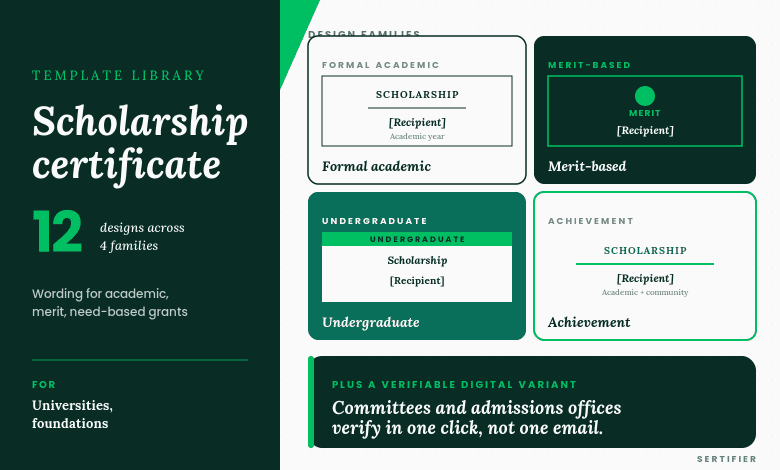
Four design families cover almost every scholarship use case. Each family has three variations differing in formality, color, and emphasis.
Formal academic family (4 designs)
Serif typography, restrained color palette, and a clear hierarchy that places the recipient name and the awarding institution most prominently. Use for university scholarships, established foundations, and any award where the institution’s brand matters.
Merit-based family (3 designs)
Bolder color choices and emphasis on the achievement. Use for merit awards where the scholarship is recognition first and financial aid second.
Undergraduate family (3 designs)
Cleaner, more contemporary visual style. Use for undergraduate scholarships and renewable awards. The simpler design ages well across academic years.
Achievement family (2 designs)
A balance between formal and modern. Use for community scholarships, employer-sponsored awards, and one-time achievement-based grants. The recipient name and the awarding body share the visual weight.
Wording examples by scholarship type
Academic scholarship
“This certificate is presented to [Recipient name] in recognition of academic excellence and is awarded the [Scholarship name] for the [academic year/term]. Granted by [Institution] on [Date].”
Need-based scholarship
“Awarded to [Recipient name] in support of [their/her/his] studies in [Field of study] at [Institution]. The [Scholarship name] provides [Amount or program details] for the [academic year/term].”
Merit-based scholarship
“In recognition of outstanding achievement in [Field/discipline], the [Scholarship name] is conferred upon [Recipient name] by [Institution] on [Date]. This award honors merit and academic distinction.”
Athletic scholarship
“[Institution] is proud to award [Recipient name] the [Scholarship name] in recognition of athletic achievement and academic standing. Granted for the [academic year], this scholarship supports the recipient’s continued participation in [Sport/program].”
Scholarship endowment
“In recognition of [Recipient name]’s academic accomplishments, the [Endowment name] is awarded for [academic year]. This award reflects the values of [Endowment donor or institution] and supports recipients in [Field of study].”
How to make a scholarship certificate verifiable
The single highest-value addition to a scholarship certificate in 2026 is a verifiable digital version. A verifiable digital scholarship certificate carries cryptographic proof of who issued it, who received it, and the fact that it has not been altered. A scholarship committee or admissions office at another institution can confirm the certificate is real in one click.
The standards behind verifiable credentials are Open Badges 3.0 from 1EdTech and the W3C Verifiable Credentials Data Model. These are open specifications that platforms across the industry implement.
Issuing a verifiable scholarship certificate involves three steps. First, the institution signs the credential using a private key tied to its identity. Second, the recipient receives the credential and can choose where to display it, typically by adding a link to a LinkedIn profile, resume, or admissions application. Third, anyone who wants to confirm the certificate clicks the verification link and sees the credential, the issuer, and a tamper-check result.
Learn what a digital credential is and how it differs from a printable certificate. The short answer: the digital version is the one that survives time, distance, and the recipient changing institutions.
Tips for design: signature, seal, and presentation
A scholarship certificate has three optional elements that significantly affect perceived authority. The institutional seal anchors the certificate to a recognized body. The signature of a senior officer (department chair, dean, foundation chair, employer’s CEO) personalizes the award. The accent color should reflect the issuer’s brand palette without overwhelming the document.
For the verifiable digital version, the verification link should be visible on the certificate itself as a small QR code or short URL. Recipients sometimes print the digital version, and committees sometimes scan the printout. Either way, the link should travel with the document.
Frequently asked questions
What should a scholarship certificate include?
At minimum: recipient name, scholarship name, issuing institution, date awarded, and signature of an authorizing officer. Optionally: scholarship amount, academic year, field of study, and a verification link if issued as a digital credential.
Who can issue a scholarship certificate?
Any organization that funds or supports academic study can issue one. This includes universities, colleges, K-12 schools, foundations, employer programs that fund education, professional associations, community groups, and government agencies. The certificate’s authority comes from the issuer’s standing, not from a specific format.
How do I make a scholarship certificate verifiable?
Use a digital credentialing platform that supports Open Badges 3.0 or W3C Verifiable Credentials. The platform handles signing and verification; you provide the certificate design and the recipient details. Verification then becomes a one-click action for any future committee or employer.
Should the certificate include the scholarship amount?
It depends on the program. Endowed scholarships and major awards often include the amount as a mark of distinction. Recurring need-based awards often omit the amount and leave it in the award letter. Either is acceptable; consistency within a program matters more than the choice itself.
What do you write on a scholarship certificate?
A statement of award (“This certifies that [name] has been awarded the [scholarship name]”), the academic year or term, the issuing institution, and the signature and title of the authorizing officer. The wording examples above cover academic, need-based, merit-based, athletic, and endowment scholarships.
How do you make a scholarship certificate?
Pick a template that matches the scholarship’s tone, fill in the recipient, scholarship name, institution, and date, and issue it on paper, digitally, or both. A digital credentialing platform adds a verification link so committees and employers can confirm the award in one click.
Next steps
Pick the template family that fits the scholarship’s tone, customize with the program details, and decide whether to issue as paper, digital, or both. For programs running annually or at scale, the verifiable digital version is the version recipients keep and committees verify. See all Sertifier certificate templates for related designs, the student award certificate template for a related student recognition design, or review Sertifier pricing if your program is ready to issue verifiable scholarship certificates this academic year.