How to spot a fake academic transcript: 7 verification checks for HR and admissions
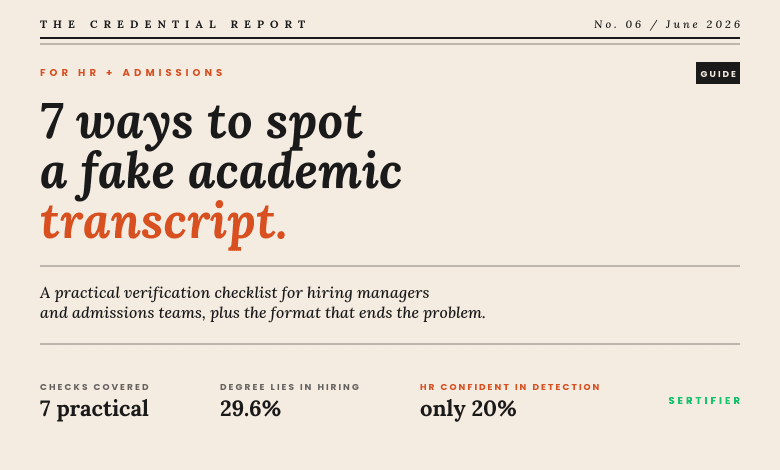
Fake academic transcripts are easier to make in 2026 than they were in 2024. AI-driven document forgery has lowered the barrier; templates and tutorials are openly available online. The Equifax research that 71% of HR professionals have encountered fabricated or misleading candidate information, with only 20% confident in their ability to detect it, sets the stakes clearly. The hiring teams that catch a fake transcript before the offer goes out save real money, real time, and real risk. The teams that catch it after pay all three.
This guide walks through seven practical checks any hiring manager, recruiter, or admissions officer can run on a transcript before advancing the candidate. The checks are sequenced from fastest (under one minute) to most thorough (a full institutional verification). Use as many as the situation warrants.
Why fake transcripts are a 2026 problem, not a 2018 problem
The forgery toolkit has changed. Modern fake transcripts use AI image generation for the institutional logos and seal, custom typography that approximates the real document templates, and convincing GPA distributions sampled from real cohorts. A transcript that looked obviously fake in 2018 (broken layout, wrong fonts, illegible seal) looks credible in 2026. Standout CV and Resume Builder research shows 29.6% of candidates have lied about a college degree on their resume, with 54% of that group claiming a degree they did not have.
The countermeasure is faster verification, not pattern-matching. The pattern-matching of the prior decade no longer works. The checks below assume the document looks credible and ask the questions an authentic transcript can always answer.
Check 1: institution exists at the named accreditation level
Open the U.S. Department of Education’s accreditation database (or the equivalent for the candidate’s country) and verify that the institution exists, that it is accredited at the level claimed, and that the accreditor itself is recognized. Fake transcripts often cite institutions that exist but at a different accreditation tier, or that exist but only as adult education centers rather than degree-granting bodies.
This check takes one minute and catches a meaningful fraction of fraud.
Check 2: the seal and signature match recent authentic documents
Find a recent authentic transcript from the same institution online (alumni networks and university communications sometimes publish samples). Compare the seal, the registrar’s signature block, and the formatting against the transcript in hand. Authentic transcripts from the same institution issued in the same year follow consistent templates; fakes drift in detail.
Three details to compare: the seal’s color depth and edge crispness, the registrar’s name and title (current registrars change rarely; check the institution’s website), and the template layout for course listings.
Check 3: course catalog matches the year claimed
Cross-reference the courses listed on the transcript against the institution’s published course catalogs for the year the candidate claims to have attended. Universities reorganize and rename courses constantly. A transcript dated 2018 with course numbers that didn’t exist until 2022 is a fake. A transcript with course names that don’t exist at the institution at all is a fake.
Course catalogs are usually archived publicly going back at least a decade. This check takes 10 minutes for an undergraduate transcript and is the single most effective desk-level verification.
Check 4: GPA distribution is plausible
Look at the GPA distribution across courses. Authentic transcripts show variance: a candidate’s strongest subjects pull A’s; weaker subjects pull B’s and the occasional C. A transcript with perfect A’s across every course, including the historically hardest classes at the institution, raises a flag. So does a transcript with a uniform B average across every course (real students do not perform identically across mathematics, literature, and lab science).
This check is qualitative but trained recruiters develop reliable intuition for it.
Check 5: registrar office direct verification (the slow but definitive check)
Contact the registrar’s office directly via the institution’s published contact information (not contact details supplied by the candidate). Request transcript verification with the candidate’s written consent. Most U.S. universities respond within 5-10 business days; many process within 48 hours via the National Student Clearinghouse for a small fee.
This is the gold standard. Use it for any role where the credential is load-bearing for the hire (regulated professions, security-cleared roles, executive positions).
Check 6: National Student Clearinghouse verification
For U.S. higher education credentials, the National Student Clearinghouse provides centralized degree verification covering more than 3,600 institutions. The candidate consents; the requestor receives confirmation of degree, date conferred, and program. Costs roughly $15 per verification. Turnaround is typically under 48 hours.
This is the practical operational verification step for HR teams handling more than a few candidates per month.
Check 7: the verifiable digital alternative
The structural fix for fake transcripts is the verifiable digital credential. A transcript issued as a signed verifiable credential under Open Badges 3.0 or the W3C Verifiable Credentials Data Model carries cryptographic proof of authenticity. The hiring team clicks a verification link and confirms the institution issued the credential to the named recipient on the named date. No registrar phone call. No 48-hour wait. No qualitative judgment.
The roll-out is uneven. Most U.S. universities are mid-transition (some are issuing verifiable transcripts via systems like Greenlight or Parchment; others are still PDF only). For candidates whose institutions have shipped verifiable credentials, the check is one-click and definitive. For candidates whose institutions have not, fall back to checks 1-6.
For the broader picture on why verifiable credentials are becoming the verification infrastructure layer, see the skill-based hiring essay on the policy-practice gap and what a digital credential is.
The seven checks at a glance
| # | Check | Time | Catches |
|---|---|---|---|
| 1 | Institution accreditation | 1 min | Fabricated institutions |
| 2 | Seal + signature comparison | 5 min | Template drift |
| 3 | Course catalog cross-check | 10 min | Anachronistic course listings |
| 4 | GPA distribution plausibility | 5 min | Statistical implausibility |
| 5 | Registrar direct verification | 2-10 days | Everything, definitively |
| 6 | National Student Clearinghouse | 1-2 days | Degree, date, program |
| 7 | Verifiable digital credential check | 1 click | Everything, instantly |
Where this leaves HR and admissions teams in 2026
The seven checks above are not exhaustive but they cover the practical verification surface. For roles where the credential is load-bearing, run check 5 or 6 every time. For roles where the credential is supporting evidence, run checks 1 and 3 minimum and add check 7 wherever the candidate’s institution has shipped verifiable credentials.
The longer-term answer is that verifiable digital credentials make checks 1 through 6 unnecessary because they collapse the verification work into a one-click action that any third party can perform. For credential issuers reading this, see our 2026 buyer’s guide on selecting a platform that issues genuine verifiable credentials under Open Badges 3.0.
Frequently asked questions
How can I quickly verify a college transcript?
For U.S. higher education, the National Student Clearinghouse handles verification across more than 3,600 institutions in under 48 hours for roughly $15. Verifies degree, date conferred, and program. The fastest definitive check available without a verifiable digital credential.
What percentage of transcripts submitted to employers are fraudulent?
Resume Builder January 2025 research found that 29.6% of candidates have lied about a college degree on their resume, with 54% of that group claiming a degree they did not have. Equifax research found 71% of HR professionals have encountered fabricated or misleading candidate information; only 20% are confident in their ability to detect it.
Are AI-generated fake transcripts a real risk in 2026?
Yes. Modern image generation produces convincing seals and signatures; template tutorials are openly available. Pattern-matching against authentic templates is not reliable; institutional verification is.
What is the long-term solution to fake transcripts?
Verifiable digital credentials issued by the institution under Open Badges 3.0 or W3C Verifiable Credentials specs. These carry cryptographic proof and verify in one click. Adoption is uneven across U.S. higher education but accelerating; for institutions that have shipped them, fake-transcript risk collapses to near zero.
Next steps
Add checks 1, 3, and 6 to your standard hiring workflow this month. For institutional issuers reading this, the answer is to ship transcripts as verifiable credentials. See what a digital credential is, Open Badges 3.0 explained, or Sertifier pricing if your institution is ready to issue verifiable academic credentials.