Sertifier vs Credly: digital credentialing platform compared
Reviewed by Arda Helvacılar, CEO of Sertifier, a platform that has issued more than 10 million digital credentials across 70+ countries. Last updated July 2, 2026.
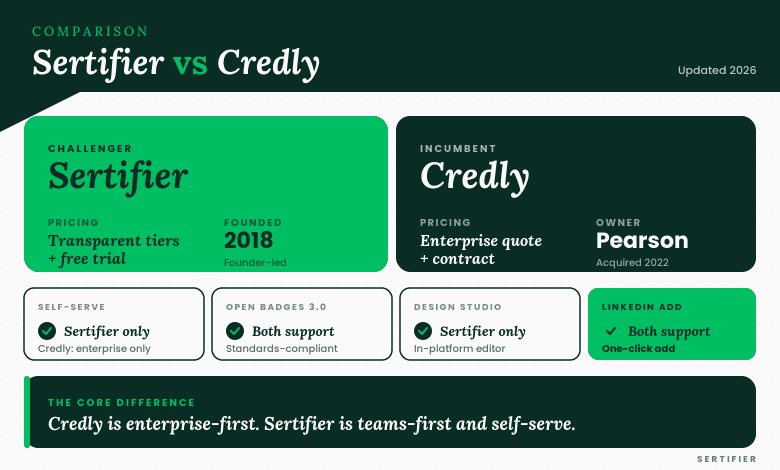
Sertifier and Credly are both digital credentialing platforms. Sertifier charges $1 per unique recipient per year above a 250-recipient free tier; Credly uses quote-based enterprise pricing. Sertifier is built for fast self-serve setup and recipient experience; Credly is part of Pearson and is most often used by enterprise certification bodies inside the Acclaim network.
If you are issuing credentials and trying to decide between the two, this guide gives you the comparison on pricing, setup, verification, integrations, and recipient experience. It also calls out when Credly is the better choice and when Sertifier is. Every feature claim in this page is verifiable on each vendor’s public pricing or product pages as of May 2026.

Sertifier vs Credly at a glance
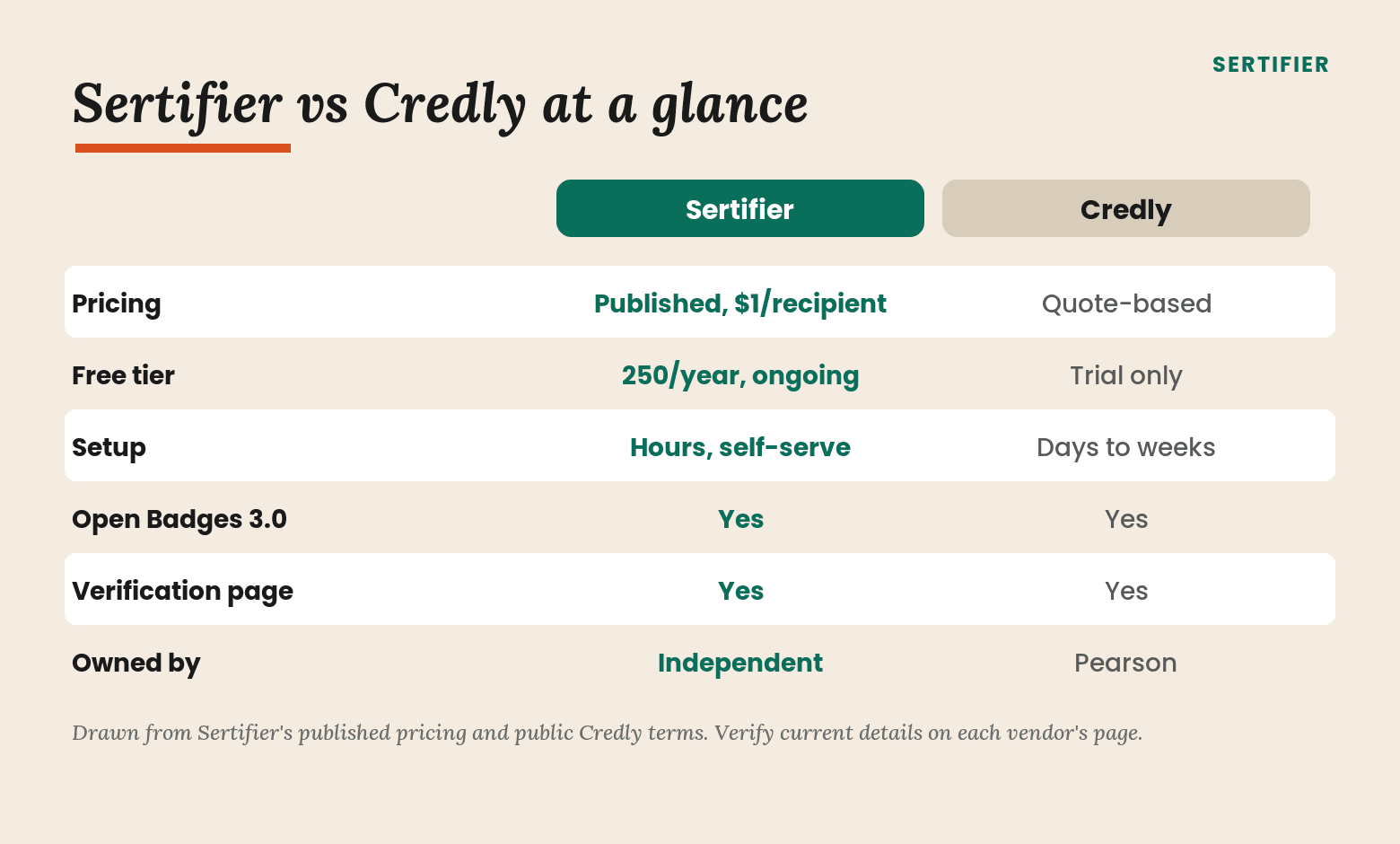
| Attribute | Sertifier | Credly (Pearson) |
|---|---|---|
| Pricing model | $1 per unique recipient per year above 250 free | Quote-based, enterprise |
| Volume discount | Yes, at tier breakpoints | Negotiated |
| Nonprofit and education discount | 20% off | Negotiated |
| Setup time | Hours, self-serve | Days to weeks |
| Recipient wallet | Yes (Sertifier wallet) | Yes (Acclaim) |
| LinkedIn one-click share | Yes | Yes |
| Verification page per credential | Yes | Yes |
| Blockchain anchoring | Optional, supported | Limited |
| Europass compliance | Native | Add-on |
| API | Yes | Yes |
| LMS integrations | Major LMSs supported | Major LMSs supported |
| Open Badges 3.0 | Supported | Supported |
| Multi-language | Yes | Limited |
| Owned by | Independent | Pearson |
| Free trial / free tier | 250 recipients free per year, ongoing | Free trial only |
Verify the latest details on each vendor’s pricing page before signing a contract. Both platforms iterate frequently.
How Sertifier compares on pricing
The biggest difference between Sertifier and Credly is pricing model, not pricing level.
Sertifier publishes its price: $1 per unique recipient per year above a free tier of 250 recipients, with volume discounts at higher tiers and a 20% discount for nonprofits and accredited educational institutions. A unique recipient is counted once per email per calendar year regardless of how many credentials they receive. See pricing for the current full breakdown.
Credly uses quote-based pricing for any meaningful volume. Smaller programs may not get a usable price quote at all; Credly’s sales model is tuned toward enterprise certification bodies issuing 50,000 credentials a year or more.
For a training provider issuing 5,000 credentials a year, Sertifier’s published math is $4,750 per year (5,000 minus 250 free, times $1). For Credly the price is whatever sales agrees to with you, typically settled by procurement.
The predictability of Sertifier’s price is the headline difference for programs under 50,000 credentials per year. The flexibility of Credly’s enterprise contracts is the difference for very-high-volume issuers with non-standard requirements.
How Sertifier compares on recipient experience
Sertifier and Credly both put credentials in a recipient-facing wallet with LinkedIn integration. The differences are in defaults and friction.
Sertifier sends each recipient a claim email with a one-click button to add the credential to LinkedIn. The recipient does not have to create a Sertifier account to claim or share. The wallet is optional, not required.
Credly’s recipient flow routes through the Acclaim network. Recipients create an Acclaim account, which then becomes the persistent home for any Credly credentials they collect. This is an advantage if you expect recipients to collect many Credly credentials over years; it is friction if your recipients are claiming a single credential from your program.
Both platforms support Open Badges 3.0, so a recipient who collects credentials from one and the other can keep them in a third-party wallet that aggregates both.
How Sertifier compares on verification and fraud prevention
Both platforms issue cryptographically signed credentials with a verification page per credential, hosted by the issuer. Both prevent forgery in the same way: a tampered credential fails signature verification.
Two specific differences are worth knowing.
First, blockchain anchoring. Sertifier supports optional blockchain anchoring for issuers who want a second layer of verification permanence (useful if the issuer’s verification page ever goes offline). Credly’s blockchain support is more limited and typically not a primary verification mechanism.
Second, issuer domain trust. Sertifier verification pages can live on a subdomain of the issuer’s own domain (for example, certs.your-organization.com), which inherits your organization’s domain trust. Credly verification pages live on credly.com or acclaim.com, regardless of who issued the credential. Both approaches work; they emphasize different brands.
How Sertifier compares on integrations and APIs
Both platforms have public REST APIs. Both support common LMS and HRIS integrations including major systems used by training providers and corporate L&D teams. Both let you bulk-issue credentials via CSV upload or API.
The practical difference is implementation speed. Sertifier’s self-serve setup means a small team can be issuing credentials within a day. Credly typically requires a longer onboarding process with a customer success representative. For very large enterprise issuers this is a feature, not a bug; for fast-moving training providers and education programs it is a delay.
When Credly is the better choice
There are clear cases where Credly is the right pick.
- You are already a Pearson partner or Pearson VUE customer, and Credly is the integrated default.
- Your recipients are professional certification holders (e.g., IT certifications) who already use Acclaim profiles and will benefit from the network effect.
- You issue 100,000 or more credentials per year and need enterprise-tier procurement and SLAs that Credly’s sales process is set up for.
- Your buyer or RFP explicitly requires Credly by name.
If any of these apply, Credly is a defensible choice and you do not need to switch.
When Sertifier is the better choice
Sertifier wins on five fronts for programs outside Credly’s enterprise sweet spot.
- Predictable, public pricing for programs from 500 to 50,000 credentials per year, with no negotiation cycle.
- Fast self-serve setup, typically hours rather than weeks.
- Native Europass compliance, important for EU education and training providers.
- 20% nonprofit and accredited educational institution discount.
- Recipient claim flow that does not force account creation.
If your program is in the training provider, higher education, corporate L&D, or professional association segment under 100,000 credentials per year, Sertifier is typically the better default.
How to switch from Credly to Sertifier
If you are currently on Credly and considering a switch, the migration usually takes a week. The standard path:
- Export your existing recipient list from Credly as a CSV.
- Sign up for Sertifier and configure your first credential template, matching your existing visual design.
- Decide whether to reissue all existing recipients (creating Sertifier-hosted credentials for them) or to start fresh with new credentials going forward.
- If reissuing, upload the CSV and issue. Each recipient gets a claim email from Sertifier.
- Update your website and internal documentation to point verification queries to Sertifier-hosted pages.
Recipients can keep their Credly credentials in parallel; nothing breaks when a new platform issues. The only consideration is which platform’s verification page you list as canonical going forward.
Frequently asked questions
Is Sertifier cheaper than Credly?
For most programs under 50,000 credentials per year, yes, Sertifier is cheaper at the published price ($1 per unique recipient per year above 250 free). For very high-volume enterprise programs, Credly’s negotiated pricing can be competitive. The bigger difference is predictability: Sertifier’s price is on the public pricing page; Credly’s is in a quote.
Can I use both Sertifier and Credly at the same time?
Yes. Some organizations run pilot programs on Sertifier while keeping legacy programs on Credly. Both platforms support Open Badges 3.0, so recipients can hold credentials from both in a third-party Open Badges wallet.
Does switching from Credly to Sertifier break existing verification links?
No. Credly verification links continue to work as long as your Credly account remains active. New credentials issued on Sertifier get Sertifier verification links. Recipients who want to display Sertifier credentials on LinkedIn use Sertifier’s one-click share button.
Are Sertifier and Credly both Open Badges compatible?
Yes. Both support Open Badges 3.0, the current open specification maintained by 1EdTech. This means credentials issued by either are verifiable by any Open Badges-compatible verifier.
Does Credly own the credentials it issues?
The credentials remain owned by the issuer and the recipient under Credly’s terms of service. The same is true of Sertifier. The difference is platform dependency: if either platform stops operating, the credentials issued on it become harder to verify unless they were also anchored externally (for example, via blockchain).
Can recipients combine credentials from Sertifier and Credly in one wallet?
Yes, using a third-party Open Badges wallet that supports the standard. Recipients with credentials from multiple issuers across multiple platforms commonly use a wallet aggregator for this.
Ready to compare side by side
If you want to see Sertifier in action with your own credential design, book a 15-minute walkthrough or start free with Sertifier pricing. The first 250 recipients per year are free.
Related reading
- What is a digital credential
- Digital badges: how they work and how to use them
- Credly alternatives: a requirements checklist and evaluation scorecard
- Credly alternatives: 6 honest options for 2026
- Sertifier pricing
For the broader landscape view, see our honest 2026 buyer’s guide covering Credly, Accredible, Sertifier, and six others against seven explicit criteria.