Skill Badges: A Practical Field Guide to Credentials, Evidence, and Verification
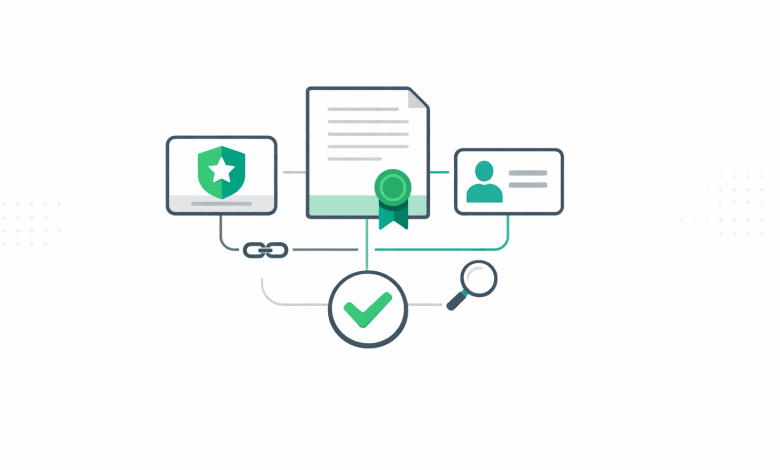
Skill badges can make skills-first hiring and internal mobility more practical—if they function as verifiable credentials rather than decorative icons. This field guide breaks down what a skill badge should represent, what evidence to attach, and what “verification” should mean when a badge is shared outside your system.
The opportunity is straightforward: people are actively searching for “skill badges,” but many results don’t answer the operational questions HR, L&D, and workforce development teams actually have. Use the frameworks below to design skill badges that stand up to scrutiny and support credential management at scale.
Key takeaways
- Define the badge as a credential: a skill claim plus issuer identity, criteria, and evidence.
- Evidence is the differentiator: attach artifacts and assessment context, not just a title.
- Verification must be independent: third parties should be able to validate authenticity and status.
- Governance prevents badge inflation: clear criteria, versioning, and revocation policies matter.
- Start small, design for scale: pilot one job family or program, then expand with a repeatable model.
What are skill badges?
Skill badges are digital credentials that represent a specific, defined skill claim (for example, “SQL joins” or “conflict de-escalation”) issued by an organization based on stated criteria and assessment.
A skill badge is most useful when it includes:
- Issuer identity (who issued it and how to contact/verify them)
- Criteria (what the learner had to do to earn it)
- Evidence (what proves the skill claim)
- Metadata (issue date, expiration if relevant, version, tags/skills)
- Verification path (how a third party validates it)
In practice, many teams use skill badges to make learning outcomes portable across programs, employers, and platforms—especially when the badge follows an interoperable standard like Open Badges. For standard details, see the official documentation from the standards community: IMS Global Open Badges specification.
Skill badges vs. other credentials (quick comparison)
Skill badges sit in a larger credential ecosystem. The question isn’t “badges vs. certificates,” but “which credential type best communicates the claim and evidence to the audience who must trust it?”
| Credential type | Best for | Typical evidence expectation | Verification expectation | Watch-outs |
|---|---|---|---|---|
| Skill badges | Discrete skills; skills-first pathways; stackable micro-credentials | Assessment artifacts, rubric results, work samples, proctoring context (when relevant) | Public or shareable verification that confirms issuer, criteria, and status | Badge inflation if criteria are vague or evidence is missing |
| Digital certificates | Course/program completion; time-bounded training; compliance documentation | Completion record, hours, syllabus, assessment summary | Recipient and third-party verification of authenticity and status | Completion alone may be misread as competency |
| Micro-credentials | Competency bundles; role-aligned capability sets; stackable pathways | Multiple assessments and artifacts mapped to outcomes | Verification plus clarity on what stacks into what | Confusion if naming, levels, or stack rules are inconsistent |
| Licenses/certifications (formal) | Regulated or industry-controlled qualifications | Exam and eligibility requirements managed by an external authority | Authoritative registry verification | May not cover granular skills needed for internal mobility |
One practical rule: use skill badges when you want to communicate a specific skill claim with attached proof, and use other credentials when the claim is primarily completion or authority-based qualification.
The evidence model: what to attach to a skill badge
Evidence is what turns a skill badge into a decision-ready credential for hiring managers, supervisors, and external partners. Without evidence, the badge forces the reviewer to “trust the label,” which is exactly what most reviewers refuse to do.
A practical evidence framework (what reviewers need to know)
- What was assessed? Name the skill and the performance context (task, scenario, project).
- How was it assessed? Rubric, test, observation checklist, simulation, portfolio review.
- Who assessed it? Trainer, instructor, employer evaluator, proctor, panel—plus qualifications if relevant.
- What does “passing” mean? Clear criteria, thresholds, and any required components.
- When and where was it assessed? Date and environment (in-person, remote, proctored, workplace).
Evidence types that work (choose what fits the risk level)
- Rubric score report (highly scannable; good for reviewers)
- Work sample or artifact (code snippet, writing sample, design output, lab result)
- Portfolio link (best when curated and tied to a rubric)
- Supervisor/assessor attestation (useful with defined criteria and identity controls)
- Scenario/simulation results (good for customer-facing and safety-critical skills)
Evidence should be privacy-aware. For example, you may need to avoid attaching personally identifiable information, proprietary work product, or sensitive client data. In those cases, a redacted artifact plus a rubric summary can still be meaningful.
Decision checklist: how much evidence is enough?
- Low-stakes internal use (team development): criteria + basic assessment summary may be sufficient.
- Hiring or partner-facing: include a rubric summary and an artifact or portfolio reference.
- Compliance, safety, or high-risk work: require stronger identity checks, controlled assessments, and auditable records.
If you’re building a broader credential program (badges plus certificates), keep your issuance workflow and evidence policy consistent. A good credential management system should make it easy to standardize fields, map skills to criteria, and keep evidence accessible without manual admin work.
Verification 101: what “verifiable” should mean for skill badges
Verification is the ability for a third party to confirm that a skill badge is authentic, unaltered, and currently valid—without needing to email the issuer or trust a screenshot.
Minimum verification requirements (non-negotiables)
- Issuer authenticity: the verifier can confirm who issued the badge.
- Integrity: the badge data (criteria, recipient, issue date) hasn’t been tampered with.
- Status: the verifier can see whether it is active, expired, or revoked.
- Evidence access controls: evidence is available in a secure way, with appropriate permissions.
Where “blockchain” fits (and where it doesn’t)
Blockchain is sometimes used as an integrity layer to help prove that credential records were not altered after issuance. It can be useful in designs where public, tamper-evident anchoring matters.
However, blockchain is not the same as verification. You still need:
- Clear issuer identity and domain control
- Revocation/expiration handling
- A human-readable verification experience for employers and partners
- Privacy controls for evidence and recipient data
In other words: blockchain can support verifiability, but it doesn’t replace strong credential governance and a reliable verification endpoint.
Security and procurement questions to ask vendors
- Data ownership and portability: Can recipients export their credentials in a standard format?
- Revocation: Can you revoke badges and do verifiers see the updated status?
- Access controls: Can evidence be restricted while keeping the credential verifiable?
- Audit trail: Can you track issuance, updates, and administrative actions?
- Integration: Does it connect to your LMS/LXP/HRIS and enrollment systems?
Asset: Skill Badge Design & Governance Checklist (downloadable section)
Use this as your internal field guide for designing skill badges that are defensible and scalable. You can copy/paste it into a doc and use it as a working checklist.
1) Badge definition (the claim)
- Skill statement is specific and observable (not a broad trait like “leadership”).
- Skill aligns to a role task, competency framework, or program outcome.
- Badge level is defined (intro/intermediate/advanced or equivalent) and consistent.
- Badge name avoids ambiguous marketing language; it matches the criteria.
2) Criteria and assessment
- Criteria are written so two evaluators would score consistently.
- Assessment method is documented (rubric, test, observation, simulation).
- Assessor qualifications and training are defined (when relevant).
- Retake policy is clear.
- Accommodations policy exists for accessibility.
3) Evidence model
- Evidence requirements are defined by risk level (internal vs external use).
- Evidence storage and retention are defined.
- Privacy review completed (PII, proprietary info, client data).
- Evidence is linked directly to the criteria (not generic attachments).
4) Verification and lifecycle
- Public verification page or endpoint is available.
- Expiration rules are defined where skills decay or policy changes apply.
- Revocation policy is defined and operational.
- Badge versioning is supported (criteria updates don’t silently change older badges).
5) Governance and operations
- Owner named (program owner) and issuer admin roles assigned.
- Approval process defined for creating new badges.
- Naming taxonomy and tagging rules documented.
- Quality review cadence set (criteria drift, assessor consistency, evidence sampling).
- Communications plan created for learners and verifiers (how to share and verify).
Stakeholder map (who cares and why)
- HR/Talent Acquisition: needs confidence that the badge reflects real skill, not participation.
- L&D: needs a scalable issuance workflow and consistent criteria across programs.
- Workforce development/program teams: needs portability and partner trust.
- Hiring managers: wants quick, decision-ready evidence tied to job tasks.
- IT/Security: cares about access controls, auditability, and data handling.
- Legal/Compliance: cares about privacy, record retention, and defensibility.
Common pitfalls (and how to avoid badge inflation)
Badge inflation happens when the number of badges grows but trust and clarity don’t. The fix is usually not “issue fewer badges,” but “tighten definitions, evidence, and governance.”
Pitfall: vague skill claims
- What it looks like: badges like “Communication” with no context.
- Fix: define the skill in job-task language (e.g., “Deliver difficult feedback using a structured model”).
Pitfall: criteria that describe effort, not competency
- What it looks like: “Attended training” or “Completed module.”
- Fix: require a performance check (rubric, scenario, or artifact) and publish the criteria.
Pitfall: no lifecycle controls
- What it looks like: badges never expire, can’t be revoked, and old versions remain indistinguishable.
- Fix: define expiration where appropriate, enable revocation, and use versioning for criteria updates.
Pitfall: evidence that can’t be shared
- What it looks like: evidence is internal-only, behind a login, or contains sensitive information.
- Fix: design “shareable evidence” options: rubric summaries, redacted artifacts, or controlled-access evidence.
Pitfall: too many micro-badges with no pathway
- What it looks like: dozens of badges with unclear relationships.
- Fix: create stack rules (which skill badges build into a larger credential) and publish the pathway map.
Implementation path: from pilot to program
Skill badges work best when you start with a narrow, high-value use case and expand only after your evidence and verification model is stable.
Implementation steps (for workforce development teams, HR/L&D, and training orgs)
- Pick a bounded pilot scope: one job family, one program, or one partner pathway with clear outcomes.
- Define 5–15 skill claims: focus on observable skills tied to tasks and assessments you can operationalize.
- Write criteria and rubrics: make grading consistent across assessors; document assessor roles.
- Design the evidence model: decide what gets attached vs summarized; complete a privacy review.
- Set verification requirements: public verification, revocation/expiration rules, versioning approach.
- Choose your credential format: align to interoperable credential standards when portability matters.
- Build issuance workflows: automate issuance from your LMS/LXP where possible; define exception handling.
- Launch and train stakeholders: teach learners how to share; teach reviewers how to verify.
- Audit and iterate: sample issued badges for criteria consistency and evidence quality; adjust governance.
Operational model: who runs what
- Program owner: owns the skill framework, badge catalog, and quality bar.
- Assessment lead: maintains rubrics and assessor training.
- Credential admin: manages templates, issuance rules, and lifecycle actions.
- Security/privacy reviewer: approves evidence handling patterns.
Decision checklist: are you ready to scale?
- You can explain each badge’s claim, criteria, and evidence in under a minute.
- Verification works for an external reviewer without emails or screenshots.
- You have a repeatable process for new badge requests and approvals.
- Revocation, expiration, and versioning are operational (not theoretical).
- Your badge catalog maps to pathways (stacking) or business outcomes (roles, mobility, partner needs).
People Also Ask (FAQ)
Are skill badges the same as digital badges?
Skill badges are a type of digital badge. The difference is the claim: a skill badge is specifically intended to represent a defined skill and is most credible when paired with assessment criteria and evidence.
What makes a skill badge credible to employers?
Credibility comes from clear criteria, strong evidence, and verification that confirms issuer identity and current status. A badge title alone is rarely enough for hiring decisions.
Should skill badges expire?
Sometimes. If the skill changes quickly, depends on policy updates, or affects safety/compliance, expiration can improve clarity. If the skill is durable, you may keep it non-expiring but still version criteria over time.
Do skill badges need blockchain to be verifiable?
No. Blockchain can be used as an integrity layer, but verifiable skill badges mainly require a trustworthy issuer, tamper-resistant credential data, and a reliable way to check status (including revocation and expiration).
How do skill badges fit with other credentials like certificates?
They complement each other. Certificates often represent completion, while skill badges can represent specific demonstrated competencies. Many programs issue both: a completion certificate plus skill badges tied to assessed outcomes.
Conclusion: design skill badges as verifiable credentials, not just recognition
Skill badges are most useful when they reduce uncertainty for the person making a decision—hiring, promotion, placement, or partner acceptance. That requires a disciplined evidence model, verifiable credential mechanics, and governance that prevents badge inflation.
If you want a system to issue, manage, and verify digital credentials with consistent workflows, Sertifier is built for credential management at scale.
CTA block: If your team is juggling manual issuance, inconsistent badge criteria, or employer questions about authenticity, a centralized credential platform can standardize evidence, verification, and lifecycle controls without adding admin overhead.