Award certificate examples and wording: 15 free templates
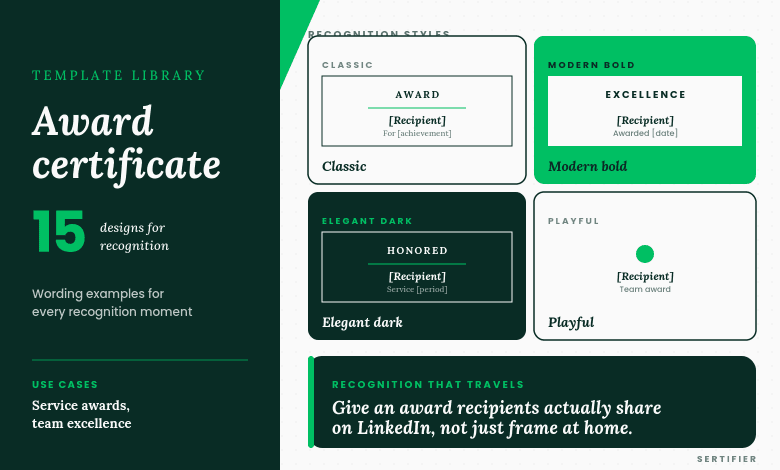
An award certificate is a written recognition of distinction. It names the recipient, the award, the awarding body, and the reason for the award. Unlike a certificate of completion, which documents participation, an award certificate documents excellence.
This page has 15 free award certificate templates organized by use case, award certificate wording examples you can copy (employee, leadership, academic, quiet achiever, and more), and one practical upgrade: how to make the award shareable and verifiable, so the recipient can use it on LinkedIn and an employer can confirm it.

When to issue an award certificate
Three common contexts:
- Employee recognition. Performance, tenure, behavior, peer-nominated awards. The most common use case in corporate settings.
- Academic recognition. Honor roll, dean’s list, subject distinction, scholarship awards.
- Event and competition recognition. Winner, runner-up, participation distinction, best-in-category.
The design and tone should match the context. A “Best Sales Performance” award uses different design language than a “Reading Champion” award for a sixth-grader, even though both are award certificates.
15 award certificate templates
Employee recognition (5 templates)
- Employee of the month award template: classic monthly recognition design. Photo placeholder optional.
- Years of service award template: elegant, formal design with variants for 1, 5, 10, and 25 year tenure.
- Performance excellence award template: sleek, modern design suitable for sales, customer service, and engineering teams.
- Innovation award template: energetic design for ideas that shipped and shaped the business.
- Team award certificate template: designed for group recognition with space for multiple recipient names.
Academic awards (4 templates)
- Honor roll award template: traditional school certificate format with seal placeholder.
- Dean’s list award template: formal university-style certificate with space for GPA and term.
- Subject distinction award template: focused on a specific course or subject (mathematics, writing, leadership, etc.).
- Scholarship award template: premium design suitable for scholarship recipients, with space for award amount and donor.
Event and competition (3 templates)
- Winner certificate template: bold, celebratory design for first-place finishers.
- Best in category award template: structured design with space for category name and selection criteria.
- Participation distinction award template: warmer than a plain participation certificate, designed for recipients who showed exceptional effort without winning.
Recognition and behavior (3 templates)
- Service excellence award template: focused on customer-facing teams.
- Above and beyond award template: flexible design for ad-hoc recognition.
- Peer nomination award template: designed to highlight that the award came from coworkers, not management.
Each template includes a placeholder for the verification link, which is what separates a hanging-on-the-wall award from a credential the recipient can use on LinkedIn or in their resume.
Award certificate wording examples
The wording carries most of the weight on an award certificate. Eight patterns to adapt:
For employee recognition
Presented to [Recipient Name] in recognition of [Specific Achievement] during [Quarter or Year]. Your contribution exemplifies the standard we hold for the [Team or Function] team.
Awarded [Date] by [Awarding Manager].
For tenure
In appreciation of [Recipient Name] for [Number] years of service to [Organization Name]. Your commitment to [Specific Theme] has made this team stronger.
[Date], [Organization Name].
For academic excellence
This is to certify that [Recipient Name] has been awarded [Award Name] for the [Term] term in recognition of [Specific Achievement].
[Awarding Institution], [Date].
For competition
First place in the [Category] category of [Competition Name] is awarded to [Recipient Name] for [Specific Submission or Performance].
Judged by [Judging Panel or Person] on [Date].
For peer recognition
The [Award Name] is awarded to [Recipient Name] by their colleagues, in recognition of [Specific Behavior or Contribution]. This recognition comes from people who work with you every day.
[Date], [Organization Name].
For leadership
The [Leadership Award Name] is presented to [Recipient Name] for leading [Team, Project, or Initiative] with clarity and accountability. Under your direction, [Specific Measurable Outcome].
Awarded [Date] by [Organization Name].
For a quiet achiever
The Quiet Achiever Award is presented to [Recipient Name], whose consistent, dependable work on [Specific Area or Project] rarely asks for attention and always earns it. This award notices what you hoped no one had missed.
[Date], [Organization Name].
For a certificate of recognition
This certificate of recognition is presented to [Recipient Name] in acknowledgement of [Specific Contribution, e.g. an outstanding research submission, sustained community service, or exceptional mentorship]. Your work has set a standard for [Team, Field, or Community].
Recognized by [Awarding Body] on [Date].
Match the formality of the wording to the audience. Stiff corporate language on a peer-nominated award reads as inauthentic.
What every award certificate should include
- Recipient name spelled exactly as preferred
- Award title specific enough to identify what was recognized
- Reason for the award in one or two sentences (specific behavior, achievement, or milestone)
- Awarding organization or person
- Date of the award
- Verification mechanism (signature, seal, or verification link)
The reason field is the most often skipped, and it is the field that makes the award durable. An award certificate that says only “Employee of the Month” tells a future employer nothing. One that says “Employee of the Month, March 2026, for leading the data warehouse migration without downtime” tells a story.
Make the award verifiable
A printed award certificate is a private artifact. A verifiable digital credential is a public one. The recipient can share it on LinkedIn, an employer can verify it, and your organization’s brand travels every time the recipient posts it.
The practical difference: a recipient with 500 LinkedIn connections who shares a verified award introduces your brand to all 500 contacts. A recipient with the same award hanging on their wall introduces it to nobody outside their household.
Modern credentialing platforms produce a printable PDF version of any award template alongside a digital credential version, from one credential record. The recipient downloads the PDF for personal use and shares the digital version on LinkedIn. Sertifier handles this case at $1 per unique recipient per year above a 250-recipient free tier. See pricing.
Common mistakes when issuing award certificates
- No specific reason given. Awards without a reason read as participation trophies.
- Identical wording across recipients. Generic awards are forgettable. Customize the reason field.
- Wrong recipient name spelling. Confirm with the recipient before issuing.
- No verifiable record. A printed award that cannot be verified externally is a one-time decorative gesture, not a credential.
- Award inflation. If everyone gets one, no one earns one. Reserve awards for genuine distinction.
Frequently asked questions
What is the difference between an award certificate and a certificate of recognition?
An award certificate names a specific honor (e.g., “Innovation Award 2026”). A certificate of recognition acknowledges a behavior or contribution without naming a specific honor. Practically, the two are often used interchangeably; the difference is mostly tone.
Can I issue an award certificate to a team?
Yes. Group-recipient award templates accommodate multiple names. Best practice is to also issue individual versions to each team member with their name on it, because individuals share individual credentials more than group ones.
What size should an award certificate be?
Most printed award certificates use Letter size (8.5 x 11 inches) in the US or A4 in the rest of the world. Digital versions used for LinkedIn sharing should be optimized for a 1:1 aspect ratio at minimum 600×600 pixels.
Do award certificates expire?
Not as documents. The recognition itself does not expire. The relevance can diminish over time; an award from 15 years ago is less compelling on a resume than one from last year.
Can I make my own award certificate template?
Yes. Use the 15 above as starting points, then customize with your organization’s brand colors, typography, and logo. Keep one consistent template per award type for recognition durability across cohorts.
Should the awarder sign the certificate physically?
A scanned or designed signature is fine for digital award certificates. The signature is symbolic; the verification link is what carries authenticity weight.
How do I make an award certificate that recipients will actually share?
Three steps: pick a design they will be proud to put on LinkedIn (clean, on-brand, legible at thumbnail), write a specific reason (not generic), and provide a one-click LinkedIn share button. Most recipients of recognition want to share it; the platform usually fails them, not the other way around.
Related reading
- Certificate of completion: template, wording, and verification
- Certificate of appreciation: 23 free examples and wording
- What digital badges are and how to use them
- Sertifier pricing
For student-specific recognition awards, see our 12 scholarship certificate templates with wording examples and the verifiable digital variant.
For nonprofit and community recognition variants, see our 10 volunteer certificate templates with wording examples for community service, charity events, and milestone hours.