Skill Badges: A US Guide to Digital Credentials, Verification, and Program Design
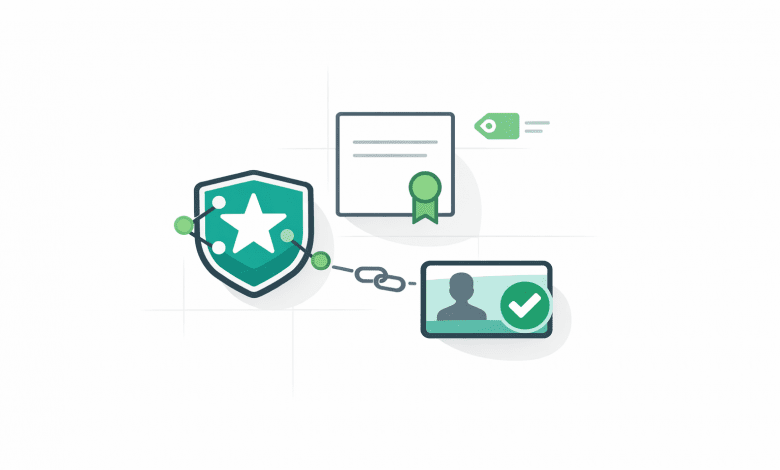
Skill badges are digital credentials that represent a specific, verifiable capability—often tied to defined criteria and evidence—rather than just participation. For US L&D leaders and credential program owners, they’re a practical way to make skills visible, portable, and easier to validate across teams, partners, or customers.
Key takeaways
- Skill badges validate a defined capability; certificates often confirm attendance or completion.
- Credible programs specify criteria, evidence, and verification—not just a design.
- Employer-friendly verification means confirming who earned it, what was assessed, when, and by whom.
- Governance (naming, levels, audits, renewals) protects trust as your badge catalog grows.
Decision checklist
- Is the goal to validate skill or confirm participation?
- Can you define measurable criteria and acceptable evidence?
- Do employers or internal stakeholders need verification beyond a PDF?
- Will the skill expire or require periodic reassessment?
- Do you have owners for content, assessment, issuance, and audit?
What “skill badges” mean (and how they differ from certificates)
A skill badge is a digital credential that signals proficiency in a specific skill area. It should be tied to transparent criteria and a method for verification so a third party can understand what was required to earn it.
A certificate of completion usually indicates that a learner finished a course, program, or required activities. It may not prove mastery; it proves completion unless paired with an assessment standard you can explain and verify.
In practice, many organizations use both: certificates for participation milestones and badges for demonstrated skills. The key difference is the decision the credential supports: “they completed it” vs “they can do it.”
When to use skill badges vs a certificate of completion
Use this as a decision lens: what risk is the credential meant to reduce? If the credential will influence hiring, staffing, promotion, partner eligibility, or customer trust, the bar for clarity and verification should be higher—often a better fit for skill badges.
| Use case | Better fit | Why | What to include |
|---|---|---|---|
| Course participation (onboarding, webinars, compliance reading) | Certificate of completion | Confirms attendance or completion without claiming proficiency | Course title, dates, issuer, completion requirement |
| Role readiness (internal mobility, staffing decisions) | Skill badges | Signals capability tied to criteria and evidence | Skill criteria, assessment method, evidence type, expiration/renewal |
| Partner enablement (reseller/service partner eligibility) | Skill badges | External stakeholders need consistent verification | Public verification page, issuer identity, versioning, renewal |
| Customer training milestones (product education) | Both | Completion for milestones; badges for applied skills | Certificate for modules; badge for hands-on assessment |
| Portfolio-based learning (projects, capstones) | Skill badges | Evidence can be linked and evaluated | Project rubric, reviewer, evidence link, issue date |
Common failure modes (and how to avoid them)
- Over-claiming. Issuing a badge for attendance but naming it like a competency. Fix by aligning the name to what was actually assessed.
- Vague criteria. “Demonstrates understanding” without measurable standards. Fix by writing observable outcomes and minimum passing thresholds (even if internal).
- No evidence pathway. Stakeholders can’t tell what work supports the credential. Fix by defining acceptable evidence types and reviewer rules.
- No lifecycle plan. Skills change; credentials without renewal can become misleading. Fix by adding renewal triggers or versioning.
Verification basics: what employers should be able to confirm
Skill badge verification should answer the questions a recruiter, hiring manager, partner manager, or internal talent team will ask. If your credential can’t answer these clearly, it will be discounted—even if the training was strong.
Minimum verification expectations
- Issuer identity: Who issued the badge (organization, program, or business unit)?
- Recipient identity: Who earned it and how identity was matched at issuance.
- Criteria: The required competencies, tasks, or learning outcomes.
- Assessment method: Exam, rubric-scored project, observation, manager sign-off, or proctored evaluation.
- Evidence: What artifacts or records support the award (where appropriate and privacy-permitting).
- Issue date and status: When it was earned and whether it’s active, expired, or revoked.
- Versioning: Which standards or curriculum version the badge aligns to.
Privacy and security considerations (practical, not theoretical)
- Data minimization: Don’t expose more personal data than needed for verification.
- Access controls: Decide what is public vs private (especially for evidence links and assessment details).
- Revocation: Ensure you can revoke a credential if issued in error or if eligibility is later invalidated.
- Audit trail: Keep an internal record of who approved criteria changes and who issued badges.
If you’re aligning your program to established formats for portable credentials, review the Open Badges specification (1EdTech) to understand what structured credential metadata typically includes.
Asset: Skill Badge Program Blueprint (scope → criteria → evidence → issuance → verification → renewal)
Use this blueprint to design a credible badge program that stakeholders can trust and learners can use. Treat it as your operating model, not just documentation.
1) Scope
- Audience: Employees, customers, partners, or applicants.
- Decision supported: Hiring screen, role placement, partner tiering, access to advanced training, or compliance readiness.
- Skill domain: Narrow and specific (one badge should not cover an entire job).
2) Criteria
- Competency statements: Observable outcomes (what the earner can do).
- Performance standard: What “good enough” means for each outcome.
- Eligibility rules: Prerequisites, required training, or experience.
3) Evidence
- Evidence types: Assessment score, rubric-evaluated project, supervisor attestation, work sample, lab performance.
- Storage and access: Where evidence lives and who can view it.
- Retention policy: How long you keep evidence and how you handle deletions.
4) Issuance
- Issuing authority: Who can approve issuance (L&D, program manager, proctor, manager).
- Automation: When issuance is automatic vs requires review.
- Exception handling: Appeals, re-tests, and manual corrections.
5) Verification
- Verification experience: A clear page that shows issuer, criteria, dates, and status.
- Sharing options: Link-based verification and exportable credential records.
- Revocation and updates: How verifiers see changes (expired, revoked, updated version).
6) Renewal
- Expiration rules: If the skill must be current, define an end date.
- Renewal pathways: Reassessment, continuing education, or updated project submission.
- Version transitions: How earners move from old to new standards without confusion.
If you’re building a broader credential ecosystem, use consistent definitions and flows across digital credentials so badges, certificates, and micro-credentials don’t become separate, conflicting systems.
Metadata & governance: naming, levels, and audit trail
Governance is what keeps a badge program credible when it scales. Without it, you get duplicates, inconsistent levels, unclear meaning, and verification friction.
Naming standards (make meaning obvious)
- Use skill-first titles: “Data Visualization: Dashboards” is clearer than “Analytics Level 1.”
- Avoid overloaded terms: If you use “certified,” define the assessment rigor behind it.
- Include context when needed: Product, framework, or role family—only if it helps a third party understand scope.
Levels (set expectations, reduce arguments)
- Define level logic: Beginner/intermediate/advanced must map to different criteria and evidence, not just more hours.
- Protect the top tier: Highest levels should require stronger evidence and stricter review controls.
- Document equivalencies: If a badge maps to internal job levels or partner tiers, record that mapping.
Audit trail (who changed what, and why)
- Criteria change log: Track edits to outcomes, rubrics, and cut scores.
- Issuance log: Who issued, when, and under what rule set/version.
- Exception log: Waivers, appeals, and manual overrides with approver identity.
Stakeholder mapping (who cares and why)
- L&D / Training Ops: Operational workflow, scalability, reporting, and consistency.
- HR / Talent: Skill signal quality, internal mobility, and defensible standards.
- Business leaders: Role readiness, partner/customer enablement, and performance outcomes (defined internally).
- Legal / Compliance: Claims language, privacy, and record retention.
- Security / IT: Access control, integrations, and data handling.
How to launch in 30 days (minimum viable badge program)
A minimum viable badge program prioritizes credibility and verification over a large catalog. Launch small, prove the workflow, then expand.
Implementation steps
- Pick one high-signal skill badge. Choose a skill tied to a real decision (role readiness, partner eligibility, or customer capability).
- Write criteria in plain language. Limit to a small set of measurable outcomes and define what passing looks like.
- Select one assessment method. Keep it operational: a scored quiz plus a rubric project, or a rubric project with reviewer sign-off.
- Define evidence handling. Decide what evidence is stored, for how long, and what is shareable on a verification page.
- Set issuance rules. Identify who can issue, what triggers issuance, and how you handle re-tests and appeals.
- Build verification requirements. Ensure verifiers can see issuer, criteria, date, status, and version.
- Publish governance basics. Naming conventions, level definitions (if used), and a change-control owner.
- Pilot with a small cohort. Use the pilot to validate operational load, review time, and learner questions.
- Review failure modes. Look for confusing names, weak criteria, verification gaps, and inconsistent reviewers.
- Decide on renewal. If the skill needs to stay current, define expiration and a renewal path before scaling.
As you expand beyond a pilot, keep your badge and digital credentials architecture consistent so verification and governance scale cleanly across programs.
FAQ: credentials, blockchain, and trust (People Also Ask)
Are skill badges considered credentials?
Yes. Skill badges are a type of credential when they represent an achievement backed by defined criteria and a way to verify the award. The more explicit the criteria and verification, the more useful the credential is for employers and internal decision-makers.
Do I still need a certificate of completion if I issue skill badges?
Often, yes. A certificate of completion is useful for documenting participation or fulfilling an administrative requirement. Skill badges are better when you need to communicate verified capability, not just completion.
What makes a skill badge “trusted”?
Trust comes from clarity and controls: transparent criteria, a credible assessment method, consistent issuance rules, and a verification experience that confirms identity, status, and version. Governance and an audit trail protect trust over time.
Do digital badges require blockchain?
No. Some credential systems may use blockchain concepts, but many trusted verification approaches rely on structured metadata, issuer identity, and verifiable records without requiring blockchain. Focus first on clear criteria, evidence, and verification workflows.
What should an employer be able to verify from a badge?
At minimum: who issued it, who earned it, what the criteria were, when it was issued, whether it is active/expired/revoked, and which version of the standard it aligns to. If appropriate, the employer should also be able to understand the assessment method behind it.
Can skill badges expire?
Yes. If a skill changes quickly or is tied to a product/version, consider expiration and renewal so the credential remains accurate. If the skill is stable, you may keep it non-expiring but still version the criteria when standards change.
Conclusion: design skill badges for decisions, not decoration
Skill badges work when they reduce uncertainty for a real stakeholder—hiring, staffing, partner readiness, or customer capability. Start with one badge, define criteria and evidence, make verification straightforward, and put governance in place before you scale.
If you’re managing multiple programs, manual issuance, or employer verification requests, a structured workflow matters. A badge program should be easy to issue, easy to verify, and easy to audit—without creating extra work for L&D and training ops.