Certificate of completion for construction: free template
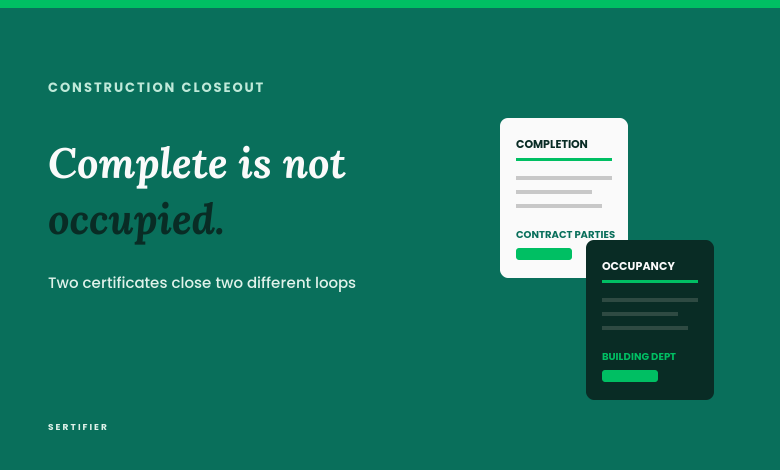
Short answer: a certificate of completion for construction is the document that records a project, or a defined phase of it, as finished according to the contract. It is issued by the contractor, the architect, or the owner’s representative, and it is not the same thing as a certificate of occupancy, which only the local building authority can issue. The template and wording below cover final completion, substantial completion, and the trade-contractor version.
What a construction certificate of completion is
The certificate marks the contractual finish line. It states what was built, under which contract, for whom, and when the work was completed, and it carries the signatures that make that statement binding. Owners use it to release final payment, close out retainage, and start warranty clocks; contractors use it as the record that their obligations ended on a date.
Many projects issue two versions. A certificate of substantial completion records the date the work became usable for its intended purpose, even with a punch list outstanding. The final certificate of completion follows when every item is closed.
Not a certificate of occupancy
A certificate of occupancy states the legal use and permitted occupancy of a building, and it comes from the local building department after inspections, not from the parties to the contract. New York City’s Department of Buildings, for example, issues the CO only after final inspection sign-offs and open violations are resolved. A contractor’s certificate of completion has no authority over occupancy; the two documents close different loops.
The certificate of completion template
- Project name and full site address
- Owner or client name
- Contractor name and license number where applicable
- Contract or project reference number
- Scope statement: what work is being certified complete
- Type of completion: substantial or final
- Completion date
- Signatures: contractor and owner or architect, with date of signing
- Optional: a verification QR code that resolves to the live document
Wording you can copy
Final completion
“This certifies that the work described in contract [number] between [owner] and [contractor] at [project address] was completed on [date] in accordance with the contract documents. All punch list items have been resolved and all contractual obligations relating to the work are fulfilled.”
Substantial completion
“The work at [project address] under contract [number] reached substantial completion on [date], on which date the work became available for its intended use. The attached punch list identifies the items to be completed or corrected, which the contractor shall finish by [date].”
Trade or subcontract completion
“This certifies that [subcontractor] completed the [trade] scope of work at [project address] on [date] in accordance with subcontract [number], and that the work was inspected and accepted by [name, title].”
The three documents at a glance
| Document | Who issues it | What it proves |
|---|---|---|
| Certificate of substantial completion | Contract parties (often certified by the architect) | Work is usable for its intended purpose; punch list remains |
| Certificate of completion (final) | Contract parties | All contracted work and punch list items are done |
| Certificate of occupancy | Local building department | The building may legally be occupied for a stated use |
Where the certificate sits in project closeout
The completion certificate is rarely a ceremonial document; money and risk key off it. Final payment applications and the release of retainage typically reference the certified completion date. Warranty and defects-liability periods usually start from substantial completion, which is why that certificate must state its date unambiguously.
It also anchors the handover package. Alongside as-built drawings, operation and maintenance manuals, and inspection sign-offs, the certificate is the one page that says when responsibility shifted from builder to owner. Keep the scope statement specific: “the work under contract [number]” ages better in a dispute than “all works at the site.”
Common mistakes
The recurring ones: not stating whether the certificate records substantial or final completion, which muddies warranty start dates; a missing contract reference, which detaches the certificate from the scope it certifies; one-party signatures where the contract requires countersignature; and issuing nothing at all for phased handovers, leaving each phase’s completion date to be reconstructed from emails later.
Completion certificates for construction training
The same document type shows up on the people side of construction: safety courses, equipment training, and induction programs all end with a completion certificate for the worker. If that is your case, the verifiable certificate of completion guide covers wording and structure for training, and the completion certificate templates give you ready layouts.
Making project certificates verifiable
Completion certificates get attached to payment claims, warranty disputes, and property records for years after signing, and a PDF in an email chain is easy to alter and hard to authenticate later. Issuing the certificate as a verifiable digital document fixes that: anyone holding the document can resolve its QR code to the issuer’s live record and confirm the parties, the scope, and the date.
Sertifier issues these as digital certificates with tamper-proof verification, and the construction completion certificate template is a ready starting point for the layout.
Frequently asked questions
Who issues a certificate of completion for construction?
One of the parties to the contract: typically the contractor certifies and the owner or the architect countersigns acceptance. On administered contracts the architect or engineer issues it. It is a private contractual document, unlike permits and occupancy certificates.
Is a certificate of completion the same as a certificate of occupancy?
No. The certificate of occupancy is issued by the local building department and governs whether the building may legally be occupied. The certificate of completion is issued by the contract parties and records that the contracted work is done. A project often needs both.
What is the difference between substantial and final completion?
Substantial completion is the date the work can be used for its intended purpose even though punch list items remain. Final completion is the date every remaining item is closed. Payment releases and warranty periods commonly key off one or the other, so the certificate should name which type it certifies.
What should the certificate include?
Project name and address, the parties, the contract reference, the certified scope, the type of completion, the completion date, and signatures. A verification QR code makes the document checkable years later without chasing the original signers.
Next steps
Pick the wording that matches your completion type, anchor it to the contract reference, and make sure both signatures land before handover. For firms that also certify training, the same account issues both project and personnel certificates: see pricing for what the free tier covers.