Forklift certification card template: what OSHA requires
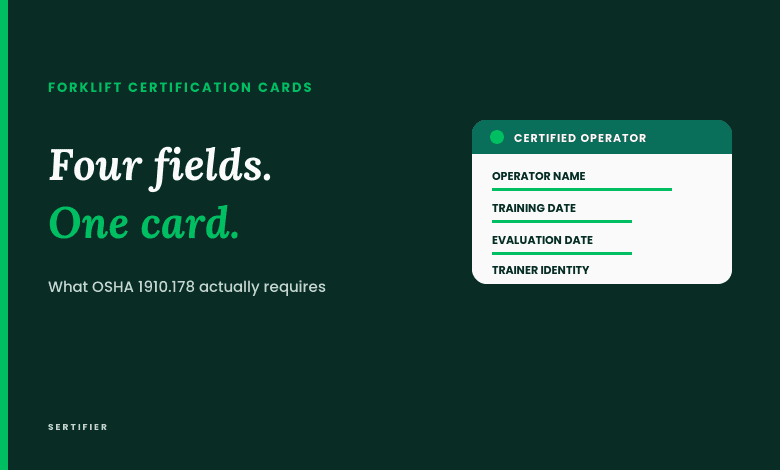
Short answer: a forklift certification card is proof that an operator has been trained and evaluated under OSHA’s powered industrial truck standard. OSHA does not require a wallet card, but it does require the employer to keep a certification record with four exact fields: the operator’s name, the training date, the evaluation date, and the identity of the person who did the training or evaluation. A card is simply the portable version of that record, and the template below covers everything it needs.
What OSHA actually requires
The requirement lives in 29 CFR 1910.178(l)(6). The employer, not a third party, certifies that each operator has been trained and evaluated. The certification must include the name of the operator, the date of the training, the date of the evaluation, and the identity of the person or persons performing the training or evaluation.
Two related rules shape the card’s lifecycle. Under 1910.178(l)(4)(iii), an evaluation of each operator’s performance must be conducted at least once every three years, so a card without an evaluation date is incomplete. And under 1910.178(l)(2)(iii), all training and evaluation must be conducted by persons with the knowledge, training, and experience to train operators and evaluate their competence.
Note what is absent: OSHA does not prescribe a card format, a license, or a government-issued document. “Forklift license” is common shorthand, but the legal artifact is the employer’s certification record.
The five refresher triggers
The three-year evaluation is the floor, not the whole rule. Under 1910.178(l)(4)(ii), refresher training in relevant topics is required whenever any of five things happens:
- The operator has been observed operating the vehicle in an unsafe manner
- The operator has been involved in an accident or near-miss incident
- An evaluation reveals the operator is not operating the truck safely
- The operator is assigned to drive a different type of truck
- A condition in the workplace changes in a manner that could affect safe operation
This is why a static plastic card ages badly. Any of these events can make the card’s implied status wrong the day after printing, which is the strongest practical argument for pairing the card with a live, verifiable record.
The forklift certification card template
A complete card carries the four required fields plus the practical extras evaluators and site managers expect. Front of the card:
- Operator’s full name
- Employer or training provider name and logo
- Statement of certification (wording below)
- Training date and evaluation date
- Expiration or re-evaluation due date (three years from evaluation)
Back of the card:
- Trainer or evaluator name and signature
- Truck types or classes the operator was trained on (recommended, since training is truck-type specific)
- A verification method: a QR code or short link that resolves to the live credential
Wording you can copy
Standard certification statement
“This certifies that [operator name] has been trained and evaluated in the operation of powered industrial trucks in accordance with 29 CFR 1910.178(l). Training date: [date]. Evaluation date: [date]. Trainer/evaluator: [name].”
Truck-specific statement
“[Operator name] is certified to operate the following powered industrial trucks: [types/classes]. Certification is valid until [date] subject to the employer’s evaluation schedule and any refresher training required after an incident or a change in workplace conditions.”
Wallet card back
“Trained and evaluated by [trainer name], [title]. Scan to verify this certification. Re-evaluation due: [date].”
Card, certificate, or both
Most safety training programs issue both: a full-size training certificate for the operator’s file and a wallet card for daily proof on site. The certificate documents the training content in more detail; the card answers the supervisor’s question in five seconds. If you issue digitally, both can point to the same verifiable record.
How to make the card verifiable
A printed card can be forged or simply outdated, and a three-year evaluation cycle means status changes. A verifiable digital credential fixes both problems: the card carries a QR code, and scanning it shows the live record with the operator’s name, dates, issuer, and current validity. Platforms like Sertifier issue these as digital certificates in bulk, so a training provider can certify a full cohort and every card resolves to a tamper-proof record.
For compliance-heavy programs, keep the issuance list synced with your evaluation calendar. When an operator is re-evaluated, the credential updates while the plastic in their wallet stays the same. Browse compliance certificate templates for layouts that fit safety programs, or design one from scratch with the AI certificate maker.
Common mistakes on forklift certification cards
Four errors come up repeatedly when cards are audited. First, the card shows a training date but no evaluation date, and the standard requires both: training and a hands-on evaluation are separate obligations. Second, the trainer or evaluator’s identity is missing, which makes the record incomplete under (l)(6).
Third, the card names no truck types. Training is specific to the equipment and workplace, and a card that says only “forklift certified” hides that. Fourth, treating the card as fully portable between employers: it is the employer who certifies, so a new employer must evaluate and certify the operator for its own trucks and conditions, even where prior training in a topic counts toward avoiding duplicative training under (l)(5).
Required vs recommended fields at a glance
| Field | Status | Why |
|---|---|---|
| Operator name | Required by (l)(6) | Identifies who is certified |
| Training date | Required by (l)(6) | Documents the training obligation |
| Evaluation date | Required by (l)(6) | Documents the hands-on evaluation |
| Trainer/evaluator identity | Required by (l)(6) | Accountability for competence sign-off |
| Truck types or classes | Recommended | Training is equipment-specific |
| Re-evaluation due date | Recommended | Tracks the three-year cycle |
| QR verification code | Recommended | Proves current status, not printed status |
Frequently asked questions
Does OSHA require a forklift certification card?
No. OSHA requires the employer to keep a certification record with the operator’s name, training date, evaluation date, and the trainer or evaluator’s identity. A wallet card is the standard way to carry proof of that record, but the format is the employer’s choice.
How long is forklift certification valid?
OSHA requires an evaluation of each operator’s performance at least once every three years. Refresher training is also required in specific situations, such as unsafe operation, an accident or near miss, or changes in the workplace or truck type.
Who can train and evaluate forklift operators?
Anyone with the knowledge, training, and experience to train operators and evaluate their competence, per 1910.178(l)(2)(iii). That can be an in-house supervisor or an external trainer, as long as the employer certifies the result.
Can forklift certification cards be digital?
Yes. Nothing in the standard requires paper. A digital credential with a QR code satisfies the record-keeping fields and adds live verification, which printed cards cannot offer.
Next steps
Copy the wording above, confirm your four required fields against your training records, and decide how the card will be verified on site. If you certify operators regularly, issuing digitally in batches costs less than printing and re-printing plastic: Sertifier’s free tier covers small programs, and pricing scales per recipient from there.