Communication Skills: How to Prove, Verify, and Share Them With Digital Credentials
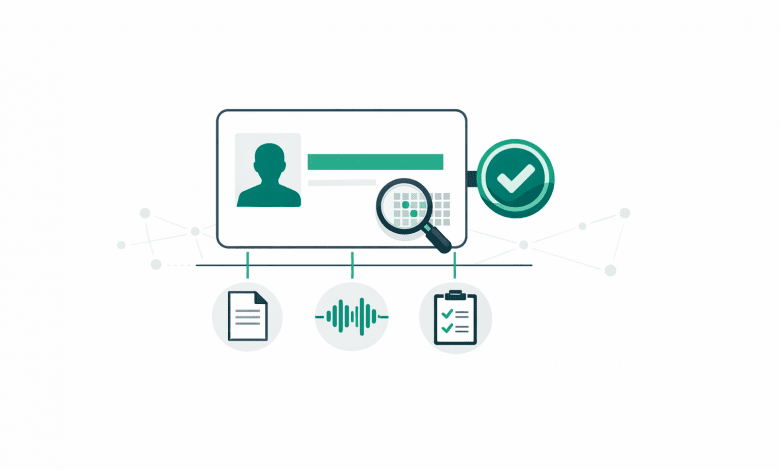
“Communication” is one of the most requested skills in hiring and professional development, but it’s also one of the easiest to overstate. If you’re an HR/L&D leader or training provider, the practical question isn’t whether communication matters—it’s how to prove it in a way that’s consistent, auditable, and easy to verify.
This guide shows a verification-first approach: define communication as measurable competencies, assess them, and issue digital credentials that carry evidence and verification details.
Key takeaways
- Define communication as observable behaviors (not a single trait) using a competency map and rubric.
- Build credentials “verification-first”: learning outcomes → assessment → evidence → issuer verification.
- Attach evidence to the credential (work samples, recordings, feedback, supervisor validation) so the claim is reviewable.
- Use micro-credentials to reflect progression, then stack them into broader professional development pathways.
- Avoid vanity certificates by publishing criteria, strengthening assessments, and clarifying what’s verified.
What employers mean by “communication” (and how to define it as measurable skills)
In workforce language, “communication” is usually a shorthand for multiple distinct capabilities: writing clearly, speaking persuasively, collaborating asynchronously, and aligning stakeholders under constraints (time, risk, ambiguity). Because it’s broad, it becomes hard to compare across candidates or training cohorts unless you define it precisely.
Make communication measurable by translating it into observable behaviors and decision-quality outcomes. A practical definition includes:
- Context: audience, channel, urgency, sensitivity.
- Behavior: what the learner does (structure, tone, listening, follow-up).
- Artifact: what’s produced (email, memo, deck, recording, meeting notes).
- Quality criteria: clarity, accuracy, completeness, actionability.
For L&D and training providers, the goal is to move from “completed a communication course” to “demonstrated communication behaviors under defined criteria,” then capture that demonstration in a verifiable credential.
A verification-first model: from learning outcome → assessment → credential
A verification-first model starts with the end in mind: when an employer (or internal manager) reviews the credential, what exactly can they verify? The credential should answer: what was assessed, against what criteria, by whom, and what evidence supports the claim.
Use this chain:
- Learning outcomes: specific, behavior-based outcomes (e.g., “Summarizes decisions and action items with owners and dates”).
- Assessment method: standardized tasks and scoring approach (rubric-based evaluation, recorded role-play, writing sample review).
- Evidence capture: attach or reference the artifacts that demonstrate the skill.
- Credential issuance: issue a digital badge or digital certificate with published criteria and verification.
- Ongoing verification: ensure anyone can confirm the credential is authentic and unaltered.
If your credential strategy includes Open Badges, ensure the badge includes criteria and evidence references in a structured way so the claim stays portable and reviewable across systems.
Asset: Communication Skills Credential Blueprint (competency map + rubric + evidence checklist)
Below is a reusable blueprint you can adapt to your organization’s roles, levels, and channels. The intent is to standardize what “communication” means, how it’s assessed, and how it’s verified through a digital credential.
Competencies and sub-skills (written, verbal, async, stakeholder comms)
Start with a competency map that mirrors how communication happens in real work.
- Written communication
- Structures messages with a clear purpose and call-to-action.
- Uses appropriate tone and level of detail for the audience.
- Writes with accuracy (facts, numbers, references) and avoids ambiguity.
- Produces scannable documents (headings, bullets, summaries) when appropriate.
- Verbal communication
- Explains complex ideas clearly and checks for understanding.
- Uses concise framing (problem, options, recommendation).
- Handles Q&A without deflecting; acknowledges uncertainty appropriately.
- Adapts message based on audience cues and constraints.
- Asynchronous communication
- Provides context so others can act without additional meetings.
- Documents decisions, assumptions, and next steps.
- Maintains version clarity (what changed, why, and by whom).
- Communicates status, risks, and blockers early.
- Stakeholder communication
- Identifies stakeholder needs, incentives, and concerns.
- Aligns on goals and definitions; confirms agreement explicitly.
- Communicates trade-offs and constraints transparently.
- Resolves misalignment through structured escalation and follow-through.
Rubric guidance: score each sub-skill with performance levels that describe observable quality (e.g., “needs improvement / meets standard / exceeds standard”) and include “red flags” such as missing context, unclear ownership, or contradictory statements.
Evidence types to attach (projects, recordings, peer feedback, supervisor validation)
Evidence turns a communication claim into a reviewable record. Choose evidence types that match the competency and respect privacy and confidentiality requirements.
- Written artifacts: emails (sanitized), one-page memos, incident updates, project briefs, customer-ready explanations, meeting summaries.
- Recorded artifacts: role-play recordings, presentation clips, meeting facilitation excerpts (with consent and redaction where needed).
- Work products: stakeholder update deck, risk register communication, launch comms plan, FAQ documents.
- Feedback: structured peer feedback mapped to rubric criteria; facilitator notes tied to specific behaviors.
- Supervisor validation: manager attestation that references the rubric and the observed scenario (not a generic endorsement).
Evidence checklist (minimum viable set):
- One primary artifact aligned to the competency (e.g., a memo or recording).
- Rubric score sheet with evaluator name/role and date.
- Brief context note: audience, goal, constraints, and outcome.
- Any required consent/redaction confirmation for recordings or sensitive content.
Issuance + verification workflow (who approves, what gets verified, what gets displayed)
A clear workflow prevents “certificate drift,” where different cohorts receive different levels of scrutiny. Define who is responsible at each step.
- Program owner (L&D or provider): sets competencies, rubric, and minimum evidence requirements.
- Assessor(s): evaluates artifacts using the rubric; documents scores and comments tied to criteria.
- Approver: checks completeness (required evidence attached, rubric completed, identity confirmed if needed).
- Issuer: issues the digital credential with criteria and verification details.
What gets verified:
- The credential issuer and authenticity (verification status).
- The published criteria and assessment method used.
- The recipient identity process used (as defined by your program).
- The presence of evidence references (and access rules if evidence is private).
What gets displayed: keep the public view decision-friendly—credential name, competencies, criteria, issuer, issue date, and verification. Provide evidence as attachments or links with appropriate access control.
For teams planning longer-term portability, consider how your credential data aligns to a skills record approach such as a Learning and Employment Record (LER) so skills can travel across systems as part of professional development documentation.
How to package communication into micro-credentials (stacking into broader professional development)
Communication improves through repeated practice across contexts. Micro-credentials let you represent that progression with specificity instead of a single “communication” badge that hides what was actually demonstrated.
Example micro-credential structure:
- Micro-credential 1: Written Communication—Clear Actionable Writing (memos, updates, instructions).
- Micro-credential 2: Verbal Communication—Presenting and Handling Objections (presentation + Q&A).
- Micro-credential 3: Asynchronous Communication—Documentation and Decision Logs (meeting notes, decision records, status updates).
- Micro-credential 4: Stakeholder Communication—Alignment and Influence (stakeholder plan + simulated negotiation).
Stacking options:
- Role-based stacks: “Customer Success Communication,” “Manager Communication,” “Project Communication.”
- Level-based stacks: foundational → intermediate → advanced with increasing complexity and stricter rubrics.
- Pathway stacks: bundle communication micro-credentials into a larger professional development certificate of completion for a program, while keeping each skill claim independently verifiable.
Common pitfalls (vanity certificates, unverifiable claims, unclear criteria) and how to avoid them
- Pitfall: Vanity certificates that only prove attendance.
- Avoid it: separate “participation” from “demonstrated skill.” If you issue a certificate of completion, say so clearly and don’t imply proficiency.
- Pitfall: Unverifiable claims (no criteria, no evidence, no assessment detail).
- Avoid it: publish criteria and attach evidence references. Ensure the credential can be independently verified.
- Pitfall: Unclear scoring criteria across evaluators.
- Avoid it: use a shared rubric, evaluator calibration sessions, and sample “anchors” (examples of what meets standard).
- Pitfall: Evidence that can’t be shared due to confidentiality.
- Avoid it: design assessment tasks that generate shareable artifacts, sanitize examples, or use controlled-access evidence links with consent workflows.
- Pitfall: Identity ambiguity (who did the work?).
- Avoid it: define identity checks appropriate to risk (proctored assessment, supervisor validation, cohort-based verification) and document the method in the credential metadata.
Procurement and security considerations to align early:
- Data governance: what learner data and evidence files are stored, retained, and who can access them.
- Privacy and consent: especially for recordings and peer feedback; define what can be public vs private.
- Audit readiness: ability to reproduce the criteria, rubric, and assessment decision if challenged.
When to use a certificate vs a badge vs a skills verification record
Use the format that matches what you’re trying to prove. Communication outcomes often need more than “completed training,” so choose based on verification and evidence needs.
| Option | Best for | What it proves | Verification & evidence fit |
|---|---|---|---|
| Certificate of completion | Participation-based programs, onboarding, required training | Completion of a defined learning activity | Good for verifying completion; weak for proving communication proficiency unless paired with assessments and evidence |
| Digital badge (skills-focused) | Demonstrated communication competencies tied to criteria | Specific skills met a standard (rubric/assessment) | Strong fit when criteria and evidence are included and the badge is verifiable (including Open Badges alignment where relevant) |
| Skills verification record | Internal mobility, hiring pipelines, structured talent profiles | Granular skill assertions across multiple observations | Best fit for ongoing verification with multiple evidence points; pairs well with LER-style reporting and credential management |
Decision checklist
- Define scope: What does “communication” mean in your roles and contexts?
- Make it observable: Do you have competencies and sub-skills written as behaviors?
- Standardize assessment: Do you have a rubric and evaluator guidance?
- Plan evidence: What artifacts will be attached or referenced, and what must stay private?
- Clarify verification: Who approves issuance and what is being verified?
- Choose credential type: Certificate of completion, badge, or skills verification record based on what you need to prove.
- Design for sharing: Can recipients share the credential in hiring and internal mobility workflows?
- Align stakeholders: HR, L&D, compliance/security, and business leaders agree on criteria and governance.
Implementation steps (for HR/L&D leaders and training providers)
- Pick one communication use case (e.g., manager updates, customer-facing emails, cross-functional stakeholder alignment).
- Create a one-page competency map using the blueprint above; tailor language to your org.
- Build a rubric with performance levels and “red flag” definitions; run a short evaluator calibration.
- Design assessments that generate evidence (a writing prompt, role-play, async documentation task).
- Set an issuance workflow (assessor → approver → issuer) and document what gets verified.
- Issue a verifiable digital credential with criteria and evidence references; define what’s public vs private.
- Review outcomes quarterly: refine rubric, update evidence checklist, and expand into micro-credentials that stack into professional development pathways.
People Also Ask: Communication credentials and verification (FAQ)
How do you verify communication skills?
Verify communication skills by assessing observable behaviors with a rubric and attaching evidence (writing samples, recordings, structured feedback) to a verifiable credential that documents the criteria and the issuer.
What should a communication badge include?
A communication badge should include clear criteria, the competencies assessed, who issued it, how it was assessed, and evidence references (or controlled-access evidence) that supports the claim.
Is a certificate of completion enough to prove communication?
A certificate of completion proves participation, not proficiency. If you need to evidence communication skill, pair completion credentials with rubric-based assessments and evidence-backed digital badges or skills verification records.
What evidence is best for communication skills?
The best evidence is role-relevant: sanitized writing artifacts, recorded presentations or role-plays (with consent), documented async decisions, and structured peer or supervisor validation mapped to rubric criteria.
How do micro-credentials support professional development?
Micro-credentials break communication into specific, measurable competencies and let learners build a progression over time. Stacking these credentials creates a more credible professional development narrative than a single broad claim.
Conclusion: Turn communication into a verifiable, shareable skill narrative
Communication is too important—and too ambiguous—to leave as an unverifiable line on a resume or a generic certificate of completion. A verification-first credential model gives HR/L&D teams and training providers a consistent way to assess communication, attach evidence, and let others verify what was actually demonstrated.
To go deeper into credential strategy and formats, review Sertifier resources on digital credentials, choosing between digital badges vs digital certificates, and designing micro-credentials that stack into professional development pathways.
CTA block: If you’re fielding constant requests to “train communication” but struggling to prove outcomes, a verifiable credential workflow helps you standardize criteria, capture evidence, and reduce ambiguity for hiring and internal mobility decisions.



santhosh.m@gradsiren.com