Udemy vs Thinkific: which is best for your course business

Table of Contents
The short answer on Udemy vs Thinkific: Udemy is a course marketplace that brings you its audience but controls pricing and keeps most of each organic sale, while Thinkific gives you your own branded course site where you set prices and pay a subscription instead of a marketplace commission. Which one fits depends on whether you want reach or control. This comparison walks through both platforms feature by feature.
What is Udemy?
Udemy is one of the world’s leading online education platforms. Udemy offers thousands of online courses to students, businesses, and educators. There are hundreds of thousands of courses on the Udemy platform where you can learn about many subjects. Udemy offers students video, audio lessons, presentations, articles, books, and interactive apps to suit different learning styles.
Why do people choose Udemy?
Udemy is an online education platform and home to millions of students and teachers from around the world. Here are some of the reasons why Udemy is preferred:
Wide Choice of Courses: Udemy hosts more than 250,000 courses that cover a wide variety of topics, according to Udemy. Therefore, it offers many options for students to study in different fields of interest.
Affordable: Many courses on Udemy are affordable, and many free courses are also available. Therefore, it allows students to study different subjects without straining their budgets.
Easy Access: Udemy allows students to easily access courses as it is an online platform. Courses are accessible via a computer, tablet, or smartphone, and students can complete their studies at their own pace.
Quality Education: Many of the courses on Udemy are created by experienced teachers and are designed to provide quality education. In addition, students can rewatch course materials at any time and complete the learning process at their own pace.
What is Udemy’s vision?
Udemy’s vision is to improve lives through learning. The company aims to democratize education and make it more accessible to people all around the world. Udemy’s founders believe that everyone should have the opportunity to learn and improve their skills, regardless of their background or financial means.
How to register for Udemy
Signing up on Udemy is pretty simple. Here are step-by-step instructions for signing up with Udemy:
Go to the Udemy website: https://www.udemy.com/
Click the “Sign up” button in the upper right corner of the page.
Fill out the registration form. In this form, you need to enter information such as your name, surname, e-mail address and password. Also, tick the “I am not a robot” box on the registration form.
Submit the form.
Open the confirmation message sent to your e-mail address and click the “Confirm My Account” button. This is required to complete your registration.
Log into your Udemy account and start learning by purchasing the courses you want or signing up for free courses.
Signing up on Udemy is free, but you may have to pay when purchasing a course or signing up for a paid course. Signing up for free courses is free.
What is Thinkific?
Thinkific is a platform where teachers and educators can create and manage their own online courses. Thinkific empowers teachers, coaches, consultants, writers, entrepreneurs and other experts to sell their courses, training and ebooks online.
Thinkific allows users to easily create their own courses and offers a range of features. For example, users can use different materials such as videos, pdf files, presentations and quizzes to prepare their courses. In addition, Thinkific provides users with the ability to offer free and paid courses and can integrate with various payment methods.
Thinkific offers a range of tools and options for teachers to brand and customize their courses. This allows courses to be designed to suit their different corporate identities. In addition, Thinkific offers a range of tools and features for students to follow courses, monitor their progress, and issue digital credentials.
What are the features of Thinkific?
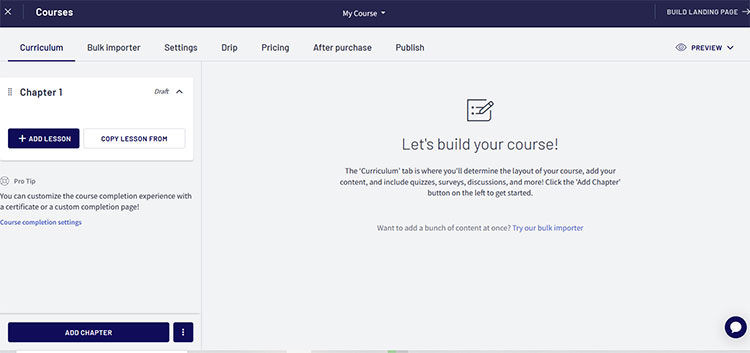
- Course Creation Tools: Thinkific provides a user-friendly course builder that allows users to create and customize their courses with ease. Users can add videos, text, quizzes, surveys, and other multimedia content to their courses.
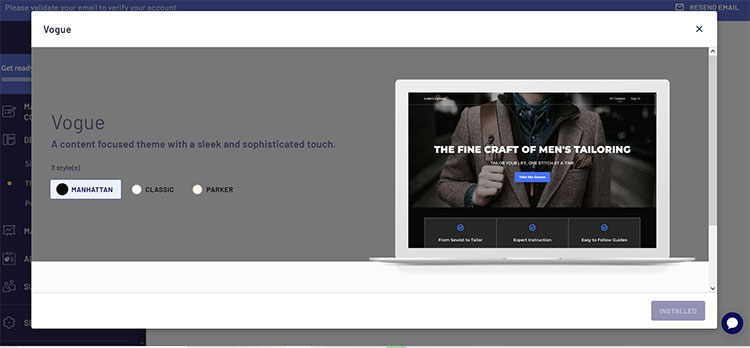
- Customizable Templates: Thinkific offers customizable templates that users can use to create a professional-looking website for their courses. Users can choose from a range of templates and customize them to fit their branding and style.
- Multimedia Support: Thinkific supports a range of multimedia formats, including videos, audio, PDFs, quizzes, and surveys. This makes it easy to create engaging and interactive learning experiences.
- Course Analytics: Thinkific provides detailed analytics and reporting tools that allow users to track their students’ progress and performance. This data can be used to improve the course content and marketing strategies.
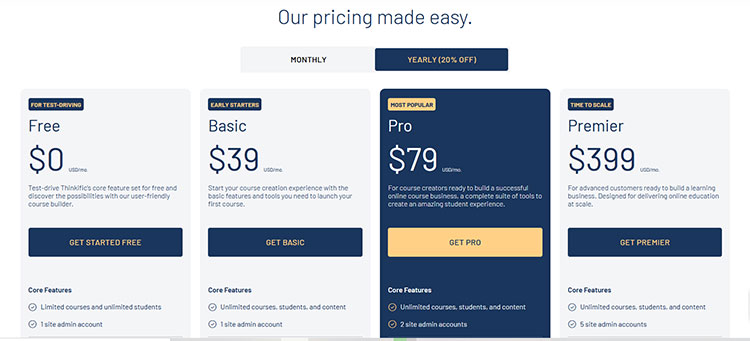
- Payment Processing: Thinkific offers built-in payment processing, allowing users to accept payments for their courses directly on the platform. Users can set up one-time payments, subscriptions, or payment plans. You want to see Thinkific pricing plans.
- Marketing Tools: Thinkific offers a range of marketing tools, including email automation, affiliate marketing, and integrations with popular tools like Mailchimp, Google Analytics, and Facebook Pixel.
- Custom Domains: Thinkific allows users to use their own custom domains, giving them greater control over their branding and online presence.
- Mobile Responsive: Thinkific courses are mobile-responsive, ensuring that students can access the course content on any device.
Why do people choose Thinkific?
- Ease of use: Thinkific is a user-friendly platform that makes it easy for anyone to create and sell online courses. The course builder is intuitive, and the customizable templates make it easy to create a professional-looking website.
- Comprehensive feature set: Thinkific offers a wide range of features, including course creation tools, customizable templates, multimedia support, course analytics, payment processing, and marketing tools. This makes it a one-stop-shop for users looking to create and sell online courses.
- Customization: Thinkific allows users to customize their courses and website to match their branding and style. Users can use their own custom domains, logos, and colors, giving them greater control over their online presence.
- Mobile responsiveness: Thinkific courses are mobile-responsive, meaning they can be accessed on any device, including smartphones and tablets.
- Marketing tools: Thinkific provides a range of marketing tools, including email automation, affiliate marketing, and integrations with popular marketing tools like Mailchimp, Google Analytics, and Facebook Pixel. These tools can help users promote their courses and reach a wider audience.
What are the differences between Udemy and Thinkific?
Udemy and Thinkific are two popular online learning platforms, but they differ in a few ways.
Course Creation
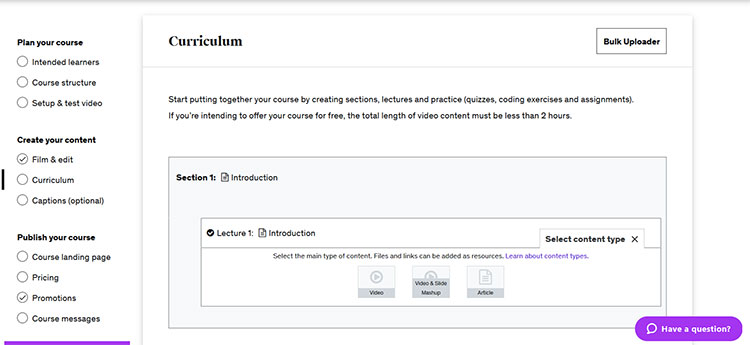
Both platforms allow you to create and sell online courses, but the process is different. Udemy offers a course creation tool that’s designed to be simple and easy to use, so you can quickly create a course and publish it on the platform. Thinkific, on the other hand, provides a more customizable course creation process that allows you to design a unique course experience. You can choose from different course templates, customize the course player, and add multimedia content like videos, quizzes, and surveys.
Course Pricing
Udemy controls course pricing on its marketplace and runs frequent sitewide discounts. Its published revenue share gives instructors 37% of net revenue on marketplace sales, or 97% when a student buys through the instructor’s own coupon or referral link.
Thinkific lets you set your own prices and takes no commission on sales processed through Thinkific Payments. You pay a monthly subscription plus standard payment processing fees, and a plan-based fee of 0.5% to 5% applies only if you sell through a third-party gateway such as your own Stripe account, per Thinkific’s pricing documentation. You can offer free courses, one-time payments, or recurring subscriptions.
Marketing and Promotion
Udemy has a large student base and offers built-in marketing and promotion tools to help you reach more students. Udemy has a search algorithm that promotes courses based on relevance, quality, and student feedback. Thinkific, on the other hand, doesn’t have a built-in marketing system, but it provides integration with email marketing platforms and social media marketing tools to help you promote your courses to your audience.
Customization
Thinkific offers more customization options than Udemy. You can create a branded course website that matches your brand identity, and you have control over the look and feel of your course player. Udemy, on the other hand, provides a standard course player that’s consistent across all courses on the platform.
Support and Training
Udemy offers a comprehensive help center and community forum to help you get started with course creation and promotion. They also offer a course creation guide and video tutorials. Thinkific provides a similar level of support, but they also offer personalized onboarding and dedicated customer support for their paid plans.
What are the similarities between Udemy and Thinkific?
E-commerce
Both platforms provide an e-commerce infrastructure that enables course creators to sell their courses and process payments. They also offer features like coupons, bundles, and affiliate programs to help course creators market and sell their courses.
User interface
Udemy and Thinkific both offer a user-friendly interface for both course creators and learners. The platforms are designed to be easy to navigate, making it simple for learners to find and enroll in courses.
Analytics and reporting
Both platforms provide analytics and reporting tools that enable course creators to track student progress, monitor course performance, and adjust their strategies accordingly.
Mobile-friendly
Both platforms are mobile-friendly, allowing learners to access courses from their smartphones and tablets.
Udemy vs Thinkific: which is the best for your course business?
Udemy and Thinkific are popular platforms for online courses. The best platform for your business may vary depending on your needs and goals.
Udemy has a large student base and you can find courses on many different topics on the platform. Also, Udemy’s advertising and marketing tools are highly effective for promoting your course to potential students. However, Udemy also has some disadvantages. For example, Udemy shares only limited student data with instructors, and on marketplace sales that do not come through your own coupon or link, you keep 37% of net revenue.
Thinkific, on the other hand, lets you host and sell courses on your own branded site, which gives more control and flexibility. Thinkific takes no marketplace commission: you pay a subscription, plus a small gateway fee only if you process payments outside Thinkific Payments. Also, Thinkific’s customization options are extensive and you can tailor your course entirely to your brand. The tradeoff is that Thinkific has no built-in marketplace audience, so bringing in students is up to your own marketing.
So, while Udemy may be the better option with its large student base and advertising/marketing benefits, Thinkific offers more control and customization options. It’s important to consider your needs and goals to determine which platform is best for you.
Whichever platform you pick, course completions are worth recognizing with a verifiable certificate. Sertifier integrates with Thinkific and is free for up to 250 credentials per year.